Yerba Mate Caffeine vs Coffee Differences
When people search for yerba mate caffeine vs coffee, they are usually asking more than a simple caffeine question. They want to know how each drink feels, how it tastes, how it fits into a daily rhythm, and which one makes more sense for their body, schedule, and brewing style. Yerba mate and coffee can both feel energizing, but they arrive through very different traditions. Coffee is often quick, dark, concentrated, and familiar in cafes across the world. Yerba mate is more herbal, grassy, social, and rooted in a slower ritual, even when prepared in modern ways. For tea makers and herbal product developers, the comparison is even more interesting because both ingredients open different paths for blending, roasting, extraction, and flavor design.
In practical terms, yerba mate offers a broader herbal profile, while coffee tends to lead with roast, bitterness, and aroma intensity. That difference matters in everything from hot infusions to concentrate programs and low-acid alternatives. It also matters when building a menu or retail offering. If you understand yerba mate caffeine vs coffee from the perspective of energy, ritual, and flavor, it becomes much easier to choose the right base for a morning blend, an afternoon lift, or a more rounded beverage concept with roots, peels, and flowers.
What makes yerba mate and coffee feel different
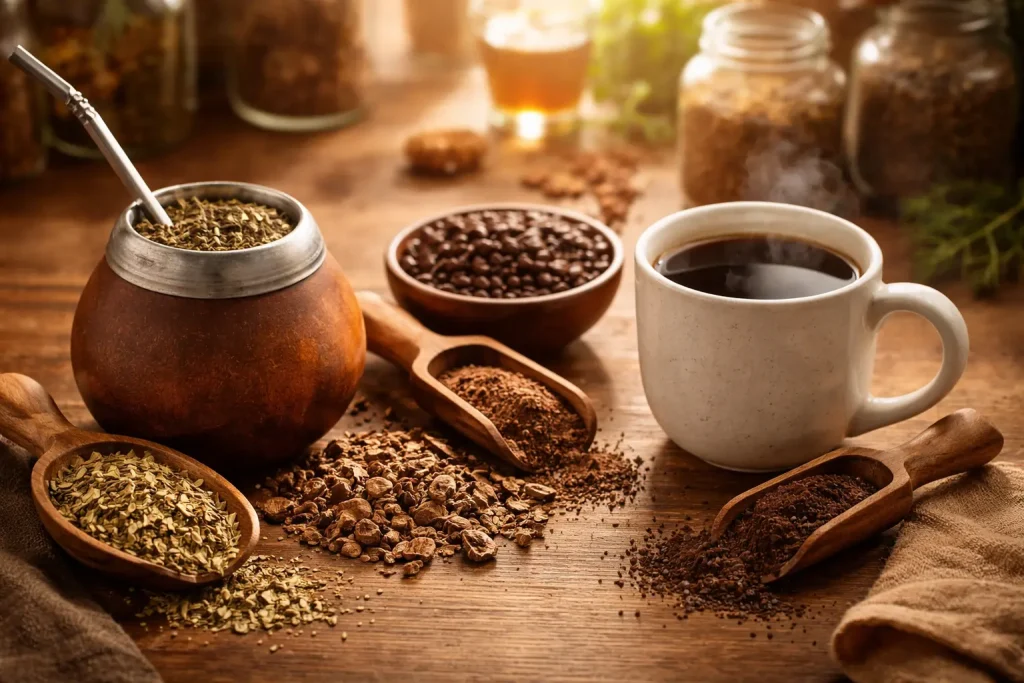
The most obvious difference in yerba mate caffeine vs coffee is not just the caffeine number on paper, but the whole sensory package around it. Coffee is usually extracted under higher intensity conditions, whether that means espresso pressure, strong drip brewing, or a dark roast profile that feels bold and immediate. Yerba mate is generally lighter on the palate in body, though it can still be robust, especially when brewed strongly or combined with roasted ingredients.
Herbalists often describe yerba mate as lively, green, toasty, and persistent. Coffee leans more toward roasted nuts, cocoa, smoke, caramel, and bitter depth, depending on roast and origin. In daily use, many people find coffee more abrupt and mate more gradual, though personal response varies widely.
For tea makers, this is where formulation starts to get interesting. A coffee-forward beverage can dominate supporting ingredients quickly. Yerba mate tends to leave more room for secondary notes. Try adding roasted chicory root c/s when you want roasted depth without pushing fully into coffee territory.
Yerba mate caffeine vs coffee in actual cup strength
A straight comparison of yerba mate caffeine vs coffee can be misleading unless you compare realistic serving styles. A typical cup of brewed coffee often delivers more caffeine per serving than a standard cup of yerba mate infusion, but mate is frequently infused more than once, sipped over time, or brewed in larger volumes. That changes the lived experience.
Coffee is usually consumed in a single, defined cup. Yerba mate may be prepared traditionally in a gourd, brewed loose in a teapot, or made as a concentrated base for blending. For production work, extraction ratio and steep time matter more than assumptions.
A practical starting point for loose infusion:
- Yerba mate: 8 grams per 240 ml water (about 2 heaping teaspoons)
- Roasted chicory root: 3 grams per 240 ml water (about 1 heaping teaspoon)
For a stronger tea-house style blend:
- 12 grams yerba mate per 300 ml water (about 1 tablespoon + 1 teaspoon)
- 4 grams roasted chicory root per 300 ml water (about 1 1/2 teaspoons)
Water temperature also shapes perception. Yerba mate is often more pleasant around 75 to 82°C (167 to 180°F), while brewed coffee typically uses hotter water, often around 90 to 96°C (194 to 205°F). If the goal is balance, not harshness, that lower mate range helps preserve greener and toastier notes.
Energy curve, rhythm, and daily ritual
One reason the topic of yerba mate caffeine vs coffee keeps coming up is that energy is never just chemical. Ritual affects perception. Coffee is often tied to speed. Grind, brew, drink, move on. Yerba mate tends to invite repetition and pace. Even in non-traditional service, it often feels less like a jolt and more like a companion beverage.
That difference matters commercially. Coffee menus often build around intensity and indulgence. Mate-based menus can build around continuity, clarity, and herbal character. A roasted mate blend can bridge both worlds, especially for people who like the feeling of a morning beverage ritual but want a profile that tastes more botanical than burnt.
For a smoother transition beverage, try adding dandelion root c/s to a mate base. It contributes earthy roast character and can help round sharper edges in more assertive yerba preparations.
Flavor architecture: green bitterness vs roasted bitterness
The flavor question is central to yerba mate caffeine vs coffee. Both drinks can be bitter, but the bitterness behaves differently. Coffee bitterness is usually darker, fuller, and more oil-driven, especially in deeper roasts. Yerba mate bitterness is greener, drier, and more herbal, sometimes with hay, toast, or faint smoke depending on cut and processing.
This is useful from a blending standpoint. If you want brightness and lift, mate is easier to pair with leaves, peels, and cooling botanicals. If you want density, body, and roasted comfort, coffee gets there faster, but it also narrows the lane for subtle ingredients.
A practical tea-maker approach is to decide whether you want the bitterness to lead or support. For a layered infusion with lift and freshness, try adding organic peppermint leaf to mate. For more texture and spice, organic cinnamon chips can help connect roasted chicory with the greener edge of mate.
When yerba mate works better than coffee in blends
From a formulation perspective, yerba mate often gives more flexibility than coffee. In the yerba mate caffeine vs coffee discussion, this is the point many beverage developers notice first. Coffee can overpower flowers and delicate leaves unless the roast is very carefully matched. Yerba mate gives more room to work with roots, spices, and aromatic leaves while still bringing a recognizable caffeinated backbone.
A balanced house blend for hot service might look like this:
- 10 grams Yerba Mate Leaf C/S
- 4 grams Roasted Chicory Root C/S
- 2 grams Organic Cinnamon Chips
- 1 gram Organic Peppermint Leaf
This yields a roasted-herbal cup with lift, mild sweetness, and cooling finish. For lighter seasonal profiles, mate can also carry floral or orchard-like accents without losing structure. Try adding organic calendula petals for color and a softer visual signature in loose blends. For a more apple-like tartness and rounded fruit note, organic cut apple pieces fit well in autumn-style mate blends.
Brewing methods for better comparison
If someone wants to judge yerba mate caffeine vs coffee fairly, they should taste both under controlled conditions. Use similar water quality, similar freshness, and clear brew ratios. Otherwise, the comparison says more about technique than ingredients.
For yerba mate hot infusion:
- Heat water to 75 to 82°C.
- Use 8 to 12 grams per 240 to 300 ml.
- Steep 4 to 6 minutes in a covered vessel.
- Strain and taste before sweetening.
For coffee drip comparison:
- Heat water to 92 to 96°C.
- Use 14 to 18 grams coffee per 240 to 300 ml.
- Brew 3 to 5 minutes depending on grind and device.
- Taste black first.
For a low-acid roasted herbal alternative:
- Use 8 grams yerba mate and 4 grams chicory.
- Add 2 grams dandelion root if desired.
- Simmer gently for 5 minutes, then cover and rest 4 minutes.
- Strain and serve.
This side-by-side method helps reveal what each drink is really doing. Try adding yerba mate leaf c/s when you want a caffeinated base that still leaves room for herbal nuance.
Troubleshooting flavor and batch issues
A practical look at yerba mate caffeine vs coffee should include troubleshooting, especially for tea makers testing blends, concentrates, or ready-to-serve infusions.
Flat flavor
Usually caused by stale material, low leaf ratio, or water that is too cool for the chosen cut. Increase yerba mate by 2 grams per cup or extend steep time by 1 minute.
Too tart
This is more likely when fruit pieces or tart botanicals are added. Reduce apple or peel ingredients, or increase roasted chicory to soften the blend.
Over-carbonation
If using a brewed mate base in sparkling or fermented beverage development, excess residual sugars or unstable bottling can push carbonation too high. Bottle only when gravity and sweetness are controlled, and chill quickly once the profile is where you want it.
Sediment
Fine cut mate and roots can leave heavy cup sediment. Use a finer filter or allow the batch to settle before final decanting.
Aroma loss
Volatile aromatics fade with heat exposure, oxygen, and repeated opening of bulk containers. Blend smaller runs more often instead of keeping a large mixed batch open for weeks.
For aroma lift in otherwise dense roasted profiles, try adding organic tulsi leaf in a modest percentage. It can brighten the top note without turning the blend perfumed.
Storage + Quality
The quality side of yerba mate caffeine vs coffee is often overlooked, but it matters for both taste and customer trust. Yerba mate should be stored airtight and away from humidity, direct light, and kitchen heat. Coffee also needs protection, but mate can pick up environmental odors very easily because of its leafy structure.
Look for clear sensory cues:
- Color should remain natural to the ingredient type, not dull and gray
- Scent should be fresh, grassy, toasted, or cleanly roasted, never dusty or musty
- Texture should feel dry and mobile, not soft from moisture exposure
Roasted roots like chicory and dandelion need especially dry storage. Leaves and petals should be protected from crushing if visual presentation matters. For tea makers selling loose blends, freshness depends as much on packaging discipline as sourcing.
Try adding roasted chicory root c/s when you want a pantry-stable roasted note that pairs well with airtight storage programs and low-mess blending.
Safety and compliant herbal wording
Any useful discussion of yerba mate caffeine vs coffee should stay grounded and compliant. These are traditional beverage ingredients, not medical products. Herbalists often use yerba mate for an uplifting cup and coffee for a stronger roasted stimulant beverage, but individual tolerance varies.
Avoid making disease-related claims. Avoid implying guaranteed outcomes. Better language includes phrases like “traditionally used,” “many people prefer,” “may feel gentler,” or “often chosen for.” If a product label or blog copy discusses caffeine, it should do so as a beverage characteristic, not a treatment claim.
For commercial blends, always consider caffeine-sensitive customers, serving size clarity, and clean ingredient labeling. If you are building a roasted mate blend for broader appeal, organic cinnamon chips and dandelion root c/s can increase warmth and familiarity without requiring exaggerated claims.
Conclusion: choosing between yerba mate and coffee
In the end, yerba mate caffeine vs coffee is not a contest with one universal winner. It is a choice between two very different beverage experiences. Coffee is concentrated, dark, familiar, and often faster in both preparation and sensory impact. Yerba mate is more herbal, more flexible in blends, and deeply tied to ritual, pacing, and layered flavor. For tea makers, yerba mate opens more room for flowers, roots, leaves, and gentle roast notes. For coffee drinkers looking for a broader botanical palette, mate can feel like a meaningful shift rather than a compromise.
The most useful way to approach yerba mate caffeine vs coffee is to taste them side by side, pay attention to extraction, and decide what kind of energy, aroma, and ritual you actually want in the cup. That is where the comparison becomes practical, not theoretical.
FAQ
Is yerba mate stronger than coffee?
In most standard servings, coffee often contains more caffeine per cup, but yerba mate can be consumed over multiple infusions, so the experience may last longer.
Does yerba mate taste like coffee?
No. In a yerba mate caffeine vs coffee comparison, mate is usually greener, more herbal, and more earthy, while coffee is darker and more roasted.
Can I blend yerba mate with roasted ingredients?
Yes. Roasted chicory root, dandelion root, and cinnamon are especially useful for adding body and warmth.
Is yerba mate better for tea blends than coffee?
Often yes. Yerba mate usually leaves more space for supporting botanicals, while coffee can dominate subtle ingredients.
What is a good starting ratio for a roasted mate blend?
A practical starting point is 10 grams yerba mate and 4 grams roasted chicory root per 300 ml water.
Why does yerba mate sometimes taste harsh?
Water that is too hot, too much fine material, or steeping too long can make the cup overly bitter and dry.
Can I serve mate as an alternative to coffee on a menu?
Yes. Many businesses position it as a botanical energy option with ritual appeal and more blend flexibility.
What matters most in yerba mate caffeine vs coffee for product development?
Flavor structure, extraction method, caffeine communication, and how well the base supports additional herbs.