Strawberry Plants Life Cycle: From Early Growth to Fruiting Season
There is something quietly remarkable about watching a strawberry plant move through its seasons. The strawberry plants life cycle unfolds in stages that reward patient observation: the slow unfurling of trifoliate leaves in early spring, the delicate white blossoms that appear almost apologetically before the fruit, and finally the flush of red that draws every gardener outside without a second thought. For herbalists and tea makers, this cycle matters beyond the berry itself. The leaves, harvested at the right stage, carry their own value. The flowers, brief as they are, offer a gentle floral note. Understanding each phase of the strawberry plants life cycle helps you work with the plant more intelligently, whether you are growing your own, sourcing dried leaf for blends, or simply trying to understand what you are steeping in your cup. This guide covers the full arc, from dormancy through fruiting, with attention to the moments that matter most for flavor, harvest, and herbal use.
What Drives the Strawberry Plants Life Cycle
Strawberries are perennials, which means the strawberry plants life cycle does not end at harvest. The plant persists underground through winter, storing energy in a crown that sits at soil level. What triggers each new stage is a combination of temperature, day length, and moisture. Botanically, strawberries belong to the Rosaceae family, and like many of their relatives, they use chilling hours during winter to reset their internal calendar. Once a sufficient number of hours below 7°C (45°F) accumulate, the plant is primed to respond to spring warmth.
Commercial growers and home gardeners manage this cycle differently depending on variety. June-bearing types concentrate their fruiting into a single flush. Everbearing and day-neutral varieties distribute flowering across a longer window. The herbal implications are real: leaf quality and tannin content shift depending on when in the cycle you harvest.
Dormancy: The Hidden Foundation of the Strawberry Plants Life Cycle
Before the strawberry plants life cycle becomes visible, it is happening underground. During late autumn and winter, the plant withdraws. Leaves die back or become leathery and unproductive. The crown contracts. Energy moves into the root system, where it will sit as stored carbohydrate until conditions change.
This dormancy period is not inactivity. It is preparation. The roots deepen, the crown hardens, and the plant accumulates the cold exposure it needs to flower reliably the following year. Gardeners who skip this phase by growing in perpetually warm climates often see erratic fruiting or plants that produce vegetatively without ever setting much fruit.
For the herbalist, dormancy is a reminder that the most potent plant material often comes from specimens that have weathered a real winter. Leaf quality in the season following a proper dormancy tends to be superior, with a cleaner, more astringent profile in the cup.
Spring Emergence: The Cycle Becomes Visible
As soil temperatures climb above 10°C (50°F), the strawberry plants life cycle resumes with visible urgency. New leaves push up from the crown. They arrive tightly folded, bright green, and covered in a fine fuzz that softens as they expand. This is the moment many herbalists consider the most interesting from a harvest standpoint.
Young spring leaves, gathered before the plant flowers, carry the highest concentration of tannins and the most vivid green character in the cup. They dry well at low temperatures (35 to 40°C, or 95 to 104°F) and hold their color better than leaves harvested mid-summer. If you are building a strawberry leaf blend, spring is your primary window.
At this stage, pair fresh-dried material with Strawberry Leaf C/S for a full-spectrum base that captures both the vigor of new growth and the depth of properly cured leaf. Add hibiscus flowers on the side for a tart counterpoint that brightens the blend without competing with the leaf’s quieter astringency.
Vegetative Growth: Runners, Crowns, and Leaf Production
Once established, the plant enters a period of rapid vegetative expansion. This is when runners appear: long horizontal stems that reach out from the mother plant and root where they touch soil, creating daughter plants. A single vigorous strawberry can send out dozens of runners in a productive season.
This phase matters for the tea maker because it represents peak leaf biomass. The canopy is at its fullest, the leaves are mature but not yet stressed by fruit production, and the tannin-to-moisture ratio is ideal for drying. Herbalists who harvest during this window often describe the dried leaf as having a mild, grassy quality with a clean finish, closer to a light green tea in behavior than anything berry-forward.
To build on that profile, blend mid-growth strawberry leaf with spearmint leaf for a cooling edge, or layer in lemon verbena to add a citrus lift without the sharpness of actual citrus peel.
Flowering: Brief, Beautiful, and Botanically Critical
Strawberry flowers are small, white, and five-petaled, appearing in clusters above the leaf canopy. They open in succession rather than all at once, which extends the pollination window and staggers the ripening of the fruit. Each flower that gets successfully pollinated becomes a berry. Those that do not simply drop.
From a botanical standpoint, the flower is the pivot point of the strawberry plants life cycle. Everything before it is preparation. Everything after it is consequence. Bees and other pollinators are essential here. Gardens with poor pollinator traffic tend to produce misshapen or undersized fruit because not all the achenes (the tiny seed-like structures on the surface) get fertilized evenly.
For the herbalist, the flowers themselves can be used in small quantities. They carry a delicate floral note, mild and slightly sweet, suitable as a garnish in loose-leaf blends or cold infusions. They do not hold their character well when dried at high heat, so keep the dehydrator below 35°C (95°F) if you want anything left in the cup.
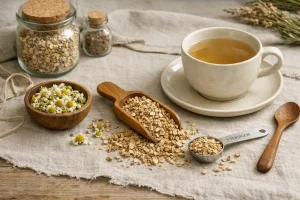
A small addition of chamomile flowers alongside strawberry flower creates a gentle, floral infusion that works well as an evening tea. The chamomile provides the body the strawberry flower lacks on its own.
Fruiting Season: Peak of the Strawberry Plants Life Cycle
The strawberry plants life cycle reaches its most dramatic moment when the fruit ripens. Green berries, hard and starchy, gradually soften and redden over one to three weeks depending on temperature. Cool nights and warm days produce the most aromatic fruit. Heat waves push ripening too fast, resulting in berries that are sweet but flat.
At full ripeness, the berry is largely water, fructose, and volatile aromatic compounds. From a tea-making perspective, the berry itself does not infuse well dried (it tends toward a jammy, one-dimensional sweetness), but the dried leaf harvested just before or just after fruiting retains excellent complexity. Post-fruiting leaves are slightly more oxidized in character, closer to a pale oolong in their dried state, and they hold up better to boiling water than the more delicate spring leaf.
For a fruiting-season blend, consider pairing late-season strawberry leaf with raspberry leaf for a complementary tannin structure, or add elderflower as a top note that mirrors the floral esters present in ripe strawberries.
Harvesting Ratios and Drying Guidance
Getting the ratios right matters whether you are building a blend or drying single-herb leaf for later use.
For a standard strawberry leaf infusion, use 2 to 3 grams of dried leaf per 240 ml (8 oz) of water (roughly 1 to 1.5 teaspoons of loosely packed dried leaf). Steep at 90 to 95°C (194 to 203°F) for 5 to 7 minutes. Longer steeps increase astringency without adding flavor depth, so time it deliberately.
For a blended recipe pairing strawberry leaf with hibiscus and chamomile:
- Strawberry Leaf C/S: 2 g (1 tsp)
- Hibiscus Flowers: 1 g (0.5 tsp)
- Chamomile Flowers: 0.5 g (0.25 tsp)
Steep the blend at 90°C for 6 minutes. The hibiscus will dominate color and tartness; adjust down if you want the strawberry leaf to come forward more. This ratio scales linearly for batch blending.
Drying fresh leaf: spread in a single layer on mesh screens. Dehydrate at 38°C (100°F) for 4 to 6 hours, checking for crispness at the stem. Properly dried leaf snaps cleanly rather than bending. Store immediately in airtight containers.
Troubleshooting Your Strawberry Leaf Infusion
Flat flavor. Usually a sign of leaf that was harvested too late in the season or dried too slowly. Late-summer leaf loses volatiles quickly after picking. If your cup tastes like hay, try blending with peppermint leaf to restore some brightness.
Too astringent. You have either over-steeped, used too much leaf, or harvested at peak tannin (early spring). Drop your steep time to 4 minutes and reduce to 1.5 g per cup.
Weak color. Strawberry leaf infuses to a pale yellow-green. If you want more visual presence, add hibiscus flowers at 0.5 g per cup. The red deepens immediately.
Sediment in the cup. This is typically fine leaf particles passing through a loose strainer. Use a finer mesh or add a paper filter inside your basket. It is not harmful, just textural.
Aroma loss after storage. Dried leaf stored in clear containers degrades faster due to light exposure. Switch to dark glass or opaque tins and your aromatics will last significantly longer.
Storage + Quality
Properly dried strawberry leaf stored in an airtight container away from heat and light will hold its quality for 12 to 18 months. The indicators of degradation are straightforward: color shifts from olive green toward brown, the dry aroma becomes musty or papery rather than grassy, and the infused cup tastes flat even at proper steep times.
Humidity is the primary enemy. In climates where ambient humidity regularly exceeds 60%, add a food-safe silica desiccant packet inside the container. Do not store near the stove, dishwasher, or any appliance that generates steam.
For bulk quantities, vacuum sealing in portions extends shelf life considerably. Seal in 50 g or 100 g lots and open only what you need. Once a container is opened regularly, expect a shorter window of peak quality, roughly 6 to 9 months.
Safety Considerations
Strawberry leaf has a long history of traditional use in herbal practice and is generally considered well-tolerated for most adults when used as a tea in typical culinary amounts. Herbalists traditionally use the leaf as a mild astringent and digestive support, though no medical claims are made here.
Individuals with known sensitivities to Rosaceae family plants (including roses, raspberries, and related species) should introduce strawberry leaf cautiously. If you are pregnant, nursing, or managing a health condition, consult a qualified practitioner before adding any new herbal preparation to your routine.
The fruit and leaf are distinct in their chemistry. Reactions to the fruit do not automatically predict reactions to the leaf, but the relationship between the two is worth noting if you have any history of sensitivity.
As with all plant material, source matters. Strawberry Leaf C/S from a reputable supplier gives you consistent material with documented origin, which matters both for safety and for reproducibility in your blends.
The Cycle Restarts: What Happens After Fruiting
After the fruiting season closes, the strawberry plant enters a period of post-harvest recovery. Runners proliferate. The plant redirects energy toward crown development and root extension. Leaves produced during this phase tend to be larger but less concentrated in tannins. They are still usable for tea, just milder.
As day length shortens and temperatures drop, the plant begins preparing for dormancy again. Leaf production slows. The crown tightens. And the strawberry plants life cycle completes its loop, carrying the plant back to the same still, cold place it started from, ready to do it all again when the soil warms.
Understanding this rhythm does not just make you a better gardener. It makes you a more deliberate herbalist. Knowing that the best leaf comes from the window between spring emergence and first flower means you can plan your harvest, source accordingly, and build blends that reflect the plant at its most expressive.
FAQ
What is the strawberry plants life cycle? The strawberry plants life cycle moves through dormancy, spring emergence, vegetative growth, flowering, fruiting, and post-harvest recovery before returning to dormancy. It repeats annually in perennial varieties.
When is the best time to harvest strawberry leaves for tea? Spring, just before flowering, is ideal. Leaves at this stage have the highest tannin content and freshest green character. Post-fruiting harvest is a secondary option with a milder, slightly oxidized profile.
How long does the strawberry plants life cycle take from planting to fruit? In the first year, most gardeners sacrifice the flowers to let the plant establish. Year two typically produces the first real harvest. From spring emergence to ripe fruit in an established plant: 8 to 12 weeks depending on variety and climate.
Can you use strawberry flowers in tea? Yes, in small amounts. They add a delicate floral note but lack body on their own. Blend with chamomile or use as a garnish rather than a base.
Does the strawberry plants life cycle differ by variety? Significantly. June-bearing types fruit once, heavily. Everbearing and day-neutral types flower repeatedly. For leaf harvesting, this matters less than for berry production, but it affects when your plant is in vegetative mode.
How do I dry strawberry leaves properly? Harvest in the morning after dew has cleared. Spread in a single layer on mesh screens. Dehydrate at 38°C (100°F) for 4 to 6 hours until stems snap cleanly. Store immediately in airtight, dark containers.
What products pair well with strawberry leaf in a blend? Hibiscus flowers add tartness and color. Chamomile adds softness. Raspberry leaf adds complementary tannin structure. Spearmint and lemon verbena add brightness without citrus sharpness.
Is strawberry leaf safe for daily use? Strawberry leaf is traditionally used as a gentle, food-safe herb with a long history of use in European and North American herbalism. It is not recommended in therapeutic quantities during pregnancy without professional guidance. Everyday cup quantities are generally considered safe for most healthy adults.