Ajwain Powder: What It Tastes Like and How to Use It
Ajwain is one of those spices that surprises you the first time you open the jar. It smells like thyme’s bolder cousin, with a warm, medicinal edge that reads “savory” even before you taste it. In this guide to ajwain powder uses, we’ll get specific about flavor, ratios, and repeatable methods, including a kombucha-friendly workflow that keeps your batches consistent. Think of ajwain as a tiny-volume, high-impact ingredient: a pinch can steer a whole blend, especially when paired with black pepper.
If you’re a tea person, ajwain can add structure and aromatic lift to otherwise soft blends. If you’re a kombucha maker, it’s even more interesting because fermentation magnifies spice aromatics and exposes any dosing sloppiness. We’ll cover what ajwain tastes like, where it shines, how to measure it (grams and teaspoons), how to build a smooth concentrate for bottling, and how to troubleshoot the classic 2F issues like sediment and aroma loss. Warm, practical, and production-minded, with an herbalist’s respect for nuance.
What ajwain powder tastes like (and why it’s so intense)
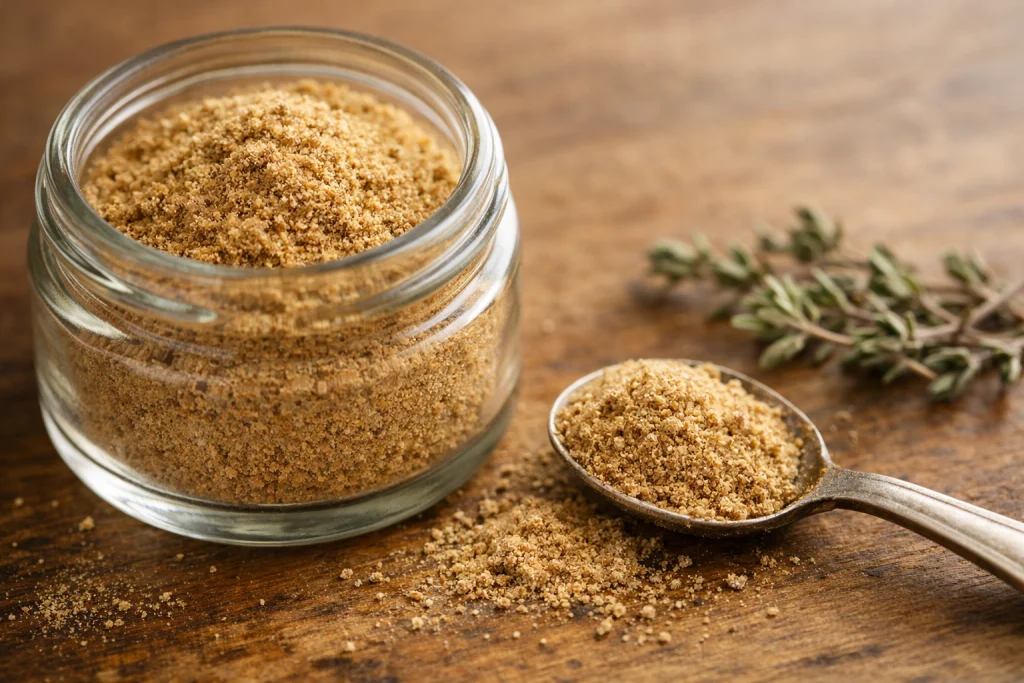
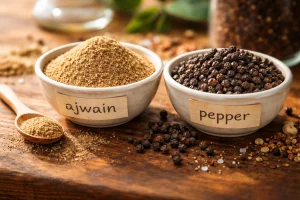 Ajwain’s signature is thymol-forward: think thyme, oregano, and a clean camphor-like brightness. In powder form, it hits faster and wider because there’s more surface area. On the tongue it starts savory and peppery, then opens into a warming, almost mentholated finish. That’s why it plays so well with simple acids (like kombucha tang) and why it can also bully delicate florals if you don’t measure carefully.
A good way to understand ajwain is to compare it to kitchen “anchors.” Black pepper gives heat and bite, ginger brings warmth and a rounded spice body, and ajwain adds aromatic direction. Used lightly, it makes a blend smell “more finished,” like turning the lights on in a room. Used heavily, it can read bitter, sharp, or medicinal.
For practical ajwain powder uses, think micro-dosing. You rarely want “ajwain-forward” unless you’re intentionally building a savory profile. Most of the time, you want it as a background aromatic that nudges the whole cup or bottle into focus.
CTA: If you want the cleanest aroma control, start with finely milled ajwain powder and measure by weight.
Ajwain powder uses: flavor, tea, and kombucha
This is the section where ajwain powder uses get real. Ajwain does three things exceptionally well: it adds savory-herbal lift, it sharpens perceived dryness (which balances sweetness), and it pairs with heat spices to create a “long finish” that lingers after a sip.
In everyday kitchen-style infusions
Ajwain is traditionally used in savory contexts, but you can treat it like a culinary tea spice. It’s excellent in:
Warm “after-meal” style spice water (very light dosing, more aroma than taste)
Ginger-forward blends where you want extra herbal top notes
Peppery, citrus-peel blends that need definition
CTA: For a simple pairing that reads warm and grounded, try a pinch of black pepper alongside ajwain in your spice concentrate.
In kombucha, it’s a precision spice
Kombucha is unforgiving with spices because CO₂ and acidity carry aromatics straight into your nose. Ajwain can taste bigger in 2F than it does in hot tea. That’s why your method matters: weigh it, standardize your steep, and keep notes.
A production mindset helps here. Instead of improvising spoonfuls, you’ll get better results by making a repeatable concentrate and dosing it per bottle. That’s the cleanest path to consistent ajwain powder uses in fermented drinks.
CTA: For a rounded base that supports ajwain without fighting it, build your concentrate with ginger root as the backbone.
Ratios that actually work (grams + teaspoons)
Ajwain is strong. If you only take one thing from this guide, let it be this: treat ajwain powder like a “fraction of a teaspoon” spice, not a scoopable ingredient. For reliable ajwain powder uses, measure by grams when you can.
Quick reference: hot infusion (single mug)
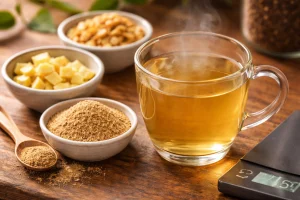 For a 10 to 12 oz (300 to 355 ml) mug:
Ajwain powder: 0.2 to 0.4 g (about 1/16 to 1/8 tsp)
Optional black pepper: 0.05 to 0.1 g (a tiny pinch, about 1/32 tsp)
Ginger root (cut/sifted): 1.0 to 1.5 g (about 1/2 tsp if finely cut)
Steep at 90 to 96°C (194 to 205°F) for 6 to 8 minutes. If you’re using a very fine powder, steep shorter and strain carefully to avoid a chalky mouthfeel.
Batch concentrate (recommended for kombucha dosing)
Make enough for multiple bottles so your flavor is consistent:
Water: 500 ml
Ajwain powder: 1.0 g (about 1/2 tsp, loosely packed)
Black pepper: 0.3 g (about 1/4 tsp or less, depending on grind)
Ginger root: 6 g
Lemon peel: 2 g (optional, for brightness)
Bring water to 95°C (203°F), remove from heat, add botanicals, cover, steep 10 minutes, then strain through a fine mesh. Chill fully before using.
This is one of the most reliable ajwain powder uses because it separates “flavor creation” from “fermentation,” letting you dial in taste without guessing inside the bottle.
CTA: For a bright, clean edge that keeps the spice from feeling heavy, add a touch of lemon peel to your batch concentrate.
How to brew ajwain as a tea blend without overpowering everything
Ajwain can be beautiful in tea when it’s treated like an accent. The trick is to give it a supporting cast that softens the sharper edges and stretches the aroma over the whole sip.
Here are three blend directions that keep ajwain balanced:
1) Warm spice comfort (tea-friendly)
Ginger root: 2 parts
Cinnamon chips: 1 part
Ajwain powder: 1/8 part
Black pepper: a whisper (optional)
Steep 8 minutes at 95°C (203°F). This reads cozy and grounded, with ajwain hovering in the aroma rather than dominating the palate.
CTA: For gentle sweetness and roundness, try cinnamon chips as the base spice.
2) Bright and brisk (kombucha-compatible)
Lemon peel: 2 parts
Ginger root: 2 parts
Ajwain powder: 1/10 part
Hibiscus flowers: 1 part (optional for tart backbone)
Steep 6 to 8 minutes at 90 to 95°C (194 to 203°F). Hibiscus makes it vivid and gives you a “red snap” that plays well in 2F.
CTA: Try adding hibiscus flowers when you want tart structure that holds up in fermentation.
3) Soft aromatic (for people who love gentle cups)
Chamomile whole flowers: 3 parts
Lemon peel: 1 part
Ajwain powder: 1/12 part
Use lower temperature (85 to 90°C / 185 to 194°F) and steep 6 minutes. This is delicate, so keep ajwain very low. Chamomile can’t “wrestle” ajwain, it can only cushion it.
CTA: If you want a soft floral buffer, build the blend on chamomile tea whole flowers.
Kombucha 2F method with ajwain (strict, repeatable)
This is where ajwain powder uses become a real system. Ajwain works best in 2F when you avoid dumping powder straight into bottles. You can do it, but it increases sediment and inconsistency. Option A is the production method. Option B is the “tiny batch, experiment” method.
Baseline assumptions (so your results are repeatable)
You’re bottling finished kombucha that tastes balanced in 1F.
Bottles are 16 oz / 473 ml.
Headspace: 1 to 1.5 inches.
2F temperature: 22 to 26°C (72 to 79°F).
Typical 2F time: 24 to 72 hours, burp only if necessary.
Option A: Tea concentrate dosing (recommended)
Make a chilled spice concentrate (use the batch recipe above).
Label bottles with dose levels (low, medium, high).
Dose concentrate first, then top with kombucha, then cap.
Dosage ranges per 16 oz / 473 ml bottle
Low: 10 ml concentrate
Medium: 15 ml concentrate
High: 20 ml concentrate
If you want more aroma without more spice “weight,” steep longer (up to 12 minutes) rather than adding more ajwain powder. Aroma extracts quickly, bitterness lags behind. That’s a key insight for clean ajwain powder uses in kombucha.
Consistency tips
Weigh your spices, don’t rely on spoons for ajwain.
Chill concentrate fully before bottling (hot concentrate can shock carbonation behavior).
Keep batch notes: date, base kombucha taste, dose, 2F hours, and final impression.
Strain well. Fine sediment is normal, but gritty powder is a process issue.
CTA: For the cleanest dosing workflow, use ajwain powder in a strained concentrate rather than free-pouring into bottles.
Option B: Direct botanicals in bottle (optional)
This is for experimenters who don’t mind sediment.
Per 16 oz / 473 ml bottle:
Ajwain powder: 0.05 to 0.15 g (about 1/32 to 1/16 tsp)
Black pepper: a tiny pinch (optional, very easy to overdo)
Ginger root: 0.3 to 0.6 g (small pinch)
Add botanicals, add kombucha, cap. Swirl gently once to wet the powder, then leave it alone. More agitation equals more powder suspension and a harsher sip.
Direct-in-bottle ajwain powder uses can be exciting, but they’re harder to replicate. If you get a result you love, convert it into a concentrate recipe immediately so you can repeat it.
CTA: If you’re doing direct-in-bottle experiments, keep black pepper minimal with black pepper so it doesn’t dominate the finish.
Pairing ajwain with other botanicals (without muddying flavor)
Ajwain’s job is to add aromatic direction. Pair it with ingredients that either support warmth or brighten the edges. Avoid piling on too many “top note” botanicals at once, because the aroma can turn noisy.
Strong pairings:
Ginger root: rounds and warms, great for structure
Lemon peel: brightens and cleans up the finish
Cinnamon chips: deep, steady warmth that makes ajwain feel cozy
Hibiscus flowers: tart backbone that holds up in 2F
Dandelion root: earthy depth that makes spice feel grounded (use lightly)
A practical way to design flavor is to pick:
One base (ginger, cinnamon, or dandelion root)
One brightener (lemon peel or hibiscus)
Ajwain as the accent
Black pepper only if you want extra bite
This approach keeps ajwain powder uses intentional. You’re not just “adding spices,” you’re building a flavor arc.
CTA: For a deeper, more roasted-feeling base note in tea or concentrate, try a small amount of dandelion root tea behind the spice.
Troubleshooting (flat flavor, too tart, over-carbonation, sediment, aroma loss)
Kombucha teaches you fast: small process differences create big results. Here’s how to troubleshoot the common issues when working with ajwain powder uses in 2F.
Flat flavor (tastes weak)
Increase steep time of concentrate (10 to 12 minutes), not the ajwain dose.
Check your bottle dose accuracy. Use a small measuring cylinder or syringe for ml.
Make sure concentrate is chilled and not diluted by melting ice or warm additions.
Too tart (acid overwhelms spice)
Your 1F may be finishing too dry. Bottle earlier next time.
Add a brightener that reads “fresh” (lemon peel) rather than “more acid” (too much hibiscus).
Use the low dose (10 ml) and shorten 2F time.
Over-carbonation
Reduce 2F time or lower temperature.
Avoid adding extra sugar sources while testing spice. Keep variables limited.
Use Option A. Direct powder can nucleate bubbles and accelerate fizz unpredictably.
Sediment (gritty or heavy)
Strain concentrate more finely.
If doing Option B, reduce ajwain powder drastically and avoid shaking bottles.
Let bottles chill upright before opening so sediment compacts.
Aroma loss (smells great at bottling, dull later)
Ajwain aromatics are volatile. Keep 2F time tight (often 24 to 48 hours is enough).
Store finished bottles cold as soon as carbonation is where you want it.
Use airtight storage for your spice so it stays potent batch to batch.
CTA: If your aroma feels thin, rebuild your concentrate with a touch of ginger root to carry the spice through the finish.
Storage + quality (keep the aroma alive)
Ajwain powder’s personality lives in its scent. If it goes flat, your results will too. For consistent ajwain powder uses, treat storage like part of your recipe.
Airtight is non-negotiable. Use a tight-lid jar and close it fast.
Keep it cool, dry, and away from light. Heat and humidity mute aromatics.
Avoid storing near the stove where temperature swings are constant.
Watch for quality cues: fresh ajwain powder smells lively and thyme-bright. Old powder smells dusty, faint, or dull.
If you live in a humid climate, consider adding a food-safe desiccant pack near your spice storage area (not inside the spice unless you’re using packaging designed for it). And don’t “air out” the jar by leaving it open while you measure. Pour what you need, close it, then work.
CTA: For best results, keep ajwain powder sealed tight and refresh your stock when the aroma fades.
Safety and responsible use (no medical claims, just common sense)
Ajwain and black pepper are culinary spices with a long history of traditional use. Herbalists often use spices as part of everyday wellness routines, but this article is about flavor and beverage-making, not treatment or cures. If you’re pregnant, nursing, managing a condition, or taking medications, it’s smart to consult a qualified health professional before making significant dietary changes.
From a beverage standpoint, the main safety issue is dosing. Ajwain can be intense, and black pepper can feel sharp in acidic drinks. Start low, keep notes, and scale slowly. In kombucha, let flavor be your guide, not the idea that “more is better.” The best ajwain powder uses are measured, intentional, and comfortable to drink.
CTA: If you’re new to spicy ferments, begin with a low dose of black pepper or skip it until you know your preference.
FAQ
What are the best ajwain powder uses for beginners?
Start with a tiny amount in a warm infusion or a strained concentrate. Ajwain is potent, so micro-dosing gives you control without overpowering the cup or bottle.
Does ajwain powder taste like thyme?
It’s thyme-adjacent, yes. Ajwain is more intense and can have a clean, camphor-like brightness that feels sharper than dried thyme.
Can I put ajwain powder directly into kombucha bottles?
You can, but it’s harder to repeat and usually creates more sediment. A chilled, strained concentrate is the most consistent method for kombucha.
How much ajwain powder should I use per 16 oz (473 ml) bottle?
If dosing directly, stay around 0.05 to 0.15 g (about 1/32 to 1/16 tsp). If dosing concentrate, start at 10 ml per bottle and adjust.
Why pair ajwain with black pepper?
Black pepper adds bite and warmth that can make ajwain feel rounder and more “finished,” especially in savory-leaning blends. Keep pepper minimal so it doesn’t dominate.
What pairs well with ajwain in tea blends?
Ginger root, lemon peel, cinnamon chips, and small amounts of hibiscus flowers all pair nicely. Chamomile can work too, but keep ajwain very low.
How do I reduce sediment in ajwain kombucha?
Use a fine mesh strainer for your concentrate, avoid shaking bottles, and chill upright before opening so any fine particles settle.
How should I store ajwain powder to keep it fresh?
Airtight, cool, dry, and away from light. If the aroma turns dull or dusty, your results will be flatter and less predictable.
Ajwain is a small-but-mighty spice that rewards careful hands. Once you understand its thyme-bright aroma and how quickly it can take over, it becomes a powerful tool for building warm, savory complexity in tea and a crisp aromatic edge in kombucha. The most reliable ajwain powder uses come from measuring by weight, making a chilled, strained concentrate, and dosing per bottle with clean notes. Pair it with black pepper for bite, ginger for body, and a touch of citrus peel or hibiscus when you want lift. Keep it simple, keep it consistent, and let the aroma do the heavy lifting.