Turmeric Benefits: Traditional Uses and Practical Ways to Take It
Turmeric benefits show up in the oldest kind of kitchen wisdom: the way a spice can make plain food feel warming, steady, and complete. Herbalists often treat turmeric less like a “hack” and more like a daily craft ingredient, valued for its deep color, earthy-bitter edge, and the way it plays well with fats, heat, and other spices. If you’re a kombucha maker, turmeric benefits also translate into something very practical: a predictable flavor lever that can turn a light, citrusy brew into something rounder and more structured, especially when paired with pepper and bright aromatics.
Turmeric is not subtle, but it is teachable. You can learn how to dose it so it tastes intentional instead of dusty and choose formats that fit your routine, from a simple stirred paste to a small tea concentrate you can dose by gram. You can also build repeatability by treating turmeric like any other production input: measure, log, standardize, and protect quality from humidity and light. This guide covers traditional uses, sensible everyday methods, and a strict kombucha 2F workflow using Turmeric Powder plus Black Pepper TBC.
Turmeric benefits in traditional herbal practice (and why they’re “daily”)
When herbalists talk about turmeric benefits, they usually mean it as a long-game spice: warming, grounding, and supportive when used consistently in food and drink. Traditionally, turmeric appears in nourishing preparations where the “carrier” matters as much as the spice itself: warm milk or milk alternatives, broths, ghee, honey, and slow-cooked foods. Those formats aren’t random. They’re built around solubility and palatability. Turmeric has an earthy bitterness and a drying feel on its own, so traditional preparations often soften it with fat, sweetness, and aromatic companions.
From a beverage-maker lens, that tradition is basically a formula: turmeric tastes best when you give it a round base and a bright top note. That’s why citrus peel, ginger, cinnamon, and pepper show up so often nearby. Black pepper is also a classic companion in traditional kitchens. In modern production terms, it’s a micro-dose flavor amplifier: a tiny amount adds lift and structure without turning your drink “spicy.”
If you want a simple way to think about it, turmeric benefits are tied to ritual use. The goal is not intensity. The goal is a consistent, pleasant daily inclusion that people actually keep doing.
Try pairing turmeric with turmeric powder in everyday cooking or drinks where the flavor can bloom.
What turmeric actually tastes like (so you can dose it on purpose)
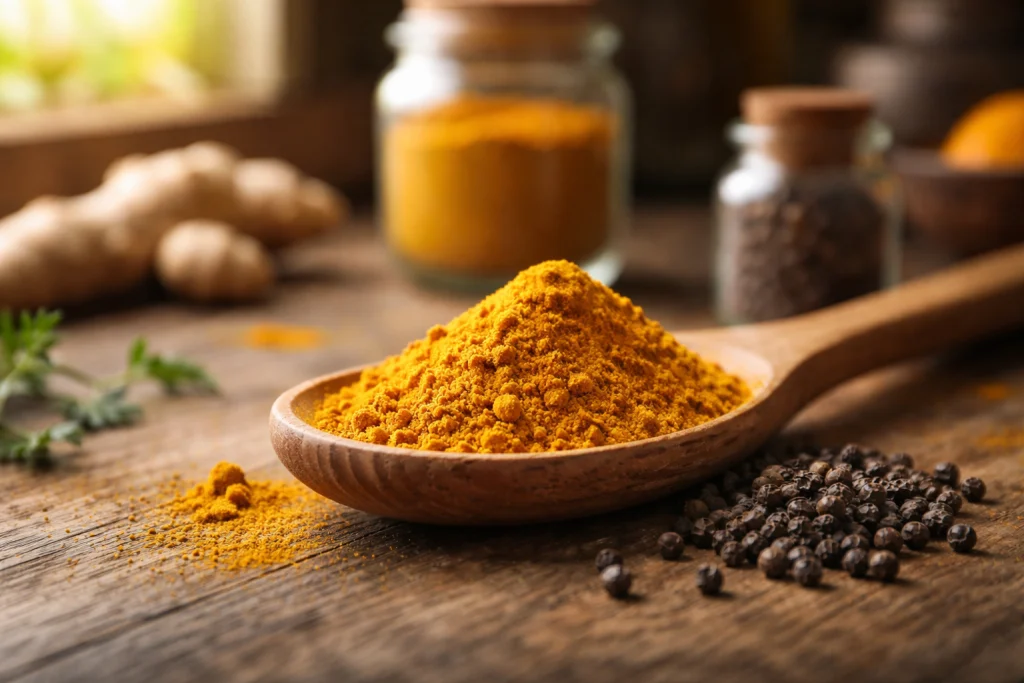
Turmeric is earthy, rooty, and slightly bitter, with a warm, mineral-like dryness and a vivid golden color. The most common dosing mistakes come from treating it like cinnamon (sweet-warm) or ginger (bright-heat). Turmeric is more architectural. It adds “backbone” and color first, then a gentle bitterness that can read as medicinal if overdone.
A practical flavor map:
Base: earthy, starchy root notes
Mid: dry bitterness, savory warmth
Top: minimal on its own (needs citrus, ginger, pepper, or aromatic herbs)
In kombucha, that means you should usually give turmeric a partner that provides aroma (citrus peel, lemon myrtle, ginger) and a partner that provides structure (pepper, cinnamon, clove in tiny amounts). Black Pepper TBC is especially useful because it’s consistent and easy to measure. It brings a warm, woody aroma and a slow-building heat when dosed correctly.
For a bright companion, try adding organic orange peel powder to keep turmeric from tasting flat.
Formats that make turmeric benefits easy to stick with (no heroic effort)
If turmeric benefits are your goal, choose the format you can repeat without thinking. Herbalists often rotate these:
“Golden paste” style (kitchen-prep friendly)
A small paste can be stirred into warm drinks, oats, or smoothies. It’s also easy to portion.Tea concentrate (best for consistent dosing)
A concentrate gives you control: grams in, milliliters out. This is the closest to a production mindset and transitions cleanly into kombucha 2F.Food-first (the simplest)
Soups, rice, eggs, roasted vegetables, and dressings. Turmeric integrates well with oil and salt, which makes it taste intentional.Micro-dose in sparkling drinks
A tiny amount plus citrus and a sweetener can be surprisingly elegant. This is where pepper becomes your “edge control.”
For a clean herbal lift in warm drinks, try blending with organic lemon myrtle for a citrusy top note.
Exact ratios for daily use (grams + teaspoons) that still taste good
These are practical ranges that keep flavor pleasant. Use a scale when you can. If you’re using teaspoons, level them and keep your spoon set consistent.
Daily warm drink (8 to 12 oz / 240 to 355 ml):
Turmeric powder: 0.8 to 1.5 g (about 1/2 to 1 tsp, depending on grind)
Optional black pepper TBC: 0.03 to 0.08 g (a small pinch, roughly 1/32 to 1/16 tsp)
Optional fat: 2 to 5 g (1 tsp to 1 tbsp coconut oil, ghee, or a creamy milk alternative)
Optional sweetener: 5 to 10 g honey or sugar (1 to 2 tsp), to round bitterness
Optional citrus: 0.2 to 0.5 g orange peel powder (about 1/8 to 1/4 tsp)
Stir turmeric into a small slurry first (a tablespoon of warm water), then add the rest. This prevents floating clumps and reduces that “dusty” mouthfeel.
Turmeric tea concentrate (makes about 250 ml concentrate):
Water: 300 ml
Turmeric powder: 6 to 10 g
Ginger (optional): 2 to 4 g dried or 8 to 12 g fresh
Simmer very gently 10 to 12 minutes, then cool and strain through fine mesh (expect some sediment). Dose 15 to 30 ml per serving.
If you want a structured spice backbone, try a micro-dose of organic black pepper TBC alongside turmeric.
Turmeric benefits for kombucha makers: why it’s a production-friendly ingredient
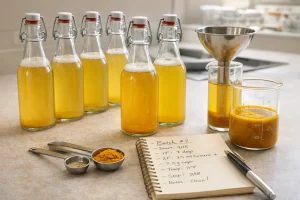 In kombucha work, turmeric benefits are less about hype and more about controllable outcomes. Turmeric gives you:
Color: immediate visual identity (golden, sunlit, premium)
Body: a sense of weight and warmth that can make a thin brew feel fuller
Blend compatibility: it works with citrus, ginger, cinnamon, vanilla, and many botanicals
Repeatability when weighed: it behaves like a stable dry input (as long as humidity is controlled)
The main tradeoff is sediment. Turmeric naturally settles. You can either manage that with process (concentrate dosing, fine straining, consistent agitation) or treat it as a normal “crafted beverage” cue (with a label suggestion to invert gently).
To brighten turmeric in kombucha, pair it with hibiscus flowers when you want a tart contrast and deeper color complexity.
Kombucha 2F method (strict + repeatable) for turmeric and black pepper
This section is designed for consistent batches. The goal is a stable flavor target per 16 oz / 473 ml bottle.
Target style: golden, warm, citrus-lifted, with a gentle pepper structure (not hot).
Baseline 2F time: 24 to 48 hours at 70 to 75°F (21 to 24°C), then cold crash 12 to 24 hours.
Option A: Tea concentrate dosing (recommended)
Make a turmeric concentrate
For about 500 ml concentrate:
Water: 600 ml
Turmeric powder: 12 g
Orange peel powder: 2 g (optional but highly recommended for aroma)
Black pepper TBC: 0.3 g (tiny, but meaningful)
Simmer very gently 10 minutes. Do not hard boil. Cool 20 minutes.
Strain through fine mesh. Let it settle 10 minutes, then pour off the top to reduce grit.
Dose per 16 oz / 473 ml bottle
Turmeric concentrate: 15 to 35 ml (start at 20 ml for a balanced profile)
Sweetener (for carbonation): 6 to 10 g sugar (1.5 to 2.5 tsp), adjusted to your base kombucha dryness
Finished 1F kombucha: fill to leave 1 inch headspace
Standardize
Always weigh turmeric powder going into the concentrate.
Record your exact dose (ml concentrate per bottle).
Use the same simmer time and strainer mesh each batch.
Dosage ranges per 16 oz bottle (finished flavor):
Light: 15 ml concentrate
Balanced: 20 to 25 ml concentrate
Bold: 30 to 35 ml concentrate
Consistency tips:
Use batch notes: date, base tea, 1F acidity, concentrate grams, dose ml, 2F hours, room temp.
If you scale up, make concentrate by weight ratio (2% turmeric in water by weight is a solid starting point for a workable concentrate).
If sediment bothers you, decant the concentrate after settling and keep the last 10% out.
For an aromatic “lift” that reads premium, try adding orange peel powder into the concentrate.
Option B: Direct botanicals in bottle (optional)
This is simpler but less consistent and more sediment-prone.
Per 16 oz / 473 ml bottle:
Turmeric powder: 0.3 to 0.8 g (start at 0.5 g)
Black pepper TBC: 0.02 to 0.06 g (a tiny pinch)
Sugar: 6 to 10 g
Fill with 1F kombucha
Method:
Add turmeric, pepper, and sugar to the bottle.
Add 30 ml kombucha, cap, and shake hard to disperse.
Top up with kombucha, cap, and ferment 24 to 48 hours.
Cold crash, then invert gently before pouring.
Direct dosing works best if you accept a natural settle and train customers to “invert once.”
To keep the spice profile warm and cozy, consider a tiny companion dose of cinnamon chips in your concentrate batches (micro-dose, not a full cinnamon drink).
Pairing ideas that keep turmeric from tasting flat or “dusty”
Turmeric benefits are easiest to enjoy when the flavor is balanced. Here are pairings that work in teas and kombucha:
Citrus-forward and clean:
Turmeric + orange peel powder + a touch of lemon myrtle
Turmeric + orange peel + ginger (classic, bright)
Floral contrast:
Turmeric + hibiscus (gold and ruby, tart meets warm)
Turmeric + sunflower petals for a soft, honeyed impression (use lightly)
Rooty and roasty:
Turmeric + dandelion root tea notes (earth on earth, best with a little sweetener)
Turmeric + cinnamon + vanilla-style sweetness (round and dessert-like without being sugary)
Pepper as structure:
Turmeric + Black Pepper TBC in tiny doses to sharpen and lengthen the finish
For a gentle floral layer, try adding sunflower petals to a turmeric blend when you want softness without extra acidity.
Troubleshooting (flavor, carbonation, sediment, aroma)
Flat flavor
Common causes: under-dosing concentrate, no aromatic top note, or too-cold 2F. Fix: add citrus peel (orange peel powder), increase concentrate dose by 5 ml per bottle, and keep 2F at 70 to 75°F (21 to 24°C).
Too tart
Cause: base kombucha too acidic going into 2F, or 2F ran too long. Fix: shorten 2F time, cold crash earlier, and consider dosing a touch more sugar (within your style limits) to round the perception of tartness.
Over-carbonation
Cause: too much sugar, too warm, too long. Fix: reduce sugar to 6 g per bottle, burp at 18 to 24 hours if needed, and always cold crash before opening. Keep batch notes so you can correlate temp with pressure.
Sediment overload
Cause: direct powder dosing or un-decanted concentrate. Fix: prefer Option A, strain finer, let concentrate settle, and decant. In bottles, tell users to pour slowly or invert once then pour.
Aroma loss
Cause: long storage of powders in humid air, leaving concentrate uncovered, or using boiling temps that drive off aromatics. Fix: store airtight, keep simmer gentle, and add aromatic companions (orange peel, lemon myrtle) late or in the dosing step.
If you want cleaner aroma and less muddiness, try using organic ginger root as a bright partner rather than pushing turmeric dose too high.
Storage + quality: keeping turmeric potent, clean, and consistent
Turmeric is sensitive to humidity and light. It can clump, dull in aroma, and lose that lively warm edge if stored poorly. For production consistency:
Storage rules:
Airtight container, ideally opaque or kept in a dark cabinet
Cool, dry environment (avoid steam zones near kettles)
Keep a dedicated scoop and never introduce wet utensils
Reseal quickly (powders pick up moisture fast)
Quality cues:
Color: vibrant golden-yellow is a good sign; dull brownish tones suggest age or oxidation
Aroma: should smell warm and earthy, not musty
Texture: free-flowing powder (clumping suggests moisture exposure)
For concentrate:
Refrigerate in a sealed bottle
Use within 5 to 7 days for best aroma
Shake before dosing, then measure immediately so each bottle matches
For a pantry-friendly companion spice that stores well, keep black pepper TBC sealed and away from heat to preserve its aromatic top notes.
Safety (compliant, practical wording)
This article discusses traditional uses and practical beverage-making methods. It is not medical advice, and it does not treat or cure disease. Turmeric benefits are described in the way herbalists and traditional food cultures often use turmeric: as a supportive, warming culinary herb used consistently in everyday routines.
Practical cautions for makers:
Start with lower doses. Turmeric can taste bitter or drying when overused.
Consider labeling guidance for customers: “Natural sediment may occur. Invert gently.”
If someone is pregnant, nursing, taking medications, or managing a health condition, they should consult a qualified professional before making significant dietary changes.
When in doubt, keep your formulas simple: measured turmeric, tiny pepper, and a bright aromatic like citrus peel.
Conclusion: turmeric benefits as a daily craft ingredient
Turmeric benefits become real in the hands of someone who treats the spice with respect: measured doses, good pairing logic, and a repeatable process. For kombucha makers, turmeric is a reliable tool for building warmth, color, and structure, especially when you use a concentrate and standardize your dosing. Pair it with citrus for lift, keep Black Pepper TBC at a micro-dose for definition, and protect quality with airtight storage and consistent notes. If you approach turmeric like a production ingredient instead of a trend, you get a drink that tastes intentional every time, and a routine people actually keep.
Try dialing in your next batch with turmeric powder and a tiny pinch of organic black pepper TBC for a structured, repeatable golden profile.
FAQ
What are turmeric benefits in everyday culinary use?
Turmeric benefits are traditionally associated with steady, daily inclusion in food and warm drinks, valued for its warming, grounding character and how it supports a consistent kitchen routine.
How much turmeric should I add to kombucha 2F?
Start with 15 to 25 ml of turmeric concentrate per 16 oz / 473 ml bottle, or 0.3 to 0.5 g direct powder if you accept more sediment.
Do I need black pepper in a turmeric drink?
Not strictly, but a tiny amount of Black Pepper TBC can add structure and aroma, helping the flavor read brighter and more finished.
Why does turmeric settle to the bottom of the bottle?
Turmeric is a fine powder that naturally settles. Concentrate dosing, fine straining, and decanting after settling reduce grit and improve consistency.
Can I reduce sediment without changing flavor?
Yes. Use a concentrate, strain through finer mesh, let it settle, and pour off the top. Also avoid over-dosing direct powder in bottles.
What sweetener amount works best for turmeric kombucha 2F carbonation?
A repeatable starting point is 6 to 10 g sugar per 16 oz / 473 ml bottle, adjusted based on your 1F dryness and 2F temperature.
How do I keep turmeric fresh in storage?
Store airtight, cool, and dark. Avoid humidity and steam exposure. Look for bright color and a clean, warm aroma as freshness cues.
Can turmeric make kombucha taste “dusty”?
Yes, if under-mixed or over-dosed. Make a slurry or concentrate, add citrus peel for aroma, and keep dosing measured to avoid harsh bitterness.