Sunflower Petals vs Calendula: Which is Better for Tea Blends?
If you’ve ever held a pinch of bright petals over a warm mug and thought, “This is going to taste like sunlight,” you’re already in the right headspace for sunflower petals vs calendula. Both are friendly, golden botanicals that can lift a blend from “fine” to “I want another cup.” But they don’t behave the same in hot water, and they definitely don’t behave the same in kombucha. One tends to read as soft and honeyed with a mellow body. The other often leans more resinous and floral, with a tidy, structured finish that can steer a whole blend.
This comparison is meant to be practical. You’ll get brewing ratios in grams and teaspoons, what to expect in aroma and color, how to build blends that taste intentional (not just “petals plus hot water”), and a strict, repeatable second fermentation method for kombucha makers. By the end, you’ll know which petal to reach for when you want gentle warmth, when you want bright floral lift, and when you want a golden note that still shows up after carbonation.
Sunflower petals vs calendula at a glance
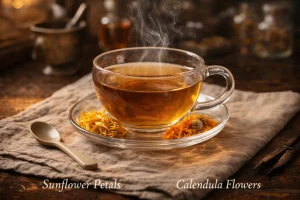 When people ask for sunflower petals vs calendula in tea blends, they’re usually asking three questions at once: Which one tastes better? Which one looks better? Which one is easier to work with consistently?
Here’s the quick, production-minded answer:
Flavor direction: Sunflower petals often feel mild, rounded, and “sunny.” Calendula can feel more aromatic, slightly resinous, and more assertive.
Aroma: Sunflower is soft and subtle. Calendula is more fragrant and can carry a “garden-flower” character that rises fast with steam.
Color: Both can tint a cup golden, but calendula commonly delivers a clearer, more saturated golden hue at lower doses.
Blend role: Sunflower is great as a background note or “softener.” Calendula is great as a top note or “brightener.”
Kombucha 2F: Both can work. Calendula tends to show up more clearly in aroma. Sunflower tends to show up more in the mid-palate if you dose it with intention.
If you’re building blends for other people (or you’re trying to replicate a favorite bottle week after week), think of sunflower as a velvet layer and calendula as a golden spotlight.
Getting to know the petals in your jar
A tea blend behaves like a small orchestra. Petals are rarely the bassline. They’re more like the brass and strings: color, lift, aroma, and a certain “feeling” in the cup.
Sunflower petals (Helianthus annuus) in the cup are usually gentle. Dry petals can smell faintly sweet, sometimes like straw-honey or warm hay in a clean way. In hot water, they tend to release a soft floral note that doesn’t shout. That’s why sunflower petals can be a smart choice when you want something golden and inviting without turning the blend perfumey.
If you’re building a bright, fruit-forward tea, sunflower can make the fruit taste rounder. If you’re building a citrus peel blend, sunflower can soften sharp edges. For a simple and versatile base, try sunflower petals as a golden backbone in both tea and 2F.
Calendula (Calendula officinalis) is often more aromatic. It can read as floral with a resinous edge, sometimes described as slightly “marigold-like” (calendula is not the same as ornamental marigolds, but the aromatic family resemblance is why people confuse them). In blends, calendula can bring a clean, sunny lift and a richer golden tint.
If you want petals that still show up when the blend includes roots, peels, or tart flowers, calendula is usually the one that keeps its seat at the table. If you’re building a bright, apothecary-style blend, try calendula flowers as the main golden petal.
Flavor, aroma, and mouthfeel in sunflower petals vs calendula
The most useful way to judge sunflower petals vs calendula is to taste them alone first, then taste them in a simple “test blend” where everything else is neutral.
Sunflower petals solo
Aroma: soft floral, faint sweetness
Taste: mild, rounded, slightly grassy-honeyed
Mouthfeel: gentle, sometimes slightly silky if steeped properly
Where it shines: calming, cozy blends; soft citrus; fruit blends that need rounding
Sunflower is the petal you choose when you want “golden” without “perfumey.” It’s also forgiving. You can overdo it a bit and still get a pleasant cup, especially if you keep steep times reasonable.
Calendula solo
Aroma: floral, more pronounced; sometimes a lightly resinous note
Taste: more distinctive; can read as herbal-floral with a structured finish
Mouthfeel: clean, slightly drying if overdosed or oversteeped
Where it shines: bright blends; citrus-peel blends; floral-forward profiles; blends that need a clear aromatic top note
Calendula is the petal you choose when you want the blend to smell like something the moment hot water hits it. If your blend needs “lift,” calendula usually gets you there faster.
A quick sensory tip: smell the steam first, then sip. Sunflower tends to show up more in the sip. Calendula tends to show up more in the steam, then echoes in the finish.
Color in the cup and blend behavior
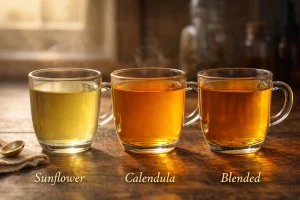 People love petals because they look like tea should look: alive, luminous, golden. But color isn’t just aesthetics. Color affects expectation. Expectation affects perceived flavor.
In sunflower petals vs calendula, calendula often wins on “immediate golden color” at lower doses. Sunflower can still tint beautifully, but it frequently needs a slightly higher dose or a longer steep to reach the same saturation.
How they behave in blends
With tart botanicals (hibiscus, berry skins): Calendula can stay present aromatically. Sunflower can soften the tartness and keep the cup from tasting too sharp.
With citrus peel: Calendula reinforces the bright aromatic lift. Sunflower rounds the peel’s bitterness.
With roots (ginger, turmeric-style profiles): Calendula can sit on top and keep the blend from feeling heavy. Sunflower can make the whole thing feel smoother.
If you’re building a blend meant to look like “sun in a cup,” calendula is the easiest way to get that effect reliably. If you want the blend to feel mellow and cozy, sunflower often does more work than its subtle aroma suggests.
For a strong visual and a tart backbone that plays well with both petals, try adding hibiscus flowers in small amounts to push color and brightness.
Brewing the petals: ratios, temps, and timing you can repeat
Here’s where blends become consistent instead of “good on Tuesdays.” Measure your petals at least a few times, learn what your “teaspoon” actually weighs, and write it down. Petals are fluffy and variable. A teaspoon can mean wildly different things depending on cut and compression.
Below are reliable starting points for a single 8 oz / 240 ml cup and a standard 16 oz / 473 ml mug, with both grams and teaspoons.
Petal-only baseline ratios (hot tea)
Sunflower petals
8 oz / 240 ml: 0.6 to 1.0 g (about 1 to 2 tsp)
16 oz / 473 ml: 1.2 to 2.0 g (about 2 to 4 tsp)
Temp: 200 to 205°F / 93 to 96°C
Time: 6 to 10 minutes
Calendula flowers
8 oz / 240 ml: 0.3 to 0.8 g (about 1/2 to 2 tsp)
16 oz / 473 ml: 0.6 to 1.6 g (about 1 to 4 tsp)
Temp: 195 to 205°F / 90 to 96°C
Time: 5 to 8 minutes
Calendula can get a little drying when pushed too hard. If your cup starts feeling “stiff” on the sides of your tongue, shorten the steep or drop the dose.
If you’re deciding sunflower petals vs calendula purely for brewing ease, sunflower is more forgiving. Calendula is more efficient. You can use less and still get a clear signature.
Blend-friendly ratios (petals as 10 to 25% of the blend)
For most “daily drinker” blends, petals usually sit best as 10 to 25% by weight.
Gentle golden blend: 10 to 15% calendula or 15 to 25% sunflower
Bright aromatic blend: 15 to 25% calendula plus lighter supporting botanicals
Cozy citrus blend: 15 to 20% sunflower plus peel and a soft leaf
For citrus lift that reads clean (especially in iced tea), try dried orange peel as the bright edge that petals can round out.
Building tea blends that taste intentional
If you want blends that feel designed, assign each ingredient a job. Petals usually do three jobs: lift, glow, and soften.
When choosing sunflower petals vs calendula, decide which job you want done most.
Blend role guide
Lift (aroma, top note): Calendula usually leads.
Glow (golden color, visual appeal): Calendula is efficient; sunflower is softer.
Soften (rounding sharp edges): Sunflower usually wins.
Three practical blend formulas (small batch)
Each formula below is a simple “master recipe” you can scale. Mix by weight for consistency.
1) Golden Citrus Comfort (mellow, warm)
40% sunflower petals
25% dried orange peel
20% lemongrass
15% peppermint leaf (optional, for a cool finish)
Steep: 200°F / 93°C for 7 minutes.
CTA: For a clean citrus lift that doesn’t taste like candy, try lemongrass with petals as your bright, grassy citrus bridge.
2) Bright Apothecary Gold (aromatic, structured)
35% calendula flowers
25% dried orange peel
25% hibiscus flowers
15% rose petals
Steep: 195°F / 90°C for 6 minutes.
CTA: If you want a floral note that feels classic and elegant, add a small amount of rose petals alongside calendula.
3) Ginger-Gold Spark (warming, kombucha-friendly)
30% calendula flowers
30% sunflower petals
25% ginger root
15% lemongrass
Steep: 205°F / 96°C for 6 minutes (or use as a 2F concentrate).
CTA: For a warming finish that stays noticeable after carbonation, try ginger root in small, measured doses.
In sunflower petals vs calendula blending, the biggest mistake is treating petals like the whole story. They’re the lighting, not the stage. Pair them with one “spine” ingredient (peel, root, tart flower, or leaf) and one “finish” ingredient (mint, rose, lemongrass, gentle spice).
If you want a clean, crisp finish without making the blend taste like toothpaste, keep peppermint leaf low and let the petals do the softness.
Kombucha 2F: strict, repeatable methods with dosing per bottle
Kombucha is where petals can get weird if you don’t control variables. The goal is repeatability. That means measuring, consistent timing, and batch notes that you actually keep.
In sunflower petals vs calendula for kombucha, calendula usually throws aroma upward (especially when you crack the bottle). Sunflower tends to fill the mid-palate, but it needs enough contact or a concentrate approach so it doesn’t vanish behind acidity.
Baseline setup (for both options)
Bottle size: 16 oz / 473 ml
1F kombucha: finished and strained, still slightly sweet (not bone-dry)
2F temperature: 70 to 76°F / 21 to 24°C
2F time: 24 to 72 hours, then refrigerate
Always leave headspace: 1 to 1.5 inches / 2.5 to 4 cm
Option A: Tea concentrate dosing (recommended)
This is the production-minded method. You control extraction, dose precisely, and get predictable flavor.
Concentrate recipe (makes about 8 oz / 240 ml)
Water: 8 oz / 240 ml at 200°F / 93°C
Petals (choose one):
Sunflower petals: 3.0 g
Calendula flowers: 2.0 g
Or a split: 2.0 g sunflower + 1.0 g calendula
Optional supports (pick one):
Dried orange peel: 1.0 g
Ginger root: 0.8 g
Hibiscus flowers: 0.7 g (powerful, go easy)
Steep 8 minutes, then strain hard. Cool fully. Refrigerate up to 48 hours.
Dose per 16 oz / 473 ml bottle
Mild: 0.5 oz / 15 ml concentrate
Medium: 1.0 oz / 30 ml concentrate
Bold: 1.5 oz / 45 ml concentrate
Fill the rest with 1F kombucha, cap, and ferment 2F.
Consistency tips:
Weigh petals for the concentrate every time.
Use the same steep time and temperature.
Write batch notes: dose, 2F hours, room temp, and your carbonation result.
CTA: If you want a bright aromatic top note that pops when you open the bottle, try calendula flowers in the concentrate at measured grams.
Option B: Direct botanicals in bottle (optional)
This method can work, but it creates more variation and more sediment. It’s still useful for small runs, especially if you’re testing.
Direct dosing per 16 oz / 473 ml bottle
Sunflower petals: 0.3 to 0.8 g (about 1 to 2 tsp loosely filled)
Calendula flowers: 0.2 to 0.6 g (about 1/2 to 1.5 tsp)
Optional add-ons (choose one):
Dried orange peel: 0.2 to 0.5 g
Ginger root: 0.2 to 0.6 g
Hibiscus flowers: 0.1 to 0.3 g
Add botanicals first, then kombucha. Cap and ferment 2F.
Sediment control:
Use a small mesh insert or strain before serving.
Keep petals low if you want a cleaner pour.
In sunflower petals vs calendula for 2F, if you want the cleanest, most consistent results, Option A wins. Option B is fine for quick experiments or when you like the rustic look.
CTA: For a tart backbone that still tastes bright after chilling, try a tiny dose of hibiscus flowers in 2F (measure it, because it’s strong).
Troubleshooting: flat flavor, too tart, over-carbonation, sediment, aroma loss
Kombucha and tea blends both have predictable failure modes. Fixing them is usually about one variable, not a total rewrite.
Flat flavor (tastes thin or “gone”)
Use the concentrate method and increase dose from 15 ml to 30 ml per bottle.
Shorten 2F time if the flavor is getting eaten by acidity.
In sunflower petals vs calendula, sunflower can read “invisible” if your kombucha is already very tart. Try shifting to calendula or blending both.
Too tart (acid dominates everything)
Bottle earlier in 1F so there’s more residual sweetness to carry flavor.
Reduce 2F time or refrigerate sooner.
Add petals via concentrate so you can increase aroma without increasing sediment.
Over-carbonation (gushers, too fizzy)
Reduce concentrate dose or reduce added fruit/peel sugars.
Burp at 18 to 24 hours if your room is warm.
Chill fully before opening.
Sediment overload
Switch to Option A concentrate dosing.
If using Option B, lower petal grams and avoid powdery cuts.
Decant gently and leave the last half-inch in the bottle.
Aroma loss after chilling
Some aromatics fade cold. Increase calendula slightly or add a small citrus peel note.
Keep concentrate sealed and cold, and don’t leave bottles at room temp longer than needed.
CTA: If you want a clean aromatic lift that survives chilling, pair petals with a small amount of dried orange peel instead of pushing petal dose too high.
Storage + Quality control (plus Safety)
Petals are delicate. They’re basically edible sunlight with a short attention span. If you treat them like rugged roots, they’ll punish you by smelling like nothing.
Storage rules
Airtight always. If you can smell your petals without opening the jar, the jar isn’t airtight.
Keep away from humidity. Moisture is the fastest path to dull aroma and clumpy texture.
Store in a cool, dark place. Light fades color and aroma.
Quality cues
Color: vibrant golds and yellows are a good sign. Dull brown-yellow usually means age or poor storage.
Scent: sunflower should smell softly sweet and clean. Calendula should smell floral and bright. If either smells dusty or flat, use it in stronger blends (like citrus + hibiscus) or refresh your stock.
Texture: petals should feel dry and crisp, not leathery or damp.
Batch consistency
Weigh a teaspoon once in your own kitchen and write it down (for your specific product cut). Petals vary a lot.
Keep a simple log for blends and 2F: grams, steep time, and results.
If your goal is gentle warmth and a mellow cup, sunflower petals vs calendula often lands in sunflower’s favor. If your goal is a clear aromatic lift and a strong golden visual at lower doses, calendula usually wins. For kombucha, both work, but the most repeatable path is concentrate dosing, measured in milliliters per bottle, with batch notes so your “best bottle” becomes your standard bottle.
CTA: If you want a golden blend that’s both cozy and aromatic, consider pairing sunflower petals and calendula flowers together, then anchoring the profile with one supporting botanical like lemongrass or ginger root.
FAQ
Sunflower petals vs calendula: which is better for beginners?
If you want an easy, forgiving petal, sunflower is usually simpler. If you want strong aroma and color with smaller doses, calendula is easier to “read” in the cup.
Will calendula make my tea bitter?
Not usually bitter, but it can feel slightly drying if you oversteep or overdose. Keep it in the 5 to 8 minute range and measure your grams.
Can I blend sunflower petals and calendula together?
Yes. A split petal approach often tastes more complete: sunflower for softness, calendula for lift.
What’s the cleanest way to use petals in kombucha 2F?
Use a cooled tea concentrate and dose 15 to 45 ml per 16 oz bottle. It’s more consistent than putting petals directly in the bottle.
How do I reduce sediment in petal kombucha?
Use concentrate dosing, strain well, and keep direct-in-bottle petal grams low. Sediment is normal, but you can control it.
Do petals lose aroma over time?
Yes. Airtight storage and low humidity matter. If the scent fades, petals will still add color, but the flavor will be quieter.
What ingredients pair best with these petals for bright flavor?
Citrus peel, lemongrass, and small amounts of hibiscus are strong partners. Ginger adds warmth that holds up in chilled drinks.
Can I drink these daily?
These botanicals are traditionally used in everyday tea blends, but personal sensitivity varies. Keep blends moderate, and if you’re unsure, start with smaller servings.