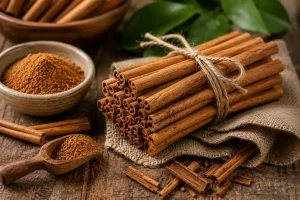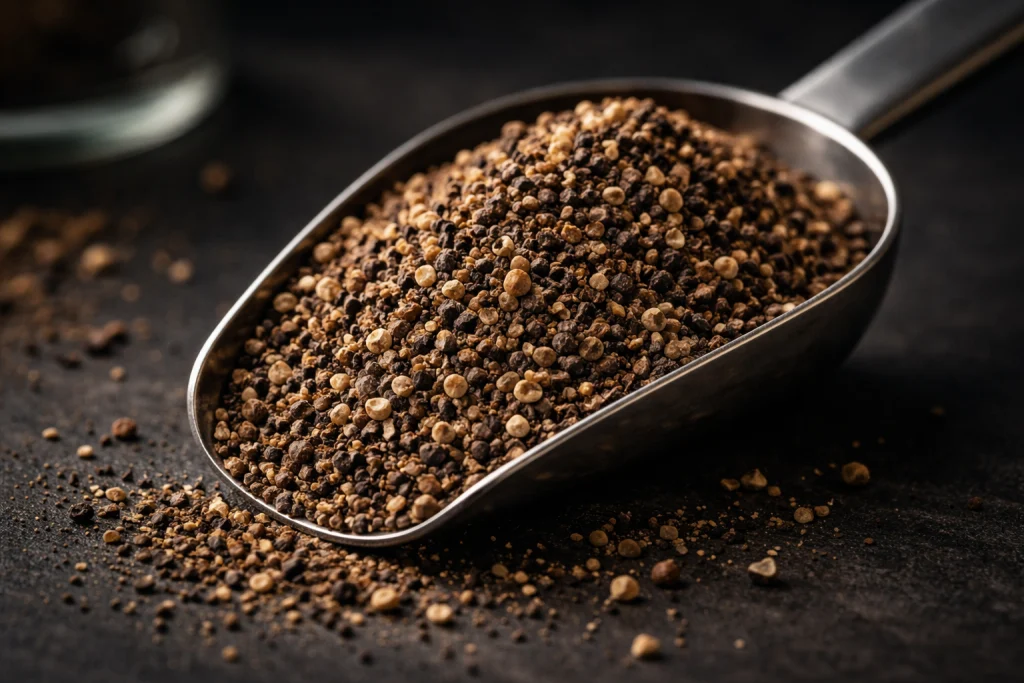
You can make black pepper feel either elegant or aggressive. The difference usually is not the pepper itself. It is the cut, the dose, and how you introduce it to a drink. black pepper tbc is a specific granulation that lands in the “structured, aromatic, easy to measure” zone, which is exactly what a beverage maker wants when you are trying to repeat a batch and keep your label taste consistent. Think warm, woody top notes, a gentle citrusy lift, and a slow-building heat that shows up after the sip, not before it.
Black Pepper TBC: What It Is and How to Use It Well
In tea, it can pull sleepy spices into focus. In kombucha, it adds the kind of “spine” that helps turmeric, citrus peel, and roots taste complete instead of flat. The trick is to treat it like a seasoning, not a main ingredient. You are not trying to make pepper tea. You are building a layered aroma that makes the bottle feel finished. ☕🫙
What black pepper tbc is (and why it behaves differently)
What that changes in your kitchen or small production run:
More even extraction. Fine dust hits fast and can taste sharp. Bigger chunks can under-extract unless you steep longer. This format tends to sit in the middle, giving warmth without turning bitter.
Cleaner dosing. It pours and scoops with less clumping than ultra-fine pepper, which makes gram-based recipes more repeatable.
Better aroma retention when stored correctly (more on this later), because you have less surface area exposed than a powdery grind.
If you want the “pepper note” to read as warm and perfumey rather than spicy and poky, this is the kind of cut that helps.
The flavor profile herbalists aim for
Black pepper is not just heat. Herbalists and spice blenders often use it for three beverage-maker reasons: warmth, lift, and a subtle drying finish that cleans up sweetness.
Here is how it tends to show up in a cup or bottle:
Opening aroma: woody, resinous, faintly citrus-peel.
Mid-palate: warm, round spice that makes turmeric taste deeper and less “chalky.”
Finish: gentle prickle that keeps sweet notes from feeling syrupy.
A very usable pairing is turmeric powder because pepper gives turmeric a clearer outline and a longer finish. If you want the blend to feel brighter instead of darker, add a thin citrus edge with organic orange peel powder. For a tart backbone that reads “refreshing” in kombucha, layer in hibiscus flowers.
Choosing your format: steeped, infused, or direct-dosed
For repeatability, the best question is not “how much pepper,” but “how will I introduce it.”
Steeped (in tea or a concentrate):
Most controllable for flavor.
Easiest to filter.
Best when you need consistent heat level across 12, 24, or 48 bottles.
Infused (brief hot contact, then cooled):
Preserves aroma.
Minimizes harshness.
Great when you want pepper to read as “perfume” more than “spice.”
Direct-dosed (into bottle):
Fast and simple.
More sediment risk.
Pepper intensity can drift bottle to bottle unless you weigh carefully.
If you are building a kombucha program you can repeat weekly, treat pepper like a concentrate ingredient first. Save direct-dosing for small experimental runs.
Exact ratios you can actually repeat (grams and teaspoons)
These are practical starting points that scale from home batches to small production. Use a 0.01 g scale if you can. Pepper is potent and tiny measurement errors matter.
Tea mug (12 oz / 355 ml):
Gentle warmth: 0.10 g (about 1/16 tsp)
Noticeable spice: 0.20 g (about 1/8 tsp)
Tea pot (1 liter):
Balanced: 0.40 to 0.60 g (about 1/4 tsp)
Spicier: 0.80 g (about 1/2 tsp)
Simple spice concentrate (recommended for kombucha dosing):
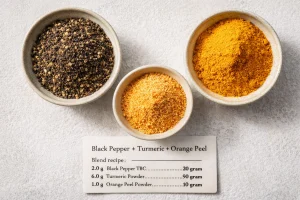
Add 2.0 g pepper plus 6.0 g turmeric to 300 g hot water (about 70 to 80 C).
Steep 12 minutes, stir twice, then fine-strain.
This yields a concentrate you can dose in grams per bottle with tight control.
For this concentrate style, our organic black pepper tbc is your anchor spice, and turmeric becomes the “body.” The steep time is short on purpose. You want aroma and warmth, not a harsh extraction.
Brewing technique: heat, time, and filtration
Pepper can go from cozy to sharp if you boil it hard. In beverage work, harshness usually comes from too much heat, too long contact, or too much fine particulate.
Useful targets:
Hot infusion: 70 to 85 C
Steep time: 8 to 15 minutes
Agitation: gentle stir, not aggressive whisking
Filtration: fine mesh for a rustic drink, coffee filter for a cleaner bottle
A small detail that helps consistency: pre-warm your steep vessel, then add your water. Stable temperature makes your extraction more predictable batch to batch.
To deepen the base note without adding sweetness, a small amount of dandelion root tea (roasty root character) can make pepper and turmeric taste more “complete,” especially in winter-style kombucha flavors.
Kombucha 2F: strict repeatable method for consistent bottles
 This is the part kombucha makers care about most: how to get the same result every time. black pepper tbc is strong enough that “eyeballing” quickly becomes “one bottle is perfect, one bottle is a pepper bomb.”
Use 16 oz / 473 ml bottles, and keep your base kombucha consistent (same 1F time, similar acidity, similar residual sweetness).
Option A: Tea concentrate dosing (recommended)
Make a pepper-turmeric concentrate
2.0 g pepper + 6.0 g turmeric in 300 g hot water (70 to 80 C)
Steep 12 minutes, fine-strain, cool to room temp
Dose per bottle (16 oz / 473 ml)
Choose your level:
Subtle: 10 g concentrate per bottle
Balanced: 15 g concentrate per bottle
Bold: 20 g concentrate per bottle
Top up and bottle
Add concentrate first, then fill with finished kombucha, leaving about 1 inch headspace.
Cap and invert gently one time to mix (do not shake).
Ferment 2F
18 to 24 hours at room temp, then refrigerate.
Always chill fully before opening.
Consistency tips:
Weigh the dose, do not pour by eye.
Write batch notes: concentrate grams, 2F time, room temp, and outcome.
If you want a brighter top note, add 0.2 to 0.4 g organic lemon myrtle to the concentrate steep, then strain. It reads clean and citrusy without adding fruit sugar.
Option B: Direct botanicals in bottle (optional)
This is for small experimental runs or when you want a rustic look. It can be tasty, but it is less consistent.
Per 16 oz / 473 ml bottle:
0.10 to 0.20 g pepper (about 1/16 to 1/8 tsp)
0.30 to 0.60 g turmeric (about 1/8 to 1/4 tsp)
Method:
Add botanicals to the empty bottle.
Fill with kombucha, cap, invert gently twice.
2F for 12 to 20 hours, then refrigerate and decant carefully.
If you use this method, treat sediment as a design choice, not a flaw. For a cleaner aromatic lift with less visible particulate, consider cardamom whole green as a companion note in a separate steep, then dose the cardamom tea into bottles.
Try a warm, golden 2F by pairing black pepper tbc with turmeric powder using Option A for repeatable results.
Layering ideas that taste “finished,” not random
Pepper works best when it has a job in the blend. Pick one direction and build around it.
Golden and bright:
Pepper + turmeric + orange peel
Add orange peel powder to the concentrate steep (0.5 to 1.0 g per 300 g water) for a clean citrus edge.
Tart and refreshing:
Pepper + hibiscus + a hint of citrus peel
Add hibiscus flowers as a separate tea, then blend a small amount into your bottle to keep color and tartness stable.
Rooty and roasty:
Pepper + turmeric + dandelion root
Add a small amount of dandelion root tea concentrate for depth, especially if you are avoiding added sugars.
Keep one principle in mind: pepper is a finishing spice. If the bottle already has strong fruit, use pepper lightly so it does not fight the fruit aroma.
Troubleshooting: flavor, bubbles, sediment, aroma loss
Flat flavor (tastes dull):
Increase the concentrate dose by 3 to 5 g per bottle, not more pepper directly.
Add a bright note like orange peel powder or a small amount of organic lemon myrtle in the concentrate.
Too tart (acid overwhelms spice):
Shorten 1F slightly next batch, or reduce 2F time.
Pepper reads harsher when acidity is high, so lower the pepper dose and add aroma through citrus peel instead.
If you are using black pepper tbc, keep it in the “balanced” range and let turmeric carry the body.
Over-carbonation:
Reduce 2F time by 4 to 6 hours.
Chill longer before opening.
If you added any sugar or fruit, remember pepper does not create bubbles, sugar does.
Sediment overload:
Use Option A concentrate dosing and fine-strain.
Avoid shaking the bottle during 2F.
For direct dosing, go lower on pepper and turmeric, and accept a rustic pour.
Aroma loss after a few days:
Pepper aromatics fade when exposed to air and humidity.
Tighten storage, use fresher spices, and consider smaller batch sizes for concentrates.
Storage + quality: keeping pepper aromatic and clean
 Pepper is an aromatic ingredient first. Treat it like one.
Best practices:
Airtight container, tightly closed immediately after scooping.
Store cool and dark, away from steam, kettles, and sunny windows.
Keep a dedicated dry scoop. Moisture is the enemy.
Quality cues you can trust:
Color: should look deep and lively, not grayish and tired.
Scent: should bloom when you open the jar. If you have to hunt for aroma, it is past its best.
Clumping: signals humidity exposure and faster aroma loss.
If you want your spice program to be consistent, buy in a size you can turn over. For makers, black pepper tbc earns its place because it is easy to dose, but it still needs good storage to stay expressive.
Safety and compliant use (no medical claims)
Black pepper and turmeric are widely used culinary spices, and herbalists traditionally include them in warming blends. In beverages, the goal is flavor, aroma, and a satisfying finish, not a health promise.
Practical safety notes:
Start low. Pepper intensity builds quickly, especially in acidic kombucha.
If someone is sensitive to spicy foods, keep pepper doses in the subtle range or offer a pepper-free variant.
Keep your process clean: sanitized bottles, fresh ingredients, and refrigerated storage after 2F.
Describe effects carefully: “traditionally used,” “herbalists often use,” and “may feel warming” are safer than medical or disease language.
FAQ
What does black pepper tbc mean in practical use?
It usually refers to a standardized pepper style intended for consistent dosing and predictable extraction in recipes.
Can I use pepper in kombucha without making it taste spicy?
Yes. Use a concentrate and dose lightly so the aroma reads warm and woody, not hot.
How much pepper should I put in a 16 oz bottle for 2F?
Start with 10 g of a pepper-turmeric concentrate per bottle, then adjust up to 15 g if you want more presence.
Why does pepper taste harsher in some batches?
High acidity, over-steeping at boiling temps, or too much fine particulate can push pepper into sharp territory.
Should I combine pepper with turmeric in the same steep?
It is a good approach for repeatability. Short steep times at 70 to 80 C keep the blend aromatic and smooth.
How do I reduce sediment when using turmeric?
Use a concentrate and fine-strain. Direct dosing creates more particulate and bottle-to-bottle variation.
What pairs well with pepper besides turmeric?
Citrus peel for brightness, hibiscus for tartness, lemon myrtle for a clean lift, and dandelion root for roasty depth.
How long will pepper stay fresh once opened?
Aroma is best in the first months after opening if kept airtight, dry, and away from heat and steam.
Black pepper tbc is most useful when you treat it like a measured aromatic tool, not a freehand spice. Use moderate heat, short steep times, and a concentrate-first approach for kombucha 2F so every bottle tastes like the one before it. Pair it with our organic turmeric powder for golden depth, brighten with our organic orange peel powder, or add structure with dandelion root tea. Keep your spice dry and airtight, track your grams, and you will get a warm, finished flavor that feels intentional in both tea and kombucha.