Bladderwrack Benefits for Thyroid: What Traditional Herbalists Say
Bladderwrack thyroid benefits have been a cornerstone of traditional herbalism for well over a century, long before the modern understanding of iodine deficiency and thyroid physiology. This brown seaweed known as Fucus vesiculosus was the plant that first led 19th-century researchers to connect dietary iodine with goiter, the visible swelling of the thyroid gland that once affected large populations in iodine-poor inland regions. Herbalists across Europe and North America have reached for bladderwrack when clients described sluggishness, cold sensitivity, and the kinds of fatigue that traditional practitioners associated with an underactive constitution. Today, interest in this seaweed has surged alongside growing curiosity about natural thyroid support.
What Is Bladderwrack?
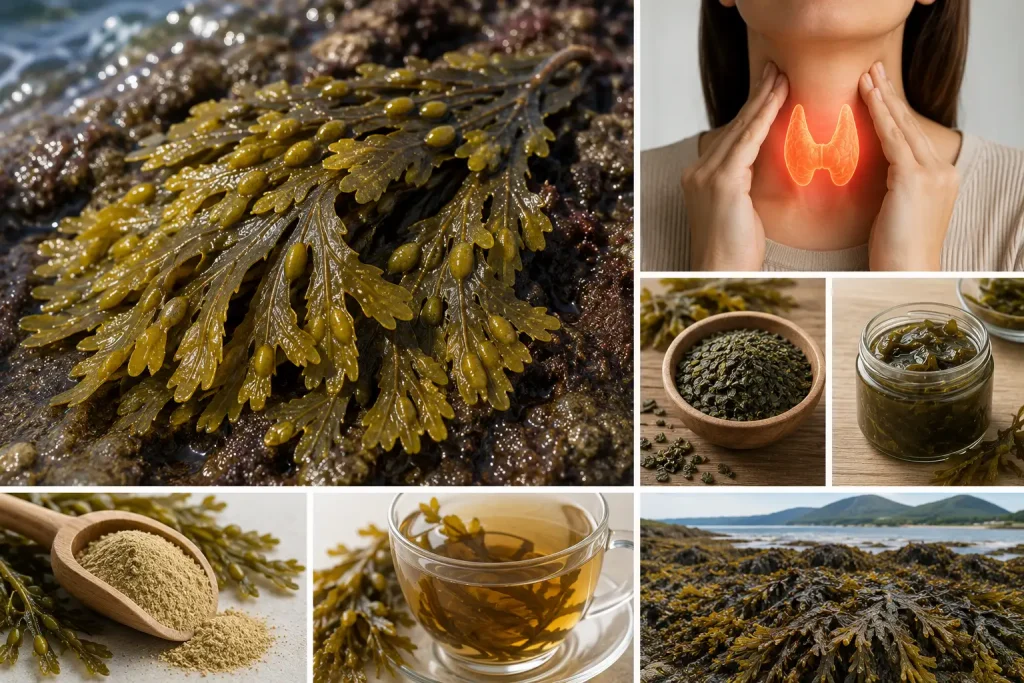
Fucus vesiculosus is a brown algae that grows along the rocky Atlantic and Pacific coastlines of Europe and North America. Its most recognizable feature is the paired air bladders embedded in its olive-green to dark brown fronds, which keep the plant buoyant in tidal waters. These bladders give the plant its common name.
Bladderwrack has been harvested for food, fertilizer, and medicine across coastal communities for centuries. In traditional European herbal medicine, it was classified as a warming, mineral-rich plant with an affinity for the thyroid. It was prescribed in tincture, decoction, and dried powder form by eclectic and physiomedical practitioners throughout the 1800s.
The Iodine Connection: Why Bladderwrack and the Thyroid Are Linked
The thyroid gland requires iodine to produce its primary hormones (thyroxine T4 and triiodothyronine T3) which regulate metabolism, body temperature, heart rate, and energy production. Without adequate iodine, the thyroid cannot manufacture enough hormone, and the gland may enlarge in an attempt to capture more iodine from the bloodstream.
Bladderwrack is one of the most iodine-concentrated foods available from nature. The iodine content in Fucus vesiculosus varies by harvest location and season, but it is consistently high enough to have been used historically as a treatment for goiter. This is the biochemical foundation beneath the traditional link between bladderwrack thyroid benefits and herbal practice.
What Traditional Herbalists Observed
Nineteenth-century eclectic physicians documented bladderwrack as a specific remedy for enlarged thyroid and for constitutional presentations they described as “sluggish metabolism.” Their clinical observations noted improvements in weight management, energy levels, and cold tolerance in clients who used bladderwrack preparations consistently over several weeks.
British herbalists of the same era categorized bladderwrack as a “metabolic stimulant”. They also noted its traditional use in coastal communities where goiter was rare compared to inland populations. These observations eventually contributed to early medical research on dietary iodine, though the plant itself fell somewhat out of fashion in mainstream medicine after iodized salt became the standard intervention.
In contemporary Western herbalism, practitioners continue to reach for bladderwrack as part of protocols addressing sluggish thyroid function, particularly in combination with other sea vegetables. The traditional use for supporting glandular health has carried forward relatively unchanged.
Fucoidan: The Other Active Compound
While iodine gets most of the attention, traditional herbalists working with bladderwrack thyroid benefits were also delivering fucoidan, a complex sulfated polysaccharide unique to brown algae. Fucoidan has attracted significant research interest in recent decades for its potential immune-modulating and anti-inflammatory properties.
Bladderwrack also contains alginic acid, phlorotannins, and a range of trace minerals including iron, calcium, magnesium, and potassium. Traditional herbalists considered the “whole plant” effect superior to isolated extracts, a view that aligns with modern holistic herbalism.
Traditional Preparations of Bladderwrack
Historically, bladderwrack was prepared in several ways depending on the tradition and the practitioner’s preference:
Decoction: Dried, cut bladderwrack was simmered in water for 15 to 20 minutes to create a mineral-rich broth. This was the most common preparation in 19th-century herbal practice and was taken as a daily tonic.
Tincture: Alcohol-extracted preparations were used in eclectic medicine for more targeted dosing. The tincture form allowed practitioners to combine bladderwrack with other herbs more precisely.
Powder in food: Coastal communities often incorporated dried, powdered bladderwrack into bread, soups, and porridge as a mineral supplement. That was long before it was considered medicine at all.
Modern use: Today, most people use bladderwrack as a cut-and-sifted dried herb in teas, or grind it into powder for smoothies and capsules. Hatton Naturals carries Organic Bladderwrack (cut and sifted), which is well suited to all of these traditional preparation methods.
Bladderwrack in Combination: Classic Herbal Pairings
Traditional herbalists rarely used bladderwrack in isolation. The most well-known pairing in thyroid-supportive herbalism is bladderwrack with Irish moss (Chondrus crispus). This combination was popularized in Caribbean herbal traditions and later adopted broadly in Western wellness circles. Irish moss contributes a rich mineral matrix, soothing mucilaginous compounds, and additional nutritional density that complements bladderwrack’s iodine content and fucoidan.
Kelp (Ascophyllum nodosum or Laminaria species) is another classic pairing, adding different brown algae compounds and additional iodine from a distinct species. Herbalists who work with thyroid support often rotate or blend these seaweeds to provide a broader spectrum of marine nutrients.
Hatton Naturals offers both Organic Kelp and Organic Irish Moss alongside bladderwrack, making it straightforward to assemble a classic herbal seaweed blend at home.
What Modern Herbalists Say About Bladderwrack Thyroid Benefits
Contemporary clinical herbalists who work within traditional frameworks continue to use bladderwrack as a primary herb for thyroid-related presentations. Their language is careful. They describe it as traditionally used to support thyroid function rather than as a treatment for diagnosed thyroid disease. This distinction matters both ethically and legally.
Most experienced herbalists emphasize that bladderwrack thyroid benefits are best understood in the context of iodine sufficiency. The herb may support healthy thyroid function in people whose intake of this mineral is insufficient. But it is not a corrective for structural thyroid disease, autoimmune thyroid conditions, or cases where thyroid hormone replacement is medically indicated.
Many also note that bladderwrack is best used as part of a broader dietary and lifestyle protocol. Adequate selenium (needed to convert T4 to active T3), stress management, and blood sugar stability are all considered important supporting factors in traditional whole-body approaches to thyroid health.
Bladderwrack Thyroid Benefits: A Summary of Traditional Claims
Drawing from historical herbal literature and contemporary traditional practice, bladderwrack has been traditionally used for:
Supporting healthy thyroid function in contexts of iodine insufficiency. Providing a natural, food-based source of iodine and trace minerals. Traditionally used for sluggish metabolism and low energy associated with poor thyroid function. Supporting weight management as part of a broader herbal protocol. Providing fucoidan and other marine polysaccharides with potential immune-modulating properties. Traditionally used for skin and connective tissue health as a mineral-dense food source.
None of these traditional uses constitute medical claims, and bladderwrack should never be used to self-treat a diagnosed thyroid condition without professional guidance.
Safety and Precautions
Because bladderwrack is naturally high in iodine, it is not appropriate for everyone. People with hyperthyroidism, Hashimoto’s thyroiditis, Graves’ disease, or other autoimmune thyroid conditions should avoid or use bladderwrack only under medical supervision, as excess iodine can worsen these conditions. Those already on thyroid hormone replacement medications (such as levothyroxine) should consult their prescribing physician before adding any iodine-rich supplement. Bladderwrack can also interact with anticoagulant medications due to its fucoidan content. Pregnant and breastfeeding individuals should seek professional guidance before use. Iodine needs during pregnancy are higher, but supplementation beyond recommended levels carries risks. Always source bladderwrack from certified organic suppliers who test for heavy metals, as seaweeds readily absorb environmental contaminants from their growing waters.
Frequently Asked Questions
What are the main bladderwrack thyroid benefits?
Traditional herbalists primarily valued bladderwrack for its iodine content and its historical use in supporting healthy thyroid function. Particularly in populations where dietary iodine was insufficient. They also recognized it as a general mineral tonic with an affinity for the glandular and metabolic systems.
Is bladderwrack safe for people with thyroid disease?
Not necessarily for all thyroid conditions. While bladderwrack may support thyroid function in iodine-insufficient individuals, it generally contraindications in hyperthyroidism, Graves’ disease, and Hashimoto’s thyroiditis without medical supervision. Always consult a healthcare provider if you have a diagnosed thyroid condition.
How do herbalists typically prepare bladderwrack for thyroid support?
The most common traditional preparations are decoctions (simmered tea), tinctures, and powdered herb added to food. A simple decoction involves simmering one teaspoon of cut-and-sifted bladderwrack in two cups of water for 15 to 20 minutes, then straining and drinking once or twice daily.
How long does it take to notice results from bladderwrack?
Traditional herbalists typically advised consistent use over four to six weeks before evaluating results. Iodine-related changes in thyroid function are gradual, and short-term use is unlikely to produce noticeable effects. Individual results vary significantly based on baseline iodine status and overall health.
Can I take bladderwrack with kelp or Irish moss?
Yes. Combining bladderwrack with Irish moss and kelp is a traditional practice in seaweed-based wellness. However, combining multiple iodine-rich seaweeds increases total iodine intake. So be mindful of cumulative amounts, especially if you are sensitive to iodine.
Does the source of bladderwrack matter?
Significantly. Bladderwrack harvested from clean, unpolluted coastal waters and certified organic will have a better safety and nutritional profile than conventionally sourced product. Heavy metal content is the primary concern with seaweeds from polluted waters.
Is bladderwrack the same as kelp?
No. Bladderwrack and kelp are different brown algae species with overlapping but distinct phytochemical profiles. Both contain iodine and fucoidan, but in different concentrations and combinations.
Conclusion
The traditional herbal case for bladderwrack thyroid benefits rests on centuries of observed use, a well-understood iodine-thyroid connection, and a rich profile of marine bioactive compounds. Whether you are exploring seaweed for the first time or deepening an existing herbal practice, bladderwrack remains one of the most historically documented and nutritionally compelling sea vegetables available for thyroid and metabolic support.