Plantain Herb Uses in Tea and Traditional Herbal Practice
When people search for plantain herb uses, they are usually looking for something simple, grounded, and practical. Plantain is not a flashy herb. It does not arrive with a loud aroma or dramatic color. Instead, it offers a calm, green, familiar presence that herbalists have appreciated for generations. In dried form, especially as cut and sifted leaf, it has a soft earthy scent, a mild grassy taste, and a blending character that makes it easy to work with in daily herbal tea practice. For tea makers, this matters. Some herbs dominate a formula. Plantain tends to cooperate with it.
Traditionally, plantain has been used in simple home herbalism as a steady, versatile leaf that pairs well with other gentle botanicals. It is often prepared as a tea, blended into broader leaf formulas, or combined with roots and flowers to create a more rounded cup. For small-batch herbal businesses and home tea makers alike, plantain offers another advantage: it is approachable. Its flavor profile is mild enough for repeat use, and its appearance fits naturally into classic loose-leaf blends. That is one reason plantain herb uses continue to interest herbalists who value everyday herbs over fashionable ones. In this guide, we will look at traditional preparation methods, blending ideas, production-minded ratios, quality cues, safety notes, and ways to make plantain more enjoyable in the cup.
Why Herbalists Keep Returning to Plantain Herb Uses
Among traditional Western herbs, plantain has long held a place as an herb of simplicity and steadiness. Many plantain herb uses come from that exact character. It is a leaf that herbalists often reach for when they want an herb that feels gentle, broadly compatible, and easy to include in formulas without overpowering the whole blend. Its dried aroma is subtle, its infusion is mild, and its flavor leans green, soft, and slightly mineral.
This is one reason plantain works so well in modern loose-leaf tea. It gives body without becoming heavy. It helps create a more grounded cup when paired with lighter flowers or sweeter roots. For people who enjoy daily herbal tea rituals, that balance is useful. A tea does not always need to be intense to be satisfying.
In traditional herbal preparation, plantain leaf is often brewed on its own or combined with demulcent, aromatic, or mineral-rich herbs. The herb also suits practical tea makers because it behaves predictably in dry blends. It cuts cleanly into formulas, stores well when kept dry, and contributes visual texture without looking messy in a pouch or jar.
For a soft and balanced starting point, try combining plantain leaf cut and sifted with marshmallow root cut and sifted for a rounder, gentler cup.
Traditional Everyday Tea Preparations
Many classic plantain herb uses begin with the simplest preparation of all: an infusion. This is not an herb that needs theatrical handling. A good plantain tea can be made with patience, fresh water, and a little attention to leaf-to-water ratio. Because the flavor is mild, it benefits from adequate herb quantity and sufficient steep time.
For a single mug, use 3 grams of dried plantain leaf, which is about 2 teaspoons loosely measured, in 250 ml of hot water. A practical water temperature is 95°C to 98°C (203°F to 208°F). Cover and steep for 10 to 15 minutes. Covering matters because even mild aromatic notes can fade if the cup sits open.
For a stronger teapot infusion, use 12 grams of dried plantain leaf, about 8 teaspoons, in 1 liter of hot water. Steep covered for 15 minutes, then strain. This method produces a more rounded, fuller liquor that works better if you plan to drink it warm throughout the day.
If you want a gentler and more comforting profile, combine:
- 6 grams plantain leaf (about 4 teaspoons)
- 4 grams marshmallow root (about 2 teaspoons)
- 2 grams calendula flowers (about 2 teaspoons)
Infuse in 500 ml water for 15 minutes. The result is softer, slightly fuller in mouthfeel, and more aromatic than plantain alone.
Try marshmallow root cut and sifted when you want a smoother, more mellow body in a plantain-based infusion.
Flavor Profile and What Plantain Contributes to a Blend
To understand plantain herb uses in tea making, it helps to know what the herb actually does in the cup. Plantain is not strongly sweet, floral, tart, or spicy. Its role is quieter. It brings a leafy, grounded tone that can make a blend feel more complete. Think of it as structure rather than spotlight.
On its own, plantain can taste grassy, soft, and faintly earthy. Some lots may lean a little more hay-like, while others have a fresher green profile depending on harvest, cut, and storage quality. This subtlety means it often performs best in formulas where it supports a central flavor idea.
For example, if a blend feels too sharp or too aromatic, plantain can help widen the middle of the flavor. If a root-heavy tea tastes too dense, plantain can lighten the perception without making the tea weak. This is one of the most useful plantain herb uses for tea crafters: it helps build a cup that feels coherent.
Plantain pairs especially well with softer botanicals and roots that add body or sweetness. It also works with select flowers when you want aroma without excessive perfume.
Try adding calendula flowers for a gentle floral lift that keeps the blend bright but not overpowering.
Plantain Herb Uses in Herbal Tea Blending
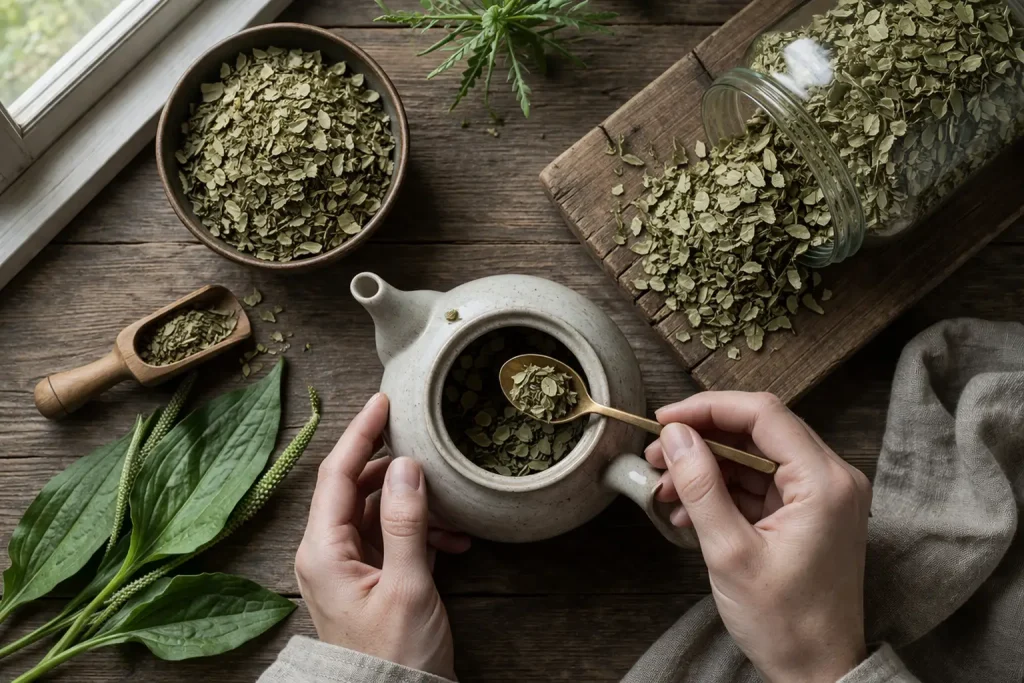 One of the most practical plantain herb uses is as a blend builder. Because the leaf is mild, it allows you to create formulas that feel layered without becoming chaotic. It can act as a base herb, a supporting herb, or even a balancing herb depending on what else is in the formula.
A balanced everyday loose-leaf blend might look like this:
Gentle Green Herbal Blend
- 40 grams plantain leaf
- 25 grams marshmallow root
- 15 grams nettle leaf
- 10 grams calendula flowers
- 10 grams linden leaf and flower
This gives you 100 grams total. By teaspoon approximation, that is roughly:
- 20 teaspoons plantain leaf
- 12 teaspoons marshmallow root
- 10 teaspoons nettle leaf
- 10 teaspoons calendula flowers
- 8 teaspoons linden leaf and flower
Use 1 tablespoon per 10 to 12 oz cup and steep covered for 12 to 15 minutes.
For a more aromatic evening-style blend, try:
- 45 grams plantain leaf
- 20 grams oatstraw
- 15 grams lemon balm
- 10 grams chamomile
- 10 grams marshmallow root
The plantain keeps the blend from becoming too sweet or too perfumed. The result is greener, steadier, and more grounded.
Try nettle leaf cut and sifted for a deeper green backbone in a daily herbal tea formula. Try linden leaf and flower when you want a softer, rounder aromatic finish.
Working Plantain Into Production-Style Small Batches
For tea makers, discussing plantain herb uses without touching workflow would miss part of the value. Plantain is a practical herb for small-scale production because it is visually attractive in blends, relatively easy to portion, and forgiving in loose formulas. It also combines well with leaves, flowers, and roots without looking disjointed in packaging.
A good starting point for a retail-ready small batch is 500 grams total blend weight. If plantain is your base, keep it between 30% and 50% depending on the flavor direction. Around 40% is often a strong working middle.
Example 500-gram batch:
- 200 g plantain leaf
- 100 g marshmallow root
- 80 g nettle leaf
- 60 g calendula flowers
- 60 g chamomile flowers
Toss gently in a wide stainless bowl or food-safe tub to reduce breakage. Add larger, lighter botanicals first and denser roots last, then fold repeatedly rather than crushing downward. Package promptly into airtight pouches or jars.
If your blend is tea-forward rather than aroma-forward, plantain helps maintain visual integrity. It fills space naturally and makes the formula look abundant without requiring overly costly floral percentages.
Try chamomile flowers in a plantain blend when you want a softer apple-like top note and a more familiar cup.
Troubleshooting Plantain-Based Tea Blends
Even mild herbs can produce disappointing tea if the formula or process is off. Here are common problems and practical ways to correct them.
Flat flavor
Plantain is subtle. If the cup tastes dull, the issue is often under-dosing rather than poor herb quality. Increase total herb weight by 15% to 20%, or steep longer with the vessel covered. You can also add a brighter companion herb such as calendula or lemon balm.
Too tart
This problem usually comes from the companion herbs, not plantain itself. If your formula includes sour botanicals from another experiment, reduce them sharply and let plantain remain the body-builder rather than forcing contrast.
Over-carbonation
If you are adapting the blend into a fermented herbal beverage or secondary infusion project, remember that plantain itself is not the culprit. Over-carbonation usually comes from sugar balance, tight bottling, or fermentation length. Reduce fermentable sugar and test in smaller bottles first.
Sediment
Plantain leaf can create fine particles, especially in smaller cuts. Use a finer mesh strainer, or let the tea settle briefly before pouring. In packaged blends, avoid overly aggressive mixing that creates excess dust.
Aroma loss
Because plantain is mild, any companion aromatics that fade will leave the whole blend feeling weak. Store away from heat and humidity, and keep floral components especially well sealed.
Try lemon balm leaf if your formula needs a fresher aromatic top note without becoming sharp or heavily perfumed.
Storage + Quality
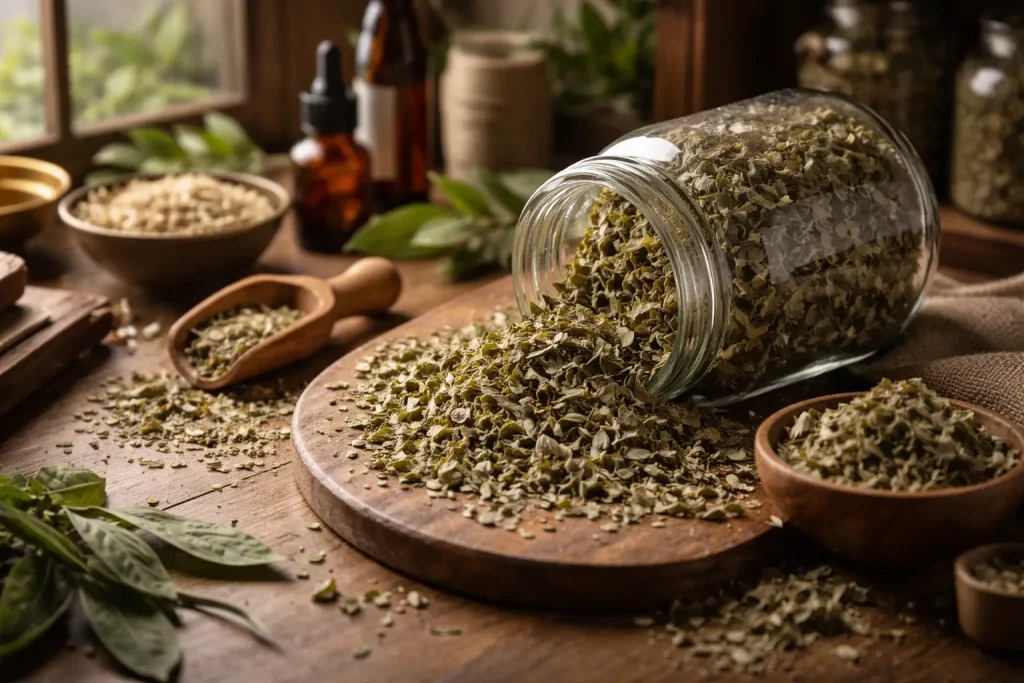
A large part of successful plantain herb uses comes down to quality management. Since plantain is visually modest and aromatically restrained, poor storage can flatten it quickly. Good plantain should retain a natural green-to-olive tone and a clean, leafy scent. It should not smell stale, dusty, or vaguely cardboard-like.
Store dried plantain in airtight containers away from direct light, humidity, and temperature swings. For home use, a tightly sealed glass jar in a cool cupboard works well. For production use, lined pouches or food-safe bins with tight lids are better for preserving bulk material.
Humidity is the main enemy. Once leaf herbs absorb moisture from the air, their scent fades and their texture softens in an unhelpful way. Instead of feeling crisp and dry, they start to feel limp or tired. This can affect blending, shelf life, and customer perception.
Color matters too. A muted olive tone can still be normal, but if the material has drifted heavily toward brown and lost all fresh herbal scent, it is likely past its best. In blends, this is especially noticeable because plantain depends on clean freshness more than dramatic aromatic oils.
Try oatstraw cut and sifted when you want to build gentle, leafy blends that store well alongside plantain.
Safety
Any discussion of plantain herb uses should stay grounded and responsible. Plantain has a long history in traditional herbal practice, but that does not mean every use is right for every person. Herbalists often describe it as a familiar and approachable herb, yet individual preferences and circumstances always matter.
This article is about traditional use, tea craft, and general herbal preparation. It is not medical advice, and it does not make disease claims. If you are selling teas or writing about herbs for customers, compliant language matters. Use phrases such as “traditionally used,” “often included in herbal tea,” or “valued by herbalists for its gentle character.” Avoid promising outcomes or presenting herbs as treatments.
For tea makers, another practical safety point is batch consistency. Keep your sourcing, storage, and labeling clean and accurate. Record blend ratios, lot numbers, and packaging dates where possible. A responsible herbal business is not just about beautiful blends. It is about repeatable quality and careful wording.
Try mullein leaf cut and sifted in small percentages when you want to explore other soft, leafy companions in traditional-style blends.
Making Plantain More Interesting Without Losing Its Character
Some people appreciate plantain immediately. Others find it too quiet on its own. That does not mean it should be dismissed. Many plantain herb uses become more enjoyable when the herb is treated as a foundation rather than the whole story.
To make the cup more aromatic, pair plantain with chamomile, linden, or lemon balm. To make it feel fuller, use marshmallow root or oatstraw. You can also make it visually prettier in loose leaf, by adding calendula flowers. And to make it feel greener and more robust, blend it with nettle.
The best formulas respect plantain’s personality. It is not there to shout over the rest of the blend. It is there to hold the blend together. For traditional herbal tea makers, that restraint is part of the appeal. In a market full of loud flavor systems, plantain offers something quieter and more enduring.
This is why plantain herb uses remain relevant. The herb fits home herbalism, tea blending, and small-batch production with equal ease. It is gentle without being empty, simple without being boring, and flexible without losing its identity. For anyone building a thoughtful herbal tea shelf, plantain deserves a place.
FAQ
What are the most common plantain herb uses?
The most common plantain herb uses include simple tea infusions, loose-leaf herbal blends, and traditional everyday herbal preparations with other leaves, flowers, and roots.
How do you make plantain tea?
Use about 3 grams, or 2 teaspoons, of dried plantain leaf per 250 ml cup of hot water. Cover and steep for 10 to 15 minutes, then strain.
What does plantain leaf taste like in tea?
It tastes mild, leafy, soft, and slightly earthy. On its own it is subtle, which is why it blends well with more aromatic herbs.
What herbs pair well with plantain?
Marshmallow root, calendula, nettle, chamomile, lemon balm, linden, and oatstraw all pair well with plantain in traditional herbal tea blends.
Can plantain be used as a base herb in loose-leaf blends?
Yes. Because it is mild and balanced, plantain works well as a base or supporting herb in many loose-leaf formulas.
How should dried plantain leaf be stored?
Keep it in an airtight container away from light, humidity, and heat. Good storage helps preserve both color and subtle aroma.
Why does my plantain tea taste weak?
Plantain is naturally gentle. Increase the herb amount, extend steep time, and cover the vessel while infusing to preserve flavor.
Is plantain herb strong or bitter?
Usually neither. It is generally mild and easygoing, especially compared with more aromatic, bitter, or tart herbs.