Private Label Herbal Tea: How to Start With Bulk Ingredients
Private label herbal tea is one of the most accessible product categories for new food and beverage brands. The startup costs are relatively low, the supply chain is straightforward, and consumer demand for premium botanical teas has grown steadily for more than a decade. What separates a brand that thrives from one that stalls is usually not the idea, it is the execution: sourcing the right ingredients, understanding compliance obligations, designing a production workflow, and choosing packaging that protects quality while communicating value. This post is a practical walkthrough of each of those steps for founders, product developers, and retailers who want to launch a private label herbal tea line using bulk botanicals.
Why Herbal Tea Is a Strong Private Label Category
Herbal tea sits at the intersection of three durable consumer trends: interest in functional botanicals, preference for organic and clean-label products, and growing demand for caffeine-free beverage options. Unlike many food categories, private label herbal tea does not require specialized equipment or a commercial kitchen to get started. Dry blending of whole or cut botanicals can often be done at small scale with basic tools, and minimum order quantities from wholesale suppliers are typically accessible even for early-stage brands.
Margins in the private label herbal tea category are attractive. Bulk organic botanicals purchased wholesale can be packaged and sold at retail multiples of five to ten times the ingredient cost, depending on branding and channel.
Building Your Ingredient Foundation
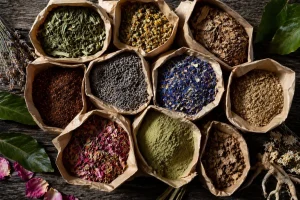
The first practical step in launching a private label herbal tea line is identifying your core botanicals and establishing a reliable wholesale source. Working with a supplier that offers certified organic, cut-and-sifted botanicals in bulk gives you control over quality, cost, and formulation flexibility. Hatton Naturals supplies a range of botanicals suited to private label tea production:
- Chamomile Flowers Whole: One of the most widely consumed herbal teas globally.
- Peppermint Leaf Whole: A high-volume SKU in any herbal tea line.
- Hibiscus (Cut and Sifted): Produces a vivid ruby-red infusion with a tart, cranberry-like flavor.
- Organic Lavender Super: Adds floral elegance to blends.
- Red Rooibos: A caffeine-free base from South Africa with naturally sweet character.
- Cornflower Blue Petals: A visual ingredient that adds premium positioning to blends.
Browse the full range at the Hatton Naturals shop.
Designing Your Blend Lineup
Most successful private label herbal tea launches start with three to five SKUs rather than a large collection. A focused lineup is easier to produce, manage from an inventory standpoint, and communicate to retail buyers. Consider building your initial assortment around distinct flavor profiles: a calming blend (chamomile + lavender), a digestive blend (peppermint + fennel), a vibrant fruity blend (hibiscus + rosehip), and a rooibos base for caffeine-free consumers.
Work in small batches (50-100 grams per trial) before committing to larger quantities. Brew each trial multiple times, evaluate color, aroma, flavor, and appearance. Document every ratio so you can reproduce winning formulas consistently.
What Buyers Should Know
If your distribution includes wholesale accounts, buyers typically require product liability insurance ($1-2 million minimum), ingredient documentation including organic certifications, Nutrition Facts panels, UPC barcodes, and lot-number traceability. For direct-to-consumer online sales, you still need accurate ingredient labeling, allergen disclosure, and net weight statements. The FDA regulates herbal teas as conventional food products under food labeling rules.
Work with a food business attorney or regulatory consultant early in your product development process. Getting label compliance right before launch is far less expensive than reformulating after printing packaging.
Sourcing and Quality Indicators
Quality indicators that should be part of your supplier evaluation: organic certification (USDA or equivalent), country of origin documentation, heavy metal and pesticide testing via third-party COAs, moisture content and microbial counts, and visual/sensory evaluation of every shipment. Ask for Certificates of Analysis for each lot you purchase. If a supplier cannot provide COAs, treat that as a red flag.
To start a sourcing conversation, contact the Hatton Naturals team directly.
Production Workflow for Small-Batch Private Label
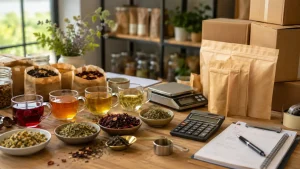
A basic private label herbal tea production workflow: incoming inspection (document every lot), weighing and staging (use calibrated scales), blending (combine in clean, food-grade containers), packaging (fill and seal immediately), and quality check (pull samples for sensory evaluation and record retention).
Packaging Options
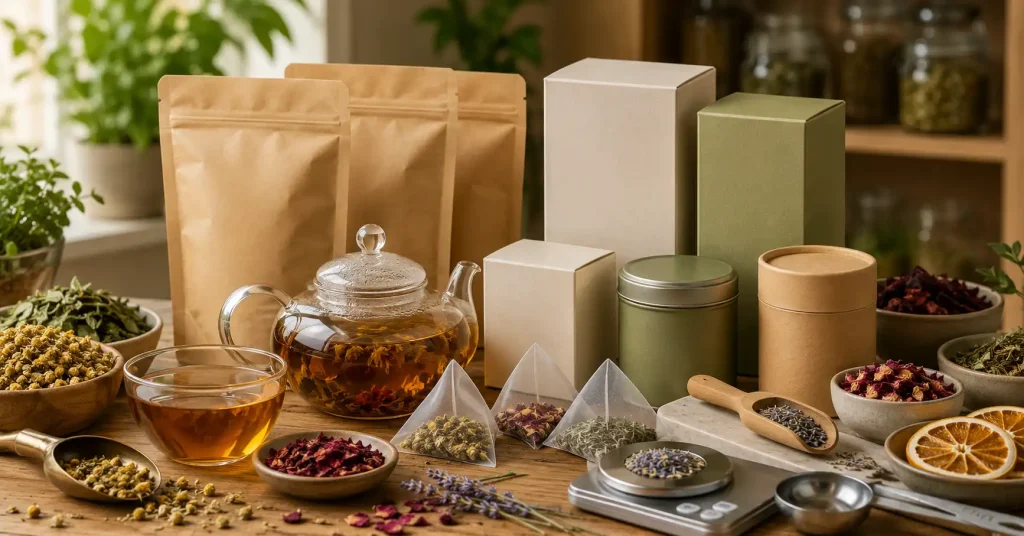
Main formats: kraft stand-up pouches (most cost-effective), tins (premium shelf presence), glass jars (good for retail display), and individual tea sachets (expand distribution but add per-unit cost). For a first launch, kraft pouches for DTC and tins for wholesale is practical. As volume grows, sachet production becomes more viable.
Safety
Herbal teas are generally considered safe for consumption by healthy adults. Certain botanicals have contraindications: chamomile may cause reactions in people with Asteraceae allergies, peppermint may not suit young children, hibiscus may interact with blood pressure medications, lavender may interact with sedatives. Never make disease claims on a food-labeled product. Work with a regulatory professional for label compliance. None of the content in this post constitutes medical advice.
Frequently Asked Questions
How much does it cost to start a private label herbal tea brand?
A realistic minimum budget including ingredients, packaging, label design, and compliance review is typically $3,000 to $8,000, depending on whether you self-produce or use a contract manufacturer.
Do I need to register with the FDA?
Food facilities that manufacture, process, pack, or hold food for US consumption must register with the FDA under the Bioterrorism Act. Registration is free and done online.
What is the difference between private label and white label?
White label is a pre-formulated product multiple brands can sell under their own name. Private label herbal tea involves developing your own formula specific to your brand.
Can I make health claims on packaging?
Products sold as conventional food may not make structure-function claims without following FDA supplement labeling rules. Stick to sensory descriptors and general wellness language.
What certifications add the most value?
USDA Organic delivers the broadest market access. Kosher, Non-GMO Project Verified, and Fair Trade add value in specific channels.
How should I price for wholesale?
Standard keystone: wholesale price is 50% of suggested retail. Keep production cost at 30-35% of retail price to maintain viable margins.
What is the shelf life of a botanical blend?
Properly dried and stored whole or cut botanicals typically have 12-24 months shelf life. Packaging with good moisture and oxygen barrier supports the longer end.
How do I find a contract packager?
Search for contract packagers specializing in tea and botanical products. Trade shows like Natural Products Expo East and West are good sourcing venues.
Launching a successful private label herbal tea brand comes down to disciplined sourcing, sound formulation, and attention to compliance from the start. Explore Hatton Naturals’ wholesale botanical range and reach out to discuss sourcing for your private label herbal tea project.