Irish Sea Moss vs Sea Moss: Understanding the Difference
Irish sea moss vs sea moss — people often use the terms interchangeably. However, they actually refer to different species of marine algae. Understanding the distinction matters, especially when you shop for a specific type. In this guide, we break down the differences in species, origin, texture, appearance, and common applications. This helps you make an informed choice.
What Is Irish Sea Moss?
Irish sea moss, scientifically known as Chondrus crispus, grows naturally along the rocky Atlantic coastlines of Ireland, the United Kingdom, and parts of North America. Coastal communities have harvested it along these cold-water shores for generations. It holds a long history in Irish and Caribbean cuisine as a natural thickener.
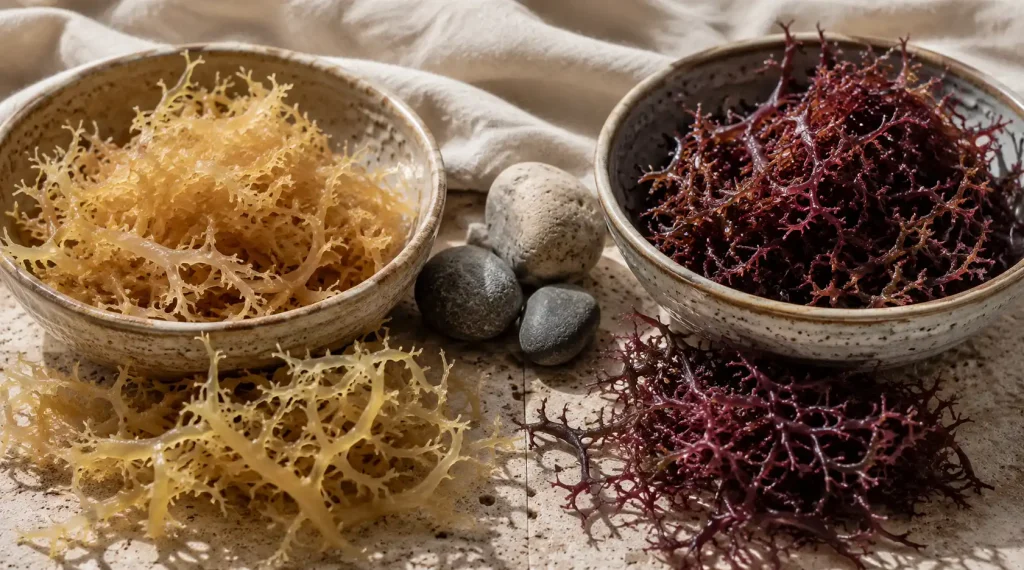
In appearance, Chondrus crispus looks small and fan-shaped. It grows in dense clusters on rocks in tidal pools. Its color ranges from dark purple to reddish-brown when fresh. It typically lightens to a golden or off-white shade when dried. The texture feels firm and cartilaginous. It holds its shape well even after soaking.
You can find authentic organic Irish moss (Chondrus chamissoi) at Hatton Naturals. This closely related species comes from clean Pacific waters.
What Do Retailers Commonly Sell as “Sea Moss”?
Most retailers and online sellers use the term “sea moss” to describe species from the genus Gracilaria or Eucheuma. These tropical seaweeds grow abundantly in warmer waters throughout the Caribbean, Southeast Asia, and parts of Africa.
Gracilaria sea moss looks distinctly different from Chondrus crispus. It tends to have long, thin, finger-like branches. It comes in a range of colors, from golden yellow to deep purple. After soaking, the texture turns soft and gelatinous. This makes it easy to blend into gels.
Sellers frequently market Eucheuma cottonii as sea moss too. Tropical farmers cultivate it widely. It has a thicker, more rubbery texture compared to Gracilaria. Growers commercially cultivate both of these species on a large scale. True Irish sea moss (Chondrus crispus), by contrast, mostly comes from wild harvesting in limited quantities.
Irish Sea Moss vs Sea Moss: Key Differences
To clarify the comparison between these types of marine algae, here is a side-by-side breakdown of the most important differences:
- Species: Irish sea moss refers to Chondrus crispus (cold-water). Generic sea moss usually means Gracilaria or Eucheuma (warm-water).
- Origin: Irish moss comes from the North Atlantic (Ireland, Canada, New England). Tropical sea moss comes from Jamaica, St. Lucia, the Philippines, and other equatorial regions.
- Appearance: Chondrus crispus looks flat and fan-shaped. Gracilaria has long, stringy branches. Eucheuma appears thicker and more bulbous.
- Texture when soaked: Irish moss stays firm and retains structure. Gracilaria becomes very soft and blends easily. Eucheuma feels chewy and dense.
- Color: Irish moss ranges from dark purple to golden. Gracilaria often appears golden or light tan. Eucheuma varies from green to brownish.
- Harvesting: Harvesters mostly wild-collect Irish moss. Farmers raise Gracilaria and Eucheuma in ocean pools or rope systems.
Common Uses for Each Type
Both Irish sea moss and tropical sea moss serve a wide range of culinary and non-culinary applications. However, their different textures and gel-forming properties make each one better suited to certain tasks.
Chondrus crispus produces carrageenan, a natural polysaccharide. The food industry uses it widely as a thickener and stabilizer. It works well in puddings, soups, and traditional Irish moss drinks. Its firmer texture also makes it popular in skincare formulations like face masks and body creams.
Gracilaria sea moss serves as the go-to choice for making sea moss gel. This thick, blendable paste goes into smoothies, juices, and desserts. Its soft texture after soaking makes processing in a standard blender easy. Manufacturers commonly use Eucheuma in commercial agar production. Asian cooks also feature it as a salad ingredient.
Wild-Harvested vs. Pool-Grown Sea Moss
Another important factor involves how producers source these products. Wild-harvested sea moss grows naturally on ocean rocks. Collectors gather it by hand during specific seasons. This method limits supply. However, it tends to produce algae with a more complex mineral profile. The diverse ocean environment contributes to this.
Pool-grown or rope-farmed sea moss grows in controlled conditions. This approach makes it more affordable and widely available. However, the growing environment offers less variety. Some buyers prefer wild-harvested varieties for their perceived quality and authenticity.
When shopping, look for sellers who clearly state the species name and harvesting method. Transparency in sourcing signals a trustworthy product. Pairing sea moss with other seaweeds like organic bladderwrack appeals to those who enjoy marine botanicals.
Buying Tips
Here are a few practical guidelines for purchasing either type:
- Check the species name on the label. Reputable sellers list the scientific name (Chondrus crispus, Gracilaria, or Eucheuma).
- Look at the color. Extremely white or uniform-colored sea moss may contain bleach or chemical treatments. Natural sea moss varies in shade.
- Smell it. Authentic dried sea moss carries a mild, oceanic scent. A strong chemical smell raises a red flag.
- Buy from trusted sources. Organic certification and clear origin information signal quality.
Frequently Asked Questions About Sea Moss
Is Irish sea moss the same as regular sea moss?
No. Irish sea moss (Chondrus crispus) is a cold-water species from the North Atlantic. Most “sea moss” sold online comes from tropical Gracilaria or Eucheuma species. They differ in appearance, texture, and origin.
How can you tell if sea moss is real or fake?
Check the species name on the label. Real sea moss varies in color and has a mild oceanic scent. Extremely white or uniform-colored sea moss may have been bleached. A strong chemical smell is a red flag.
What is the best sea moss for making gel?
Gracilaria sea moss blends easily into a smooth gel because of its soft texture after soaking. Irish moss (Chondrus crispus) stays firmer and produces a thicker, more structured gel.
Shop Now
Browse organic Irish moss at Hatton Naturals. We source it responsibly and offer it in bulk. It makes a versatile addition to your pantry and DIY projects.