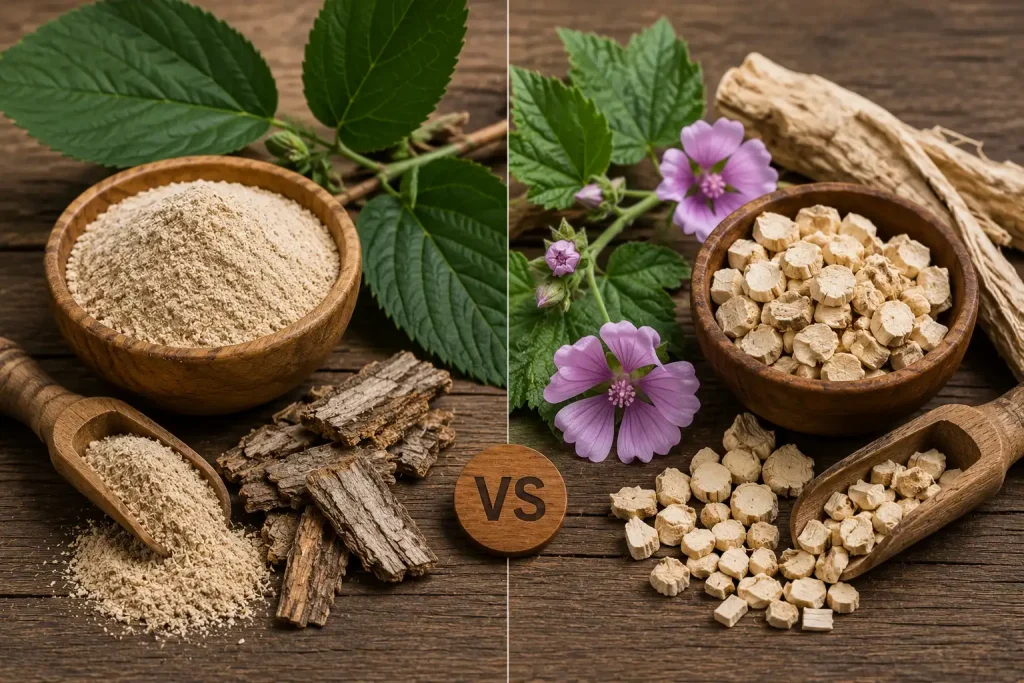
This guide takes a careful, side-by-side look at slippery elm vs marshmallow root so that you can make an informed decision about which herb, or what combination, best fits your needs.
What Is Slippery Elm?
Slippery elm comes from the inner bark of Ulmus rubra, a deciduous tree native to eastern North America. The inner bark is stripped, dried, and powdered or cut for use. When this bark makes contact with water, it releases abundant mucilage, a gel-like substance composed primarily of complex polysaccharides. This gel is what gives slippery elm its well-known soothing quality.
Native American tribes, particularly the Ojibwe and Cherokee, used slippery elm bark extensively for food and medicine. It was consumed as a porridge during illness, used topically for wounds and burns, and taken as a tea for sore throats and digestive upset. European settlers adopted many of these uses, and by the nineteenth century, slippery elm lozenges were a standard pharmacy product.
Slippery elm is also notable as a source of nutrition: the powdered bark was historically used as a survival food and consumed during periods of illness when appetite was poor. It provides small amounts of carbohydrates and some B vitamins alongside its mucilage content.
What Is Marshmallow Root?
Marshmallow root comes from the taproot of Althaea officinalis, a herbaceous perennial originally native to Europe, western Asia, and North Africa. It now grows widely across temperate zones worldwide. Like slippery elm, the root releases abundant mucilage when it contacts water, but the botanical source and exact polysaccharide composition differ.
Marshmallow has a history stretching back to ancient Egypt and classical Greece, where it was used for respiratory and digestive complaints. The Latin name Althaea comes from the Greek word for “to heal.” The plant was so widely used medicinally that it gave its name to the confection we now call a marshmallow, which historically contained marshmallow root extract as a key ingredient.
Beyond the root, marshmallow leaf is also used herbally, though it contains a smaller concentration of mucilage than the root and has a somewhat different phytochemical profile. Hatton Naturals carries both Organic Marshmallow Root C/S and Marshmallow Leaf (Whole) for buyers who want flexibility in their formulations.
Comparing the Mucilage: Slippery Elm vs Marshmallow Root
In the slippery elm vs marshmallow root comparison, mucilage is the primary currency. Both herbs produce it, but in different concentrations and compositions.
Slippery elm inner bark can contain anywhere from five to eight percent mucilage by dry weight, composed mainly of hexoses, pentoses, and methylated sugars. It forms a particularly thick gel when powdered and mixed with water, which is why slippery elm powder is sometimes used to make nutritive gruels or poultices as well as teas.
Marshmallow root contains around five to ten percent mucilage depending on the variety and harvest conditions, composed mainly of galacturonic acid, glucuronic acid, and arabinose. It too forms a thick, viscous liquid, particularly when cold-infused, which is the preferred extraction method for marshmallow mucilage.
In practical terms, both herbs deliver substantial mucilaginous action when properly prepared. The difference is more one of character than magnitude: slippery elm tends toward a thicker, more food-like gel, while marshmallow root produces a more fluid, slimy consistency that coats mucous membranes efficiently.
Gut Health Applications: What Each Herb Does Best
When comparing slippery elm vs marshmallow root for specific digestive applications, each herb has scenarios where it has traditionally excelled.
Slippery elm has been particularly favored for esophageal and stomach conditions, including acid reflux and ulcers, because its thick gel seems to stay in place and coat the stomach lining effectively. It was historically fed to patients recovering from stomach surgeries and illnesses. And it remains a common recommendation in naturopathic practice for gastroesophageal reflux and gastritis.
Marshmallow root, while also useful for stomach soothing, has a stronger traditional application in the lower digestive tract and urinary system. Its mucilage is highly effective at soothing the intestinal lining and has been used historically for irritable bowel syndrome and colitis in the context of traditional herbal medicine. Its urinary mucilage action is better documented and more widely cited than slippery elm’s.
For individuals dealing with whole-tract digestive concerns, combining both herbs can provide coverage across multiple areas of the gastrointestinal system.
Sustainability: An Important Difference
One of the most important considerations in the slippery elm vs marshmallow root debate is sustainability. Slippery elm is a slow-growing native North American tree that is under significant pressure due to Dutch elm disease, habitat loss, and overharvesting for the herbal market. Harvesting inner bark requires removing a substantial portion of the bark from the tree, which can kill the tree or severely damage it.
United Plant Savers, an organization that monitors at-risk medicinal plants in North America, has listed slippery elm on its “To-Watch” list due to declining populations. This does not mean you cannot ethically use slippery elm, but it does mean the sourcing matters enormously. Buyers should prioritize suppliers who source from sustainably managed stands or cultivated trees.
Marshmallow root, by contrast, is cultivated widely across Europe and Asia and faces no significant sustainability concerns. The plant is easy to grow, fast-maturing, and harvested from cultivated crops rather than wild stands. For buyers motivated by environmental responsibility, this is a meaningful differentiator in the slippery elm vs marshmallow root comparison.
How to Prepare Each Herb for Maximum Benefit
Preparation method significantly affects the output of both herbs, but the differences are instructive.
Slippery elm is most commonly prepared as a powder mixed into water, juice, or a smoothie. The powdered bark disperses easily and creates a gel within minutes. It can also be decocted from cut bark, though the powder format is most popular for gut support. A typical serving is one teaspoon of powder stirred into eight ounces of warm or cool water.
Marshmallow root is uniquely suited to cold infusion. Unlike most herbs, marshmallow root releases its full mucilage content more effectively in cold or room-temperature water than in boiling water, because heat can alter some of the polysaccharide structures. To make a cold marshmallow root infusion, combine one tablespoon of cut root with eight ounces of cold water and allow it to sit at room temperature for four to eight hours, then strain. The resulting liquid is viscous, mildly sweet, and highly soothing. Hatton Naturals’ Organic Marshmallow Root C/S is ideal for this preparation.
Using Marshmallow Leaf Alongside the Root
Many herbalists use marshmallow leaf alongside marshmallow root for a more complete preparation. The leaf contains a different polysaccharide fraction and is more suitable for hot infusion. It provides a lighter, more fluid mucilaginous action compared to the root. And it also adds flavonoids and phenolic acids to the preparation. For formulators, combining root and leaf can offer a broader phytochemical range within the same plant genus. Hatton Naturals stocks Marshmallow Leaf (Whole) as a complement to its root offering.
Which One Should You Choose?
In the slippery elm vs marshmallow root debate, the answer is genuinely “it depends,” and sometimes the answer is “both.” Consider the following:
- If you are focused primarily on upper digestive soothing, particularly esophageal or stomach comfort, slippery elm has a stronger traditional track record and a thicker gel that may provide more localized coating.
- If you are focused on intestinal, urinary, or whole-tract soothing with a sustainability-conscious approach, marshmallow root is an excellent choice.
- If budget and availability are factors, marshmallow root is generally less expensive and more consistently available in bulk than slippery elm.
- For formulators building a product line, marshmallow root offers a more scalable and sustainable ingredient story, while slippery elm can be included at lower percentages for its specific upper-GI benefits.
Browse the full range of digestive and demulcent herbs at the Hatton Naturals shop. Explore options for your blend or wellness routine.
Safety Information
Both slippery elm and marshmallow root are considered very safe for most adults. However, a few important notes apply:
- Because both herbs coat the mucous membranes of the digestive tract, they may slow the absorption of medications taken around the same time. Take any prescription medications at least one to two hours apart from demulcent herb preparations.
- Slippery elm is not recommended in large quantities during pregnancy, as it has historical associations with uterine stimulation in very high doses. Normal beverage quantities are generally considered safe, but consult your healthcare provider.
- Marshmallow root is considered safe in pregnancy in traditional use. But again, consult your provider before adding any new herb during pregnancy.
- Neither herb is a substitute for medical diagnosis or treatment of digestive conditions. Persistent or severe digestive symptoms should be evaluated by a physician.
- These statements are for educational purposes and have not been evaluated by the Food and Drug Administration.
Frequently Asked Questions: Slippery Elm vs Marshmallow Root
Are slippery elm and marshmallow root the same thing?
No. They are different plants from different botanical families. Slippery elm (Ulmus rubra) is a North American tree, while marshmallow (Althaea officinalis) is a European perennial herb. Both produce mucilage but from different polysaccharide structures and in different parts of the plant.
Which herb is better for acid reflux?
Traditional herbalism tends to favor slippery elm for acid reflux due to its very thick gel that can coat the esophagus and stomach lining. Marshmallow root is also useful and can be used alongside slippery elm. Neither should replace medical treatment for diagnosed GERD.
Can I use both slippery elm and marshmallow root together?
Yes. Many herbalists combine them for a more comprehensive demulcent effect. The herbs are complementary rather than competitive, and their different polysaccharide profiles may provide broader mucous membrane support together than either alone.
Is marshmallow root better than slippery elm for sustainability?
Yes. Marshmallow root is a widely cultivated herb with no significant sustainability concerns, while slippery elm is a native North American tree under pressure from disease and overharvesting. For environmentally conscious purchasing, marshmallow root is the more responsible choice at scale.
How do I use marshmallow root for gut health?
The most effective preparation is a cold infusion: one tablespoon of cut marshmallow root steeped in eight ounces of cold water for four to eight hours at room temperature. Strain and drink the resulting viscous liquid one to two times daily.
Does marshmallow leaf work the same as the root?
Marshmallow leaf has a similar mucilaginous quality but in a lower concentration than the root. It is better suited to hot infusion and adds different secondary compounds. Many herbalists use both the root and leaf together for a more complete preparation.
Where can I buy marshmallow root for gut health?
Hatton Naturals offers Organic Marshmallow Root C/S and Marshmallow Leaf (Whole) in bulk quantities suited for home and commercial use.
Conclusion
The slippery elm vs marshmallow root comparison ultimately reveals two excellent herbs with complementary strengths rather than a clear winner. Slippery elm offers a thick, food-like gel with deep traditional roots in North American medicine. Marshmallow root provides a sustainable, highly soothing demulcent with applications from the mouth to the urinary tract. Choose based on your specific needs, your values around sustainability, and your formulation goals. Find both at Hatton Naturals.