Wholesale Herbs and Spices: What to Ask Before You Order
Placing a first wholesale herbs and spices order with a new supplier is one of those decisions that looks simple until the pallet arrives. The pricing made sense on the quote sheet. The website listed all the right certifications. Then the chamomile smells flat, the turmeric COA is eight months old, and the cut grade on the peppermint is coarser than what your tea filling equipment tolerates. None of that shows up in a catalog.
The gap between a supplier who looks right and one who actually performs comes down to the questions you ask before committing to an order. Experienced formulators, tea blenders, and wellness brand buyers develop a standard vetting protocol over time, often after at least one costly mistake. This guide compresses that learning curve.
What follows covers the documentation you should request, the quality markers that separate premium stock from commodity filler, how pricing tiers and minimums actually work at scale, and the logistics details that determine whether a supplier fits your production cadence. The audience here is anyone buying botanical ingredients for resale, manufacturing, or formulation: small-batch producers scaling up, brand owners consolidating their supply chain, and procurement managers evaluating new vendor relationships.
What Buyers Should Know About Wholesale Herbs and Spices
The wholesale herbs and spices market segments into three broad supplier tiers, and understanding which tier you are dealing with shapes every other conversation.
Broker-distributors aggregate inventory from multiple growers and processors, then resell under their own brand or in bulk. They offer broad catalogs and competitive pricing but often have limited traceability. Asking for lot-specific documentation from a broker frequently surfaces how much they actually know about their source material.
Direct-import wholesalers work with growers or cooperatives in origin countries, handle import logistics, and stock material in domestic warehouses. They typically carry deeper traceability but narrower catalogs. Price-per-pound is often lower for high-volume commodities, but minimum order quantities (MOQs) run higher.
Specialty organic distributors focus on certified material, maintain stricter documentation standards, and serve the formulation and supplement markets where regulatory compliance is non-negotiable. Their pricing reflects that overhead. For buyers whose products carry organic label claims, this tier is usually the right starting point.
Regardless of tier, every supplier conversation should establish the same baseline: current USDA Organic certificate with visible certifying agent, lot-traceable inventory, and a Certificate of Analysis dated within the last 12 months for the specific lot you are purchasing. If a supplier cannot provide all three without friction, that tells you something.
Sourcing and Quality Indicators
Cut grade is the specification buyers most commonly underestimate when placing wholesale herbs and spices orders. Cut and sifted (C&S) is the standard for tea and most extract applications. It delivers consistent particle size, blends evenly, and performs predictably in volumetric filling equipment. Whole material commands a visual premium but varies more in density and blending behavior. Powders maximize surface area for extraction and capsule applications but oxidize faster once opened and require tighter storage controls.
Always request a sample before committing to a new lot, even from an established supplier. Sensory evaluation at intake takes two minutes and catches problems that paperwork misses. Strong aromatics like peppermint, rosemary, and Wholesale Herbs and Spices from the mint family should hit you immediately when you open the bag. If you have to press the material and bring it to your nose before detecting any scent, volatile oil content is low and the lot will underperform in finished products.
Color is a quality Indicator
Color is the other immediate visual signal. Bulk Herbs Botanicals with intact pigmentation signal proper drying temperatures and good storage conditions. UV exposure bleaches plant material. Excessive drying temperatures accelerate the same degradation. Chamomile flowers should show visible yellow centers and white petals, not a uniform straw-tan. Hibiscus should be deep burgundy, not muted pink. Turmeric powder should be vivid orange-yellow. Any significant deviation from the expected color of a well-known botanical is grounds for either rejecting the sample or negotiating a price reduction before accepting the lot.
Moisture content is the specification most directly tied to microbial risk. Below 10% is the accepted threshold for most dried herbs. Material arriving above that level creates mold risk in storage, particularly in humid climates or non-climate-controlled warehouses. A COA showing moisture percentage for the specific incoming lot is a non-negotiable request for any production buyer.
The Documentation Stack: What to Request Before Every Order
Building a standard documentation request into your purchasing workflow protects your operation on multiple fronts: regulatory compliance, quality consistency, and liability in the event of a customer complaint or product recall.
The baseline stack for any wholesale herbs and spices purchase should include the current organic certificate for the specific ingredient (not a general company certificate), the lot-specific COA with moisture, aerobic plate count, yeast and mold counts, and heavy metals panel, a pesticide residue screening result even on organic lots, and the country of origin for the material.
For supplement or functional food applications, add allergen statements and a statement of identity confirming the botanical name matches the label claim. Chamomile is a useful example: Matricaria chamomilla (German chamomile) and Anthemis nobilis (Roman chamomile) have different compound profiles and are not interchangeable in formulation, but they appear under similar common names across supplier catalogs.
For any herb in the Asteraceae family including chamomile, calendula, and echinacea, request confirmation of species identification. For roots and barks with known adulterant risk (slippery elm is commonly adulterated with other mucilaginous barks, for instance), request HPTLC or similar identity verification if your application demands it.
Keep a supplier file for every vendor with copies of all certificates dated at receipt. Organic certificates renew annually. A certificate that was current when you onboarded a supplier may have lapsed by the time your second or third order ships. Build a calendar reminder to verify renewal before each order cycle.
How Minimums, Pricing Tiers, and Lead Times Work
Minimum order quantities in the wholesale herbs and spices market reflect the supplier’s logistics model more than any production constraint. A one- to five-pound minimum signals a retail-oriented operation that also offers bulk pricing. A 25-pound minimum per SKU is typical for mid-tier distributors. Large import-direct operations often require 50 to 100 pounds per item, with full-pallet orders for the best per-pound pricing.
Know your monthly consumption rate for each herb before you negotiate. Ordering at the 50-pound tier for an ingredient you consume at two pounds per month locks up capital and introduces shelf-life risk. Ordering at the five-pound tier for a high-velocity ingredient means you are paying retail economics at production scale. The right order quantity sits at roughly three to four months of inventory for stable high-volume items, and one to two months for specialty or seasonal herbs.
Price breaks in the wholesale market typically fall at predictable thresholds: 10 pounds, 25 pounds, 50 pounds, and 100 pounds. The percentage reduction varies by commodity status. High-demand herbs like peppermint, chamomile, and lavender see modest breaks because the market is competitive and margins are already thin. Specialty items like Organic Elderflowers or Organic Tulsi Leaf may show steeper percentage breaks at volume because the supplier’s inventory carrying cost is higher and they incentivize volume commitments.
Lead time is the variable buyers most often fail to ask about until it disrupts a production schedule. Domestic warehouse stock typically ships in two to five business days. Import-direct orders against a future harvest may carry four to twelve week lead times. Ask explicitly whether the quoted price applies to stock on hand or a forward order, and confirm the expected ship date in writing before submitting payment.
Building a Vetting Protocol for New Suppliers
First contact with a new wholesale herbs and spices supplier should function as a structured interview, not a purchase. A supplier’s response quality tells you as much as the answers themselves.
Start with documentation requests: current organic certificate, sample COA for the specific item you intend to buy, and country of origin. Note how quickly they respond and whether the documents arrive without chasing. A supplier who provides documentation promptly and without pushback operates with an organized compliance posture. One who delays, sends general certificates rather than lot-specific documents, or asks why you need that information is flagging future friction.
Request a physical sample before your first order. Evaluate it against the sensory criteria for that specific botanical. If the sample meets your standards, place a small test order, typically the supplier’s stated minimum, and evaluate the incoming lot against the sample for consistency. Color, aroma, cut grade, and moisture at intake should match. Any meaningful deviation from the sample on a first order predicts inconsistency at scale.
Check references where possible. Other buyers in your network who use the same supplier are the most reliable source of information on fill rate consistency, documentation accuracy, and how the supplier handles problems when they arise. A supplier who resolves quality disputes quickly and without excessive back-and-forth is worth a small price premium over a cheaper vendor with a poor track record on claims.
Storage Requirements at Wholesale Volume
Receiving wholesale herbs and spices in quantity creates storage obligations that home-scale operations do not face. Temperature, humidity, and light management at warehouse scale require deliberate planning rather than improvisation.
Target storage below 65°F (18°C) and below 60% relative humidity for most dried herbs. Climate-controlled storage space is the single most effective investment in ingredient quality for any producer storing more than a few hundred pounds at a time. In the absence of full climate control, prioritize the highest-volume and highest-value ingredients for your best storage conditions.
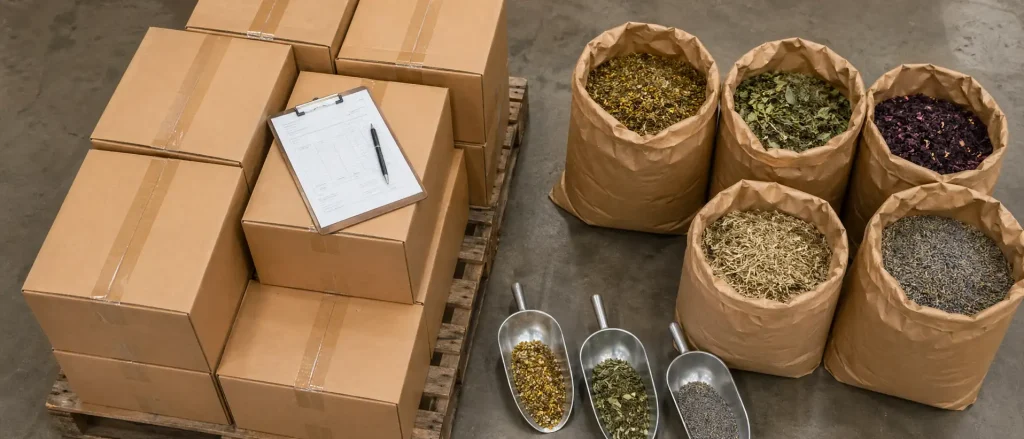
Container selection matters at volume. Food-grade sealed containers or heat-sealed Mylar bags provide the strongest moisture and oxygen barriers for long-term storage. Kraft bags with poly liners are acceptable for short-term staging (under three months) but should not serve as primary long-term storage for aromatic herbs, as volatile compounds migrate through paper over time.
Implement first-in, first-out (FIFO) rotation strictly across all lots. Label every container with herb name, supplier, lot number, harvest date, and your receiving date. For any lot approaching 18 months from harvest, request a fresh COA before continuing to use it in production. Scent and color assessment at each production pull takes 30 seconds and catches slow degradation before it reaches the finished product.
Safety and Regulatory Considerations for Commercial Buyers
Commercial buyers carry compliance obligations that individual consumers do not. The regulatory framework governing wholesale herbs and spices varies by application category, and understanding which rules apply to your product type is essential before finalizing your supply chain.
For dietary supplement applications in the US market, FDA 21 CFR Part 111 (Good Manufacturing Practices for dietary supplements) requires identity testing of every incoming ingredient lot. This means maintaining COAs, supplier certificates, and identity verification records for every lot used in production. A supplier who cannot support this documentation requirement is not suitable for supplement manufacturing regardless of price.
For food and tea products, the applicable framework is 21 CFR Part 117 (Current Good Manufacturing Practice, Hazard Analysis, and Risk-Based Preventive Controls for Human Food). Documentation requirements are similar in structure, though the specific tests required differ by ingredient and risk category.
Topical products follow cosmetic regulations rather than supplement rules, but documentation standards for ingredient traceability remain best practice regardless of regulatory mandate.
Herbalists often recommend common botanicals like peppermint, chamomile, and Organic Ginger Root as foundational ingredients in wellness formulations. For any product with label claims, ensure your copy uses compliant language: “traditionally used for,” “may support,” and “herbalists often recommend” are appropriate framings. Avoid any language that implies a specific health outcome, diagnosis, or treatment.
FAQ
What is the difference between wholesale and bulk herb pricing?
Wholesale pricing applies to verified business buyers purchasing for resale or manufacturing, typically with established account terms and volume minimums. Bulk pricing at consumer-facing retailers means larger package sizes at lower per-ounce rates but without the formal account structure, net terms, or production-grade documentation of a true wholesale relationship.
How do I verify that a supplier’s organic certification is current?
Request the actual certificate document, not just a logo on the website. The certificate will show the certifying agent (Oregon Tilth, CCOF, OTCO, etc.), the certificate holder name, and an expiration date. You can also verify certification status directly through the USDA Organic Integrity Database at ams.usda.gov.
What should a COA include for bulk herb purchases?
A complete COA for wholesale herbs and spices should show moisture content, aerobic plate count, total yeast and mold, heavy metals panel (at minimum lead and arsenic), and pesticide residue screening. It should identify the specific lot number, the test date, and the accredited third-party laboratory that performed the analysis.
Can I negotiate payment terms with wholesale herb suppliers?
Yes, particularly with established suppliers once you have a track record of consistent orders. Net-30 terms are standard for commercial accounts with good payment history. Some suppliers offer early-pay discounts (2% net-10 is common) as an alternative to extended terms. Negotiate terms as part of the account setup conversation rather than after the first invoice.
How do I handle a quality dispute with a wholesale supplier?
Document everything at intake: photos of the packaging, the lot label, and the material condition before any use. Submit the COA you received against your own sensory assessment and any third-party testing you conduct. Most reputable suppliers will issue credit or replacement for a confirmed quality failure. A supplier who resists reasonable documentation of a quality dispute is a relationship worth reconsidering.
What herbs should I prioritize for my first wholesale order?
Start with high-velocity ingredients that appear across multiple products in your line. Chamomile, peppermint, lavender, and calendula serve broad formulation categories and justify the volume commitment of a wholesale order. Build your wholesale volume around ingredients you consume consistently, then add specialty herbs in smaller quantities until your usage rate justifies the wholesale threshold.
How do I calculate the right order quantity to avoid waste?
Divide your monthly usage by the number of months of inventory you want to carry. For most dried herbs, three to four months is a reasonable buffer that captures volume pricing without creating excessive shelf-life risk. Multiply that figure by the per-pound wholesale price at your target volume tier to calculate your committed spend per ingredient.
Are there wholesale herbs and spices suppliers that specialize in certified organic material?
Yes, and for production buyers whose finished products carry organic label claims, working with a certified organic specialist is worth the typically higher per-pound cost. These suppliers maintain tighter documentation, are familiar with compliance requirements, and carry organic certificates that can support your own certification audit. Verify that the supplier’s organic certificate covers the specific items you intend to purchase, since a company-level certificate does not automatically extend to every product in their catalog.
Building a reliable supply chain for wholesale herbs and spices takes deliberate work upfront but pays dividends across every production run that follows. Ask the right questions before the first order, standardize your documentation requirements, and evaluate suppliers on consistency over time rather than on initial price alone. For buyers who need certified organic material at production scale, working with an established wholesale partner who carries both the certification chain and the documentation infrastructure simplifies compliance and protects your finished product quality.