Cut and Sifted vs Powder vs Whole: Which Form Do You Need?
When you browse a supplier catalog, the same herb often appears in multiple formats. Chamomile might be listed as whole flowers, cut and sifted, or powder. Cinnamon shows up as sticks, chips, cut and sifted, or ground. For buyers who are new to the botanical trade, these distinctions can seem like minor details. They are not. The form you choose affects brewing behavior, shelf stability, packaging options, extraction efficiency, and customer experience. Understanding herbs cut sifted vs powder is essential knowledge for anyone purchasing botanicals at a business level.
Whether you are formulating a tea blend, filling supplement capsules, creating skincare products, or stocking a retail shelf, the right format can make or break your product. This guide walks through each form in detail, compares their strengths and limitations across common applications, and helps you make informed purchasing decisions. We will use real product examples from the Hatton Naturals bulk herbs catalog to illustrate each point, so you can see exactly what is available and how to match the form to your needs.
Understanding Herbs Cut Sifted vs Powder and Whole Forms
Before comparing, it helps to define each format precisely. These are standard industry terms with specific meanings that affect how you use and sell the product.
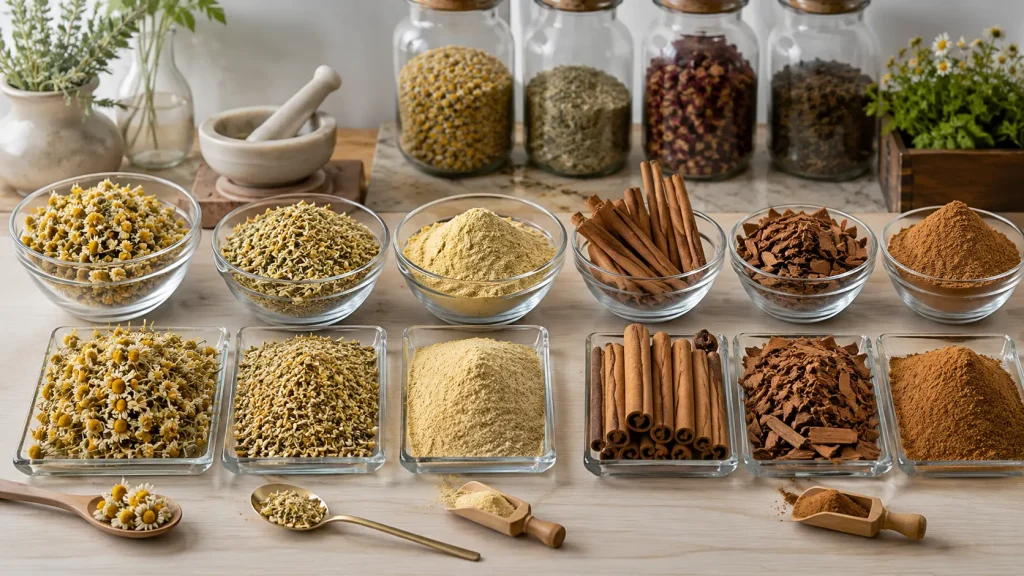
Whole herbs are sold in their natural, intact state after drying. Chamomile flowers whole and Ceylon cinnamon sticks are examples. Whole herbs retain their essential oils longest because fewer cell walls have been broken.
Cut and sifted (often abbreviated as C/S or CS) means the herb has been mechanically chopped into uniform pieces, then passed through screens to remove dust and ensure consistent particle size. Chamomile flowers cut and sifted and Ceylon cinnamon cut and sifted are typical examples. This format balances surface area exposure with reasonable shelf life.
Powder is the finest form, produced by grinding dried herbs until they pass through a fine mesh screen. Ceylon cinnamon powder and ashwagandha powder illustrate this category. Powders offer maximum surface area but degrade faster.
Botanical Profile of Common Multi-Form Herbs
Many herbs are available in two or three forms, and each one serves different markets. Cinnamon is a prime example. Ceylon cinnamon sticks are prized for visual presentation in specialty retail and slow-infusion cooking. Ceylon cinnamon chips and cut and sifted formats work well for tea blending. It is the standard for baking, capsule filling, and food manufacturing.
Ginger follows a similar pattern. Ginger root cut and sifted is the go-to for tea blends and decoctions, while ginger powder works best in capsules and culinary spice mixes. Ashwagandha offers cut and sifted root for extraction and powder for direct incorporation into formulations.
Traditional and Modern Uses by Form
Historically, herbalists worked almost exclusively with whole and cut forms. Teas, decoctions, poultices, and tinctures all relied on coarsely processed plant material. The cut and sifted format became standard for apothecary and retail tea trade because it brews consistently and measures easily.
Modern applications have expanded the demand for powders significantly. The supplement industry needs fine powders for capsule and tablet manufacturing. The food and beverage industry uses powders for instant drink mixes and smoothie boosters. Skincare formulators prefer powders for face masks and scrubs. Understanding herbs cut sifted vs powder in the context of your specific application is what leads to the right purchasing decision.
For tea businesses, the choice between whole and cut and sifted often depends on whether the product will be sold loose or in sachets. Whole flowers like chamomile whole create a beautiful visual experience in clear packaging. Cut and sifted versions like chamomile CS fit better into standard tea bags and infusers.
How to Use Each Form Effectively
Each format has optimal preparation methods that maximize its strengths.
Whole herbs are best for slow infusions, display packaging, potpourri, and applications where visual appeal matters. Steep whole herbs for five to 10 minutes in water just below boiling for most flowers and leaves. Roots, bark, and seeds in whole form may require simmering for 15 to 20 minutes.
Cut and sifted herbs are the workhorse format for tea blending. They brew faster than whole forms because more surface area is exposed to water. Use approximately one tablespoon per eight ounces of water. They also work well for tincture making, where the increased surface area allows better alcohol extraction.
Powders dissolve or disperse directly into liquids, foods, and formulations. For capsule filling, most powder herbs pack at roughly 400 to 600 milligrams per standard size 00 capsule. In smoothies, one to two teaspoons is a common serving. For skincare, mix powders with liquids at ratios specified by your formulation.
Shelf Life and Storage Considerations by Form
Form directly impacts how long an herb remains at peak quality. Whole herbs have the longest shelf life, typically 18 to 24 months under proper conditions. Their intact cell structures act as natural barriers to oxidation and volatile oil loss.
Cut and sifted herbs last 12 to 18 months. The cutting process breaks open cells and increases the surface area exposed to air, which accelerates degradation. However, when stored in airtight containers away from light and heat, they remain viable for well over a year.
Powders have the shortest shelf life, generally six to 12 months. The enormous surface area means rapid oxidation and volatile oil loss. This is a critical factor when evaluating herbs cut sifted vs powder for inventory planning. If turnover is slow, buying CS and grinding on demand can be a smarter approach.
What Buyers Should Know About Choosing Forms
Your end application should drive your format choice. Here is a practical framework for making the decision.
- Loose leaf tea blends: Cut and sifted is the standard. Whole flowers or leaves add visual premium.
- Tea bags and sachets: Cut and sifted works best for standard bags. Whole herbs suit large pyramid sachets.
- Capsules and tablets: Powder is required. Ensure particle size meets your encapsulation equipment specs.
- Tinctures and extracts: Cut and sifted provides good extraction rates without clogging filters.
- Culinary spice blends: Powder for cooking applications. Whole for grind-at-home retail products.
- Skincare formulations: Powder for masks and scrubs. Cut and sifted for infused oils.
When browsing the bulk herbs catalog, check whether the herb you need is available in the form you require before building your formula around it.
Sourcing and Quality Indicators for Each Form
Quality markers differ by format. For whole herbs, look for intact structures, vibrant color, and strong aroma. Broken pieces or excessive stem content indicate rough handling. For whole chamomile, complete flower heads with bright yellow centers and white petals signal premium quality.
For cut and sifted products, consistency of particle size matters. Uniform pieces indicate proper sifting. Excessive dust or fines suggest the product was over-processed or is aging. When comparing herbs cut sifted vs powder, note that a good CS product should have minimal powder at the bottom of the bag.
For powders, fineness and color are your primary indicators. Aloe vera leaf powder should be a consistent green. Turmeric powder should be deep golden-orange. Dull or uneven coloring can indicate age or adulteration. Always request certificates of analysis from your supplier, especially for powders where adulteration is harder to detect visually.
Safety Considerations
Each form carries slightly different safety considerations. Powders create airborne dust during handling that can irritate airways and eyes. Use dust masks and adequate ventilation when working with large quantities of any powdered herb. Some powders, such as cinnamon cassia powder, can be particularly irritating to mucous membranes.
Cut and sifted herbs produce less dust but still require clean handling practices to prevent contamination. Whole herbs are the easiest to handle safely but can harbor insects if not properly stored.
Regardless of form, always verify that your supplier provides lot-traceable products with current certificates of analysis. This is especially important for herbs entering the supplement supply chain, where regulatory requirements demand documented quality controls.
Frequently Asked Questions
What does cut and sifted mean exactly?
Cut and sifted means the dried herb has been mechanically chopped and then passed through a series of screens to achieve a uniform particle size. This removes both oversized pieces and fine dust, creating a consistent product ideal for tea blending and extraction.
Is powder more potent than cut and sifted?
Not inherently. The same herb in powder form delivers the same active compounds. However, powder may release those compounds faster due to increased surface area. For ingestion, powder can feel more potent simply because the body accesses the compounds more quickly.
Can I grind cut and sifted herbs into powder myself?
Yes. Many small businesses buy cut and sifted herbs and grind them as needed using commercial spice grinders or ball mills. This approach gives you the shelf life advantage of CS with the flexibility of powder on demand.
Which form is best for making herbal tea?
Cut and sifted is the industry standard for tea. It brews evenly, fits standard infusers, and produces consistent results. Whole herbs work well for premium loose leaf products, especially when visual presentation matters.
How do I choose between herbs cut sifted vs powder for my product?
Start with your end application. If you need the herb to dissolve or be consumed directly, choose powder. If you need it for brewing, infusing, or extracting, choose cut and sifted, and if visual appeal or extended shelf life is the priority, choose whole.
Do whole herbs cost more than cut and sifted or powder?
Pricing varies by herb. Whole forms sometimes carry a premium because they require more careful handling to preserve intact structures. However, powders can also be more expensive due to the additional grinding step. Compare unit prices from your supplier for each form.
What is the difference between cut and sifted and tea bag cut?
Tea bag cut (TBC) is a finer cut than standard CS. It is designed for traditional flat tea bags where a smaller particle size allows proper infusion. Standard CS pieces are larger and better suited for loose leaf use or large infusers.
Can I mix different forms in a single blend?
You can, but it is not recommended. Different particle sizes settle at different rates, leading to inconsistent blends. A mix of CS and powder will separate over time, with the powder sinking to the bottom. Stick to one form per blend for best results.
Conclusion
The choice between herbs cut sifted vs powder and whole forms is a practical business decision that affects product quality, shelf life, and customer satisfaction. By matching the format to your application, you ensure consistent results and minimize waste. Explore the full range of forms available at Hatton Naturals bulk organic herbs to find exactly what your business needs, from aloe vera powder to whole chamomile flowers.