Minimum Order Quantities for Bulk Herbs: What to Expect
Understanding bulk herbs minimum order quantity is one of the first things any serious buyer needs to figure out before contacting a supplier. Whether you are launching a tea brand, running a supplement company, or sourcing ingredients for a wellness product line, MOQs shape your budget, your inventory strategy, and your cash flow from day one. The challenge is that minimum order quantities are not standardized across the industry. Some suppliers set them by weight, others by dollar value, and others by SKU count. What looks like a straightforward number on a price sheet often comes with conditions that only become clear once you start asking questions.
This guide breaks down how MOQs work in the bulk herb trade, what you should realistically expect at different stages of your business, how to negotiate when you are starting out, and what to watch for when comparing suppliers. Explore the full catalog at the Hatton Naturals shop and contact the team with sourcing questions.
What Is a Minimum Order Quantity and Why Does It Exist
A minimum order quantity, or MOQ, is the smallest amount of a product a supplier will sell in a single transaction. In the bulk herb trade, this is usually expressed in pounds, kilograms, or ounces, though some suppliers express it in dollars. MOQs exist because suppliers face fixed costs that do not scale with order size. Pulling, weighing, packaging, labeling, and shipping one pound of an herb costs nearly as much in labor as pulling ten pounds. Warehousing, quality control documentation, and customer service overhead all factor in as well.
For commodity herbs with high turnover, like chamomile or peppermint, MOQs tend to be lower because the supplier moves large volumes. For specialty or imported herbs with slower turnover, MOQs are often higher because the supplier needs to justify the carrying cost. Understanding this logic helps buyers approach bulk herbs minimum order quantity negotiations from an informed position rather than treating minimums as arbitrary rules.
Typical MOQ Ranges Across the Bulk Herb Market
The bulk herbs minimum order quantity landscape varies significantly depending on the supplier tier. Spot brokers and large commodity distributors often deal exclusively in truckload or pallet quantities, sometimes starting at 200 pounds or more per SKU. These suppliers serve manufacturers and large-volume blenders.
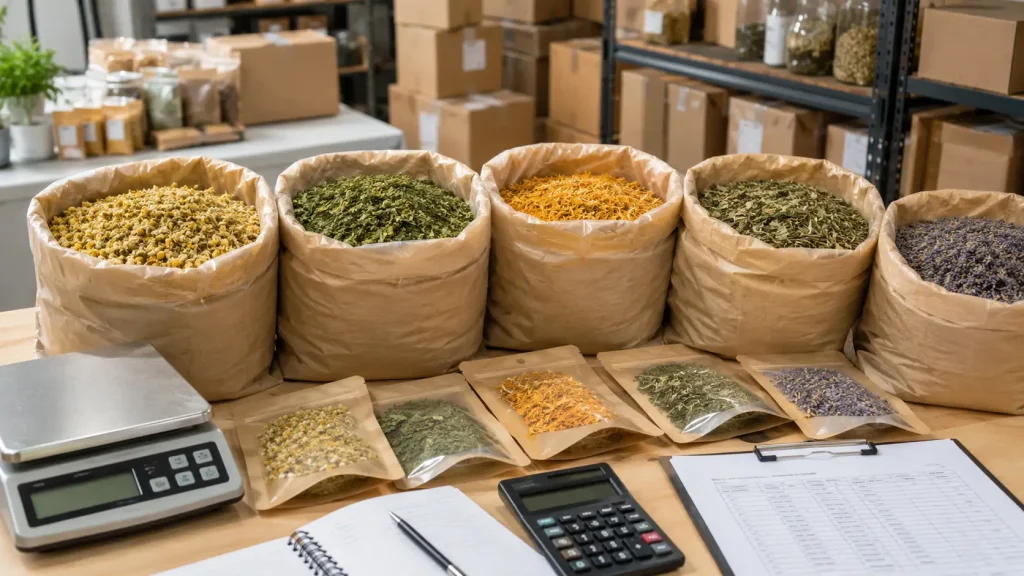
Mid-tier wholesale suppliers, which is where most independent tea and supplement brands do their sourcing, typically set MOQs between 1 pound and 25 pounds per herb. A 1-pound minimum is common for specialty herbs. Five-pound minimums are standard for popular herbs in organic grades. Some suppliers apply a blended approach: no per-SKU minimum, but a basket minimum of $150 to $300 per order.
Direct farm or co-op sourcing sits in its own category. Farms often require buyers to commit to a full harvest lot, which can mean hundreds of pounds of a single herb. This model suits established brands, not startups testing formulations.
How MOQs Affect Small Brands and Startups
For a startup tea brand, the bulk herbs minimum order quantity question is often a bottleneck. You need enough material to make samples and test formulations, but you do not yet know which blends will sell. Ordering 25 pounds of ten different herbs before your first launch is a significant capital commitment.
Practical strategies: prioritize suppliers who offer sample orders (even at a premium), build formulas around herbs with broad utility across multiple blends, and negotiate first orders as trial runs with a commitment to reorder at higher volume if the product performs.
Negotiating Minimum Order Quantities
MOQs are more negotiable than many buyers assume. A buyer who says “I need to start at two pounds but expect to order 20 pounds monthly within six months” is having a different conversation than one who simply asks for an exception. Suppliers are also more flexible when buyers demonstrate product knowledge, ask the right quality questions, and show they understand the supply chain.
Another lever is order consolidation. Instead of ordering one herb at a time, consolidate your needs into a single order that meets the supplier’s basket minimum. This increases your invoice total while keeping per-SKU quantities low. The bulk herbs minimum order quantity becomes much more manageable with this approach.
What Buyers Should Know
Before placing a first order, clarify in writing: whether MOQs apply per SKU or per order, whether they change for organic versus conventional, how they are handled for out-of-stock herbs, and how MOQs interact with pricing tiers. Many suppliers use tiered pricing where per-pound cost drops at higher quantities. Knowing the break points helps you plan purchases to hit better pricing without overcommitting.
Also confirm return or credit policies in case a shipment does not meet your quality standards. This is separate from MOQs but equally important for managing financial risk with a new supplier.
Sourcing and Quality Indicators
When evaluating suppliers for bulk herbs minimum order quantity purposes, quality indicators matter as much as the minimums. Look for suppliers who provide certificates of analysis (COA) with microbial counts, heavy metal screening, pesticide residue testing, and moisture content from accredited third-party labs. Origin transparency, organic certification from recognized bodies (USDA NOP, EU Organic), and proper storage conditions are all meaningful signals.
Ask whether your order will be packed in food-grade containers labeled with lot numbers traceable to the original COA. This traceability chain is something your own customers or regulatory auditors may eventually ask you to demonstrate.
Safety
Bulk herb purchasing involves food-safety considerations regardless of order size. All herbs intended for human consumption should be sourced from suppliers operating under good manufacturing practices (GMP) with documentation to support it. Herbs for finished US products are subject to FDA regulations under 21 CFR Part 111 for supplements or food labeling requirements for teas. Your supplier’s documentation needs to support your compliance.
Frequently Asked Questions
What is a typical bulk herbs minimum order quantity for a startup?
Most mid-tier wholesale suppliers set minimums between one and five pounds per herb, or a basket minimum of $150 to $300 per order. Some offer sample quantities at a premium price to let new buyers test formulations.
Can I negotiate lower MOQs?
Yes. Suppliers are more open to flexibility when buyers show a credible growth plan, consolidate multiple herbs into a single order, or commit to a reorder schedule.
Do MOQs differ between organic and conventional herbs?
Often yes. Certified organic herbs typically carry higher MOQs because they cost more to source and carry. Expect minimums 20 to 50 percent higher for organic grades.
What should I do if a supplier has a higher MOQ than I can use?
Consider partnering with another small brand to split an order, reformulating to use the herb across multiple products, or sourcing from a different supplier tier that caters to smaller buyers.
Is a lower MOQ always better?
Not necessarily. Very low MOQs sometimes indicate slower inventory turnover, which can affect freshness. Balance minimum flexibility with quality documentation and turnover indicators.
How do MOQs relate to pricing tiers?
Most suppliers offer tiered pricing where per-pound cost decreases as volume increases. Ask for the full pricing schedule before placing your first order.
Do I need a business license to order wholesale?
Most wholesale suppliers require a business license, reseller permit, or similar documentation before extending wholesale pricing.
What happens if my order does not meet quality standards?
Ask about return and credit policies before ordering. Reputable suppliers will replace or credit shipments that fail to meet COA specifications.
Navigating the bulk herbs minimum order quantity landscape takes preparation, but it is manageable for brands at any stage. Start by understanding supplier tiers, ask the right questions, and use consolidation and forward commitments as negotiating tools. Visit the Hatton Naturals shop or contact the team to discuss your sourcing needs.