Sunflower Petals Tea: How to Brew the Perfect Cup
Sunflower petals tea is one of those quietly sunny infusions that feels like a warm window in the morning. It’s light, floral, and gently honeyed without being perfumey, especially when you brew it with the same care you’d give a good green tea. If you’re a tea lover, it’s a simple ritual. If you make kombucha, it’s also a clean flavor tool that plays nicely with fruit, citrus, and tart florals without turning your bottles into a sediment swamp.
In this guide, we’ll brew sunflower petals tea with practical control: water temperature, steep time, exact ratios in grams and teaspoons, and how to keep the aroma alive from tin to teacup. Then we’ll take that same sunflower character into a strict, repeatable kombucha second fermentation (2F) method with two options: a concentrate dosing approach (recommended for consistency) and a direct-in-bottle botanical approach (optional when you want a more rustic vibe). Along the way, you’ll get troubleshooting fixes and storage cues that matter when you’re brewing for yourself or producing small batches that need to taste the same every time.
What sunflower petals taste like (and what they don’t)
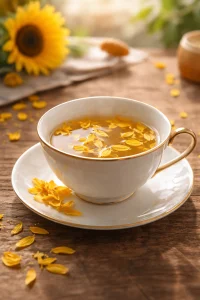 Sunflower petals are bright and floral with a soft sweetness that can read as hay-honey, light chamomile-adjacent, and slightly grassy in the best way. The flavor is usually more “yellow flower meadow” than “perfume.” That’s good news for kombucha makers because it means sunflower can lift aroma without dominating the acid.
What sunflower petals don’t do is bring heavy tannin. If your cup tastes harsh, it’s almost always process: water too hot, steeped too long, or you used too much material for the style of tea you wanted.
For blending, sunflower petals are easiest to pair with:
Tart flowers for structure (think hibiscus)
Citrus peels for top notes
Gentle roots for roundness
Try adding sunflower petals as the base floral that keeps blends tasting “sunny” instead of sharp.
Choosing quality sunflower petals (color, cut, scent)
Good sunflower petals look like sunshine: yellow to golden, not brown or gray. A little variation is normal, but the batch should not smell stale. Open your bag or jar and sniff. You want a clean, lightly sweet floral scent. If it smells dusty, cardboard-like, or flat, you’ll get a flat cup.
A few quality cues that matter:
Color: vivid yellow is your friend. Darkened petals often mean age or humidity exposure.
Texture: petals should feel dry and papery, not leathery or damp.
Aroma: light but present. If you have to work to smell it, your brew will be timid.
For production-minded consistency, weigh your botanicals instead of relying on “pinches.” Even with the same supplier, petals can pack differently from batch to batch.
To build a bright, balanced floral profile, pair sunflower petals with orange peel for a citrus lift that reads clean in both tea and 2F.
Exact ratios for sunflower petals tea (grams + teaspoons)
Here are reliable starting ratios. Use them as a baseline, then adjust like you would with coffee: strength and extraction are separate knobs.
Single mug (8 oz / 240 ml)
Light cup: 0.4 to 0.6 g (about 1 to 1 1/2 teaspoons) sunflower petals
Medium cup: 0.7 to 1.0 g (about 2 to 2 1/2 teaspoons) sunflower petals
Bold cup: 1.1 to 1.4 g (about 3 to 3 1/2 teaspoons) sunflower petals
Teapot (16 oz / 473 ml)
Light: 0.8 to 1.2 g (about 2 to 3 teaspoons)
Medium: 1.3 to 2.0 g (about 1 to 1 1/2 tablespoons)
Bold: 2.1 to 2.8 g (about 1 1/2 to 2 tablespoons)
Teaspoons vary because petals are airy. If you want repeatable results (especially for product R&D or batching), grams win every time.
For a tart backbone that makes sunflower pop, try pairing with hibiscus flowers in small amounts (it turns the cup pink and adds structure).
Water temperature, steep time, and the “clean extraction” method
 Sunflower petals are forgiving, but you’ll get the best aroma if you treat them like delicate botanicals.
Water temperature: 185 to 200°F (85 to 93°C)
Steep time: 4 to 7 minutes
Covered steeping: yes, cover your mug or pot to keep volatile aromatics in the brew
Strain: fine mesh is ideal
If you use boiling water and steep 10+ minutes, you can flatten the floral notes and pull a dull, planty edge. That doesn’t mean “bad,” it just becomes more rustic. If that’s your vibe, go for it. If you want bright, go gentler.
A practical method:
Warm your mug/teapot with hot water, then discard.
Add weighed petals.
Pour water at 185 to 200°F (85 to 93°C).
Cover and steep 5 minutes.
Taste. If you want more, add 1 to 2 minutes, not more petals right away.
For a rounder finish, blend a little licorice root into the tea (it adds natural sweetness without needing sugar, and it can be useful in 2F too).
Blending sunflower petals with complementary botanicals
Sunflower is a team player. It lifts, softens, and brightens. Here are blend structures that work for both tea and kombucha flavor prep.
Floral-bright (tea or 2F concentrate base)
Sunflower petals + hibiscus flowers + orange peel
This gives sunshine, tart body, and citrus sparkle.
Try adding hibiscus flowers for a tart backbone in 2F.
Citrus-floral (clean, refreshing)
Sunflower petals + orange peel
Simple, high-repeatability, low sediment.
Try adding orange peel for a clean citrus top note that doesn’t muddy fermentation.
Herbal-soft (calm, gentle aromatics)
Sunflower petals + peppermint leaf (light)
Keep mint low so it doesn’t bully the flower.
Try adding peppermint leaf for a cooling lift that still lets sunflower stay in front.
Rooted-floral (round, golden finish)
Sunflower petals + ginger root + a touch of licorice root
Great as a winter tea or a warming kombucha 2F profile.
Try adding ginger root for warmth and a little bite that reads “fresh” even after carbonation.
Sunflower petals tea for iced tea and batching
Sunflower petals make an excellent iced tea because they stay smooth when chilled. The key is brewing slightly stronger, then diluting over ice.
Iced tea (1 quart / ~946 ml)
Brew a concentrate:
3.0 to 4.0 g sunflower petals
2 cups / 473 ml water at 190°F (88°C)
Steep 6 minutes, covered
Strain.
Pour over a pitcher filled with ice and add cold water to reach 1 quart.
If you’re batching for consistent service or tasting panels, write it down like a recipe card:
grams, water temp, steep time, yield, and a quick sensory note (aroma level, sweetness, floral intensity).
To push aroma without extra plant material, blend a small amount of lemon balm leaf for a bright herbal-citrus impression that stays lively when cold.
Kombucha 2F with sunflower petals: strict, repeatable method
This is where sunflower shines for producers. You can get a clean floral note that feels “crafted” without the heavy sediment some flowers bring. The trick is controlling extraction and dosing.
Below are two methods. Option A is recommended because it’s consistent, scalable, and easier to troubleshoot. Option B is optional when you want a more artisanal look and you’re okay with variation.
Baseline setup for both options
Use fully fermented 1F kombucha (balanced sweet-tart, no off aromas).
Work cold if you can. Cold liquid holds carbonation better during filling.
Use pressure-safe bottles.
Always label: date, flavor, batch ID.
Dosage targets per 16 oz / 473 ml bottle (finished 2F)
Sunflower flavor level: light to medium floral
Target dosing: equivalent of 0.2 to 0.6 g dried sunflower petals per bottle
That’s the “effective” botanical load that gives aroma without turning the bottle into a compost jar.
Try adding sunflower petals as a clean floral layer that won’t overpower fruit or citrus.
Option A (recommended): Tea concentrate dosing
This method uses a sunflower petals concentrate you dose into each bottle. You get repeatable flavor, easy scaling, and fewer surprises.
Step 1: Make sunflower petals concentrate
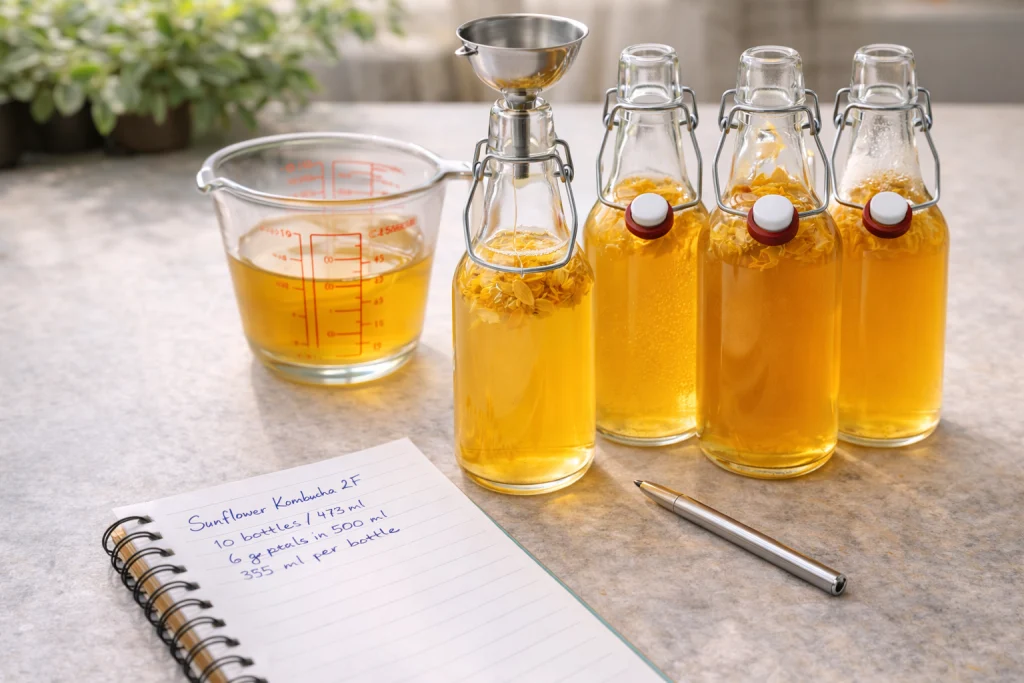
For about 10 bottles (10 x 16 oz / 473 ml), make this base:
Sunflower petals: 6 g
Water: 500 ml
Temperature: 190°F / 88°C
Steep: 6 minutes, covered
Strain very well (fine mesh)
This yields a fragrant concentrate. Let it cool to room temp (or chill). Cooling matters because hot dosing can drive off aroma and reduce carbonation.
Step 2: Dose per bottle (16 oz / 473 ml)
Start with:
15 to 35 ml concentrate per bottle (about 1 to 2 1/2 tablespoons)
Then top with 1F kombucha, leaving ~1 inch headspace.
If you want a stronger floral note:
Go up to 45 ml per bottle
Beyond that, you’ll dilute the kombucha too much and the profile can feel “tea-forward” rather than integrated.
Step 3: Sweetener for carbonation (if needed)
If your 1F is very dry, add:
2 to 6 g sugar per bottle (about 1/2 to 1 1/2 teaspoons)
This is optional and depends on how much residual sugar your 1F has and how fast you want carbonation.
Step 4: 2F time and temperature
70 to 78°F (21 to 26°C)
24 to 72 hours depending on your culture strength and sugar
Burp only if you know your bottles run hot. Burping reduces carbonation and can vent aroma.
Consistency tips (the producer stuff that saves you)
Weigh petals for every concentrate batch.
Use the same steep time and temp every time.
Record dose (ml concentrate per bottle).
Batch notes: aroma strength, tartness, carbonation level at 24h, 48h, 72h.
For a version that sells itself with color and tang, blend the concentrate with a small portion of hibiscus flowers and keep dosing consistent.
Option B (optional): Direct botanicals in bottle
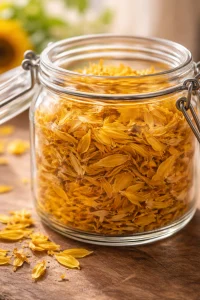 This is the “pretty bottle” approach, but it’s less repeatable. The petals keep extracting during 2F and storage, which can change the flavor over time.
Direct dosing per 16 oz / 473 ml bottle
Sunflower petals: 1/8 to 1/2 teaspoon (or 0.2 to 0.6 g)
Optional: add a tiny pinch of orange peel for lift
Fill with 1F kombucha, sweeten if needed, cap, and ferment.
Important notes for Option B
Expect more sediment and variable extraction.
Use a consistent measuring spoon, and better yet, weigh at least a few bottles to calibrate what “1/4 teaspoon” means for your specific petal cut.
Tell customers to pour gently if you’re selling it, or plan a filtering step post-2F (which reduces carbonation).
Try adding orange peel directly in bottle when you want a bright aromatic pop with minimal plant load.
Troubleshooting (tea + kombucha)
Flat flavor (tea tastes weak, 2F tastes “just kombucha”)
Tea: increase dose slightly (by 0.2 to 0.3 g per cup) or steep 1 to 2 minutes longer.
2F Option A: increase concentrate dose by 5 to 10 ml per bottle.
2F Option B: increase petals slightly, but don’t jump too far or you’ll get sediment and vegetal notes.
Too tart (2F is sharp and aggressive)
Shorten 2F time.
Use less added sugar.
Blend sunflower with rounding botanicals like a small amount of licorice root (in concentrate, not in bottle, so you can control it).
Over-carbonation (gushers, scary pressure)
Reduce added sugar.
Chill before opening.
Shorten fermentation time.
Consider Option A dosing with chilled concentrate and chilled 1F to reduce early CO2 loss and help you measure results.
Sediment overload (cloudy, gritty, lots of floaties)
Switch from Option B to Option A.
Strain concentrate with a finer mesh.
Use less plant material. Sunflower is subtle, you don’t need a lot.
Aroma loss (smells great in the pot, disappears in the cup or bottle)
Cover while steeping.
Keep steep temps under boiling.
Cool concentrate quickly with a covered container.
Store botanicals airtight and away from heat.
Try adding lemon balm leaf in small amounts to reinforce aroma in both tea and 2F without adding harshness.
Storage + quality (keep the sunshine alive)
Sunflower petals are sensitive to humidity and light. If they go stale, they don’t become “dangerous,” they just become boring.
Best practices:
Airtight container: glass jar with a good seal or a high-quality pouch with a zipper.
Cool, dark place: heat and sunlight fade aroma fast.
Low humidity: humidity is the main enemy. If your petals clump, they’re taking on moisture.
Quality cues:
Color fading: from bright yellow to dull straw can signal age or light exposure.
Scent drop: if the aroma is faint even when you crush a petal, it will brew faint.
Taste dullness: the cup tastes like warm water with a memory of flowers.
For production, rotate stock and date your containers. First in, first out is simple, and it prevents “mystery bland batch” problems.
Try adding sunflower petals to a dedicated “floral blend jar” so you’re not opening and closing your main stock constantly.
Safety (compliant, practical, no medical claims)
Sunflower petals are used as a culinary botanical and are enjoyed by many people as a gentle floral tea. That said, everyone’s body is different.
Practical safety notes:
If you have known sensitivities to plants in the Asteraceae family (daisy family), use caution and start with a small amount.
Keep your brewing tools clean, especially for kombucha. Sanitation is non-negotiable if you want stable, safe fermentation.
This article is for food and beverage crafting, not medical advice. Herbalists often talk about traditions and personal experience, but that’s not the same as treating or preventing disease.
If you’re creating products for customers, clear labeling and consistent process control are your best safety habits.
Try adding ginger root only in controlled amounts (especially in 2F) because it can speed up fermentation and carbonation.
FAQ
Is sunflower petals tea caffeinated?
No. Sunflower petals tea is naturally caffeine-free because it’s a floral infusion, not a true tea leaf.
What’s the best water temperature for sunflower petals tea?
185 to 200°F (85 to 93°C). Hot enough to extract aroma, not so hot that it flattens the floral notes.
How much sunflower petals should I use per cup?
A good medium cup is 0.7 to 1.0 g, which is roughly 2 to 2 1/2 teaspoons depending on petal cut.
Can I cold-brew sunflower petals tea?
Yes. Use about 2 g per 16 oz / 473 ml, steep in the fridge 6 to 10 hours, then strain. It’s smooth and lightly floral.
Will sunflower petals add a lot of sediment to kombucha?
Option A (concentrate dosing) keeps sediment low. Option B (direct petals in bottle) creates more sediment and variability.
How long should sunflower kombucha 2F run?
Typically 24 to 72 hours at 70 to 78°F (21 to 26°C). Chill to stop fermentation when you hit the carbonation you like.
What flavors pair best with sunflower in 2F?
Citrus peel, tart flowers, and light herbs. For example: orange peel, hibiscus flowers, and small amounts of lemon balm leaf.
Can I reuse sunflower petals after steeping?
For tea, you can try a second steep, but it will be much lighter. For kombucha concentrate, it’s usually not worth it if you’re chasing consistency.
Conclusion
Sunflower petals tea is an easy, rewarding infusion when you brew it with intention: gentle heat, covered steeping, and measured ratios. The payoff is a cup that feels bright and soft at the same time, like a warm morning. For kombucha makers, sunflower petals tea also becomes a reliable flavor building block. Use the concentrate dosing method for repeatability, track your grams and milliliters, and you’ll get a consistent floral signature without excessive sediment or surprise gushers. Keep your petals airtight and dry, and your sunflower profile will stay vivid from jar to brew to bottle.