Floral Tea Blends That Look Expensive (But Aren’t)
Floral tea blends don’t have to come from rare imports or fancy tins. Most “premium-looking” blends get their vibe from three simple things: color contrast, clean particle size, and a balanced aroma that blooms the second you crack the jar. Once you understand those levers, you can build blends that feel boutique while still using affordable botanicals, measured like a beverage maker, and stored like you mean it.
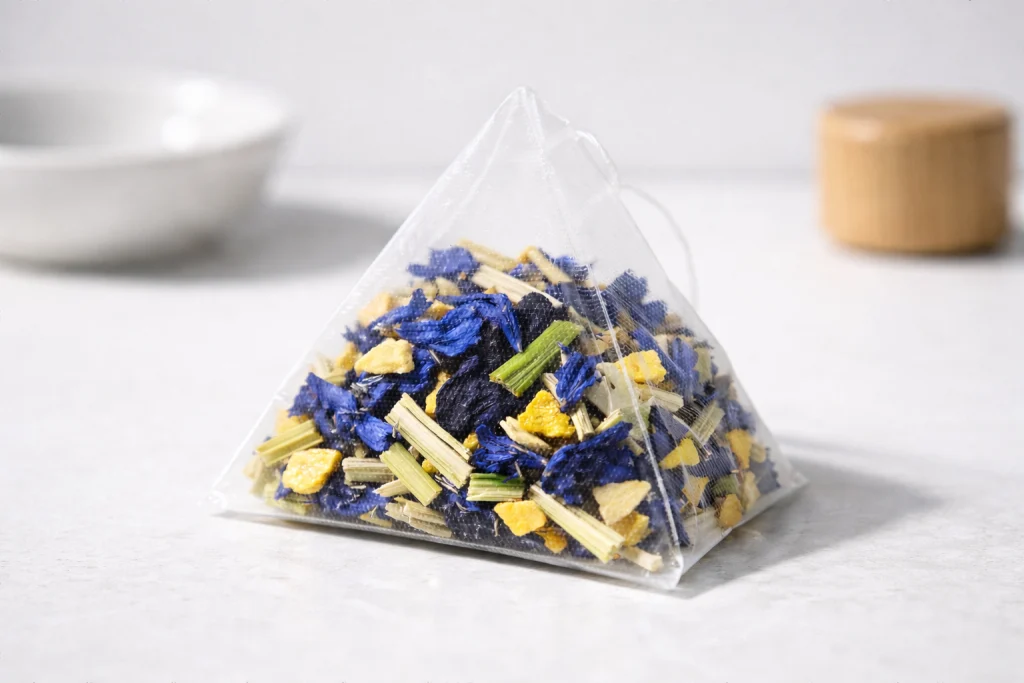
Today we’re leaning on two show-stoppers that do the heavy visual lifting: cornflower’s bright blue confetti and butterfly pea’s deep indigo wash. Together they create a floral tea aesthetic that photographs like a luxury sachet, but the cost stays friendly when you use them as accents rather than the whole blend. We’ll build a few blend “blueprints,” talk texture and clarity, then translate the same logic into kombucha so your 2F bottles look as good as they taste.
This is an herbalist-style approach with production-minded repeatability: grams, teaspoons, steep temps, and a method you can replicate batch after batch without guessing.
The “expensive” illusion: color, contrast, and clarity (floral tea blends basics)
 The most convincing floral tea aesthetic is usually a controlled composition, not an expensive ingredient list. Think like a designer and a tea maker at the same time.
Color contrast: One bold color + one soft neutral reads “intentional.” Cornflower and butterfly pea are the bold color pair here, but you’ll still want a pale base to let them pop. Pale bases are cheap and practical: lemongrass, citrus peel, milky oat tops, or light petals like chamomile.
Particle size: Boutique blends look clean because the pieces are similar in size. Big chunks next to powder reads “random.” Aim for a consistent cut: petals mostly intact, peels in tidy strips, roots in small chips. If you get dust at the bottom of a bag, sift it out for your own kitchen use and keep the retail-looking blend “bright.”
Clarity in the cup: A floral tea aesthetic isn’t only visual in the jar. The brew matters too. Butterfly pea gives a clear, jewel-like infusion when you keep it simple. Overloading with very fine herbs can turn the cup cloudy. Cloudy isn’t “bad,” it’s just not the look we’re going for.
Try adding cornflower petals as a top note that reads instantly “premium” in a clear blend jar.
Try adding butterfly pea flower for that dramatic indigo infusion that transforms with citrus.
Cornflower + butterfly pea: how to use them without blowing your cost
Cornflower is the confetti. Butterfly pea is the dye. Used together with restraint, they create floral tea blends that look like they belong in a boutique.
Cornflower: Use it like garnish. It’s most cost-effective when it’s 3–10% of a blend by weight. You want visible flecks, not a full jar of blue petals.
Butterfly pea: This is your “color engine.” In tea, a little goes a long way. In kombucha 2F, it can turn bottles into blue-to-purple gradients depending on acidity and citrus additions.
Keep them dry and crisp: Both lose impact if they’re humid. Cornflower can dull, butterfly pea can fade. We’ll cover storage cues later, but the big rule is airtight, cool, dark, and low humidity.
Try adding cornflower petals to the top layer of your blend for a “clear sachet” look.
Try adding butterfly pea flower as the base for naturally vibrant blue tea and 2F color.
Ratio cheat sheet: grams and teaspoons for a consistent “studio” blend
This section is your repeatable math. Teaspoons vary by cut and fluffiness, so grams are the anchor. Teaspoons are included because not everyone has a scale at every prep table.
Standard visual blend ratio (makes ~30 g total blend):
Base herb (pale, light) 18 g (about 6 tbsp)
Aroma herb (citrus or minty) 8 g (about 3–4 tbsp)
Color accents:
Butterfly pea 3 g (about 2–3 tsp)
Cornflower 1 g (about 2 tsp, very light and fluffy)
This yields floral tea blends that are bright and “intentional” without overloading cost-heavy petals.
Single mug steep (10–12 oz / 300–350 ml):
2.0–2.5 g blend total (about 1 heaped tsp if the cut is consistent)
Water: 90–96°C (194–205°F) for most blends
Time: 4–6 minutes
If your blend includes more delicate leaf, go 85–90°C and extend steep time slightly.
Color shift trick (for butterfly pea):
Add a tiny squeeze of lemon after steeping. Blue turns violet. That’s not magic. That’s anthocyanins responding to acidity, and it’s a free upgrade to your floral tea blends.
Try adding lemon peel to nudge a brighter aroma and make the blue feel “clean.”
Try adding peppermint leaves when you want a crisp top note without expensive ingredients.
Blend blueprint 1: “Blue Velvet Citrus” (bright, photogenic, approachable)
This is the blend that sells itself in a clear sachet. It’s also forgiving, so it works for home makers and small-batch production.
Blue Velvet Citrus (100 g batch):
Lemongrass (cut) 55 g
Lemon peel 20 g
Butterfly pea flower 18 g
Cornflower petals 7 g
Steeping: 95°C (203°F), 5 minutes.
Taste: clean citrus, soft hay sweetness, blue color that shifts purple with a little lemon juice.
Why it looks expensive: the pale lemongrass base creates negative space, lemon peel adds tidy texture, and the blue petals read like “luxury confetti.” That’s floral tea aesthetic at work.
Try adding lemongrass as the pale base that makes blue accents pop.
Try adding lemon peel to keep the aroma high and the jar visually “bright.”
Blend blueprint 2: “Indigo Garden” (soft floral, tea-party energy, low cost)
This one leans more floral but keeps the budget sane by using a gentle, affordable base.
Indigo Garden (100 g batch):
Chamomile flowers 50 g
Butterfly pea flower 20 g
Lemon peel 15 g
Cornflower petals 10 g
Peppermint leaves 5 g
Steeping: 90–95°C, 5 minutes.
Taste: honeyed chamomile, citrus lift, cool mint finish.
Aesthetic notes: Chamomile’s pale gold acts like a warm spotlight behind the blue. Cornflower is the “expensive sprinkle.” Peppermint keeps it from reading like potpourri.
Try adding chamomile flowers for a pale, honeyed base that photographs beautifully.
Try adding cornflower petals to make the blend look curated, not crowded.
Building your own blend: a simple formula for floral tea blends
If you want to improvise without losing consistency, use this formula. It keeps the floral tea aesthetic strong and the flavor balanced.
The 60/30/10 rule (by weight):
60% base (pale, mild)
30% aroma and body (citrus peel, mint, light spice)
10% accent (color petals and “visual sparkle”)
For cornflower and butterfly pea, that accent 10% can be split like: 7% butterfly pea, 3% cornflower. Or go 5/5 if you want more visible cornflower flecks.
Taste balancing tips:
If it smells amazing but tastes thin: increase base body (lemongrass, chamomile) or add a tiny amount of root chip (ginger) for structure.
If it tastes sharp: reduce peel, add a softer floral base.
If it looks premium but tastes flat: add a small mint fraction (3–8%). Mint is cheap and lifts everything.
This is how you keep floral tea blends without sacrificing “drinkability,” which is what keeps people coming back.
Try adding ginger root in tiny amounts for backbone when a blend tastes too airy.
Try adding peppermint leaves to give a clean finish that reads “fresh” in the cup.
Making it kombucha-friendly: what botanicals behave well in 2F (and why)
Kombucha 2F is not tea steeping. It’s fermentation in a sealed bottle, and botanicals act differently in acidic, carbonated liquid.
 Best performers for 2F aesthetics:
Butterfly pea (color, stable visual impact)
Citrus peel (aroma pops when you open the bottle)
Light petals like cornflower (visual sparkle, but can float and clump)
Use petals as accents, not bulk: In 2F, too many loose petals can trap bubbles, create a messy pour, and increase sediment. The goal is clean bottles that still scream floral tea blends.
Pre-infusions beat chaos: A small tea concentrate added to the bottle gives consistent flavor, less sediment, and repeatable results.
Try adding butterfly pea flower for a dramatic 2F color without needing artificial flavorings.
Try adding lemon peel to brighten aroma when the bottle opens.
Strict, repeatable kombucha 2F method (for 16 oz / 473 ml bottles)
This is built to be consistent. Write it into your batch notes and you’ll get the same result next time.
Option A: Tea concentrate dosing (recommended)
Why it’s better: consistent dosing, less sediment, cleaner flavor extraction, easier scaling.
Make a concentrate (enough for ~8 bottles):
Heat 400 ml water to 90–95°C (194–203°F).
Add 12 g butterfly pea flower + 4 g cornflower petals + 6 g lemon peel.
Steep 8 minutes, covered.
Strain well. Cool to room temperature.
That yields ~350–380 ml concentrate depending on absorption.
Dose per 16 oz / 473 ml bottle:
35–45 ml concentrate per bottle (start at 40 ml)
Optional: 3–8 g sugar per bottle if your kombucha is very dry (about 1–2 tsp)
Top with finished kombucha, leaving 1–1.5 inches headspace
2F timing:
20–24°C (68–75°F): 24–48 hours, burp-test after 24
Warmer rooms carbonate faster. Cooler rooms take longer.
Consistency tips:
Weigh your botanicals for the concentrate.
Use the same steep time and temperature.
Label bottles with concentrate ml and 2F start time.
Keep a “batch notes” page: base kombucha sourness, dosing, room temp, carbonation result.
Try adding butterfly pea flower in the concentrate for reliable color and clean bottles.
Try adding cornflower petals in the concentrate when you want visual flecks without heavy sediment.
Option B: Direct botanicals in bottle (optional)
This is the aesthetic-first method. It looks gorgeous, but it’s less consistent and can increase sediment.
Dosage ranges per 16 oz / 473 ml bottle:
Butterfly pea: 0.5–1.2 g (about 1–2 tsp, depending on flower size)
Cornflower: 0.1–0.4 g (about 1/2–1 tsp, very fluffy)
Lemon peel: 0.3–0.8 g (about 1/2–1 tsp)
Method:
Add botanicals to clean bottle.
Add kombucha, leave headspace.
Cap tight.
2F at room temp 24–48 hours.
Chill fully before opening to reduce volcano effect.
Cleaner pours: decant through a fine mesh or pour gently so petals stay behind.
Try adding lemon peel directly in bottle when you want aroma to hit immediately on opening.
Try adding cornflower petals sparingly for the “luxury confetti” look without sludge.
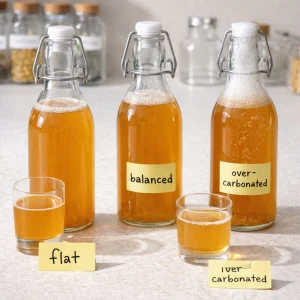
Troubleshooting: flat flavor, too tart, over-carbonation, sediment, aroma loss
Kombucha and tea blends both have failure modes. Here are the ones that matter most for floral tea blends.
Flat flavor (tea or 2F):
Tea: increase steep time by 1–2 minutes, or slightly increase grams per cup.
2F: your base kombucha may be too sour and dry. Add 3–8 g sugar per bottle or shorten 1F next time.
Too tart (2F tastes sharp):
Use less citrus peel.
Dose less concentrate (drop from 45 ml to 30–35 ml).
Blend with a slightly younger kombucha for 2F.
Over-carbonation (bottle gushes):
Reduce sugar additions.
Shorten 2F time.
Chill longer before opening (cold liquid holds CO₂ better).
If using direct botanicals, reduce particulate that triggers nucleation.
Sediment overload:
Switch to concentrate method.
Strain concentrate through a fine mesh.
Use less cornflower in-bottle. It’s fluffy and breaks down.
Aroma loss (smells dull, looks pretty but doesn’t “pop”):
Peel and mint fade with air exposure. Store airtight.
In 2F, aroma is strongest when you open cold and pour gently.
Consider adding peel to concentrate rather than long bottle contact.
Through all of this, keep the goal in mind: floral tea blends should feel intentional, not messy. Clean dosing is what makes “pretty” also taste good.
Try adding peppermint leaves when a blend tastes muted and needs lift.
Try adding lemongrass to soften sharpness and add body without heaviness.
Storage + Quality: keep color, scent, and “premium” texture
Floral tea blends die fast when botanicals go soft. Humidity is the enemy. Light is the slow thief.
Airtight matters more than fancy: Glass jars with tight lids, food-safe pouches with good seals, or tins with inner bags. If you open a jar daily, consider smaller jars so the main stash stays sealed.
Humidity cues:
Cornflower should feel crisp and papery. If it bends without snapping, it’s picked up moisture.
Butterfly pea should keep a deep color. If it looks grayish or washed out, it’s oxidizing or light-damaged.
Scent cues:
Lemon peel should smell bright. If it smells “woody,” it’s stale.
Mint should smell sharp. If it smells like dried hay, it’s past peak.
Color protection: store away from windows, away from heat. For small brands, opaque bags inside a box is a cheap upgrade. For home, a cupboard is perfect.
If you want your floral tea blends to hold, treat botanicals like you’d treat coffee: protect aroma, protect volatile oils, and keep the air out.
Try adding cornflower petals only after you’re sure your storage is truly airtight.
Try adding butterfly pea flower to blends you’ll sell or gift soon so the color is at peak intensity.
Safety and compliant herbal use (no medical claims)
These blends are meant for enjoyment and traditional, food-style use. Herbalists often talk about botanicals in terms of tradition and gentle support, but it’s important to stay grounded.
Use clean, food-grade botanicals from reputable suppliers.
If you’re pregnant, nursing, have a condition, or take medications, it’s smart to check with a qualified professional before making strong herbal routines.
Start with small servings if you’re new to a botanical.
For kombucha, keep basic food safety in mind: clean bottles, clean tools, and proper fermentation handling.
We’re focusing on flavor, aroma, and the floral tea aesthetic. That’s the win here: a beautiful cup and a beautiful bottle, made with care and consistency.
FAQ: quick answers for better floral tea blends
1) What is the easiest way to improve floral tea aesthetic on a budget?
Use a pale base (like lemongrass or chamomile) and add small accents of cornflower and butterfly pea for contrast.
2) How much butterfly pea should I use per cup?
For most blends, 0.3–0.6 g per cup is plenty (roughly 1/2–1 tsp depending on cut), especially if it’s paired with other botanicals.
3) Does cornflower add flavor or mainly looks?
Mostly visual, with a gentle, mild character. It shines as a small accent in a floral tea aesthetic rather than a main ingredient.
4) Can I use these blends in kombucha 2F without making sediment?
Yes. Use the concentrate dosing method and strain well. That keeps bottles cleaner and more consistent.
5) Why did my blue kombucha turn purple?
Butterfly pea pigments shift with acidity. Kombucha is acidic, and citrus pushes it further toward purple.
6) How do I keep aroma strong in dried blends?
Airtight storage, low humidity, and minimal light exposure. Citrus peel and mint lose their pop fastest.
7) How many times should I use the focus phrase for SEO without sounding spammy?
Enough to be clear and consistent, but still natural. Floral tea blends should read like a real guide, not a keyword dump.
8) Can I make sachets that look premium with these blends?
Yes. Keep particle size consistent, avoid dust, and use cornflower as a top-layer accent so it reads “intentional” at first glance.
In the end, a floral tea aesthetic is about discipline more than budget. Use cornflower and butterfly pea as strategic accents, keep your cuts clean, measure like a beverage maker, and store like a pro. You’ll get blends that look expensive, steep beautifully, and translate into kombucha bottles that feel studio-ready without costing studio money.