Affordable Organic Herbs in Bulk: Price, Quality & Storage
Sourcing affordable organic herbs bulk sounds straightforward until you start receiving quotes. The same pound of dried chamomile can range from $4 to $18 depending on the supplier, the certification chain, the harvest year, and whether you’re buying retail-packaged or wholesale-grade stock. That spread is not market noise. It reflects real differences in what you’re actually getting.
For tea blenders, herbal formulators, and small-batch wellness brands, navigating that gap is a core business skill. Getting it wrong means either overpaying on margin or receiving material that fails a certificate of analysis check, smells off by the third batch, or doesn’t hold the sensory consistency your customers expect.
This guide covers the mechanics of organic herb pricing, how to evaluate quality before it reaches your facility, which herbs belong in every formulator’s baseline inventory, and how storage decisions directly affect your effective cost per batch. Whether you’re placing a first test order or scaling into multi-hundred-pound runs, the framework is the same.
What Buyers Should Know About Affordable Organic Herbs in Bulk
The first thing to clarify when evaluating affordable organic herbs bulk is that USDA Organic certification is a floor, not a ceiling. It confirms the herb was grown without synthetic pesticides, herbicides, or fertilizers under a certified operation. It says nothing about moisture content, microbial load, heavy metal levels, or whether the material was handled correctly between harvest and shipment.
That’s why a Certificate of Analysis matters as much as the organic certificate. A COA from an accredited third-party lab should show moisture percentage (below 10% is the standard threshold for most dried herbs), aerobic plate count, yeast and mold counts, and ideally a pesticide screening even on organic lots. For production buyers, request the COA before committing to a lot.
Cut grade is the other variable buyers consistently underestimate. Cut and sifted (C&S) is the standard for most tea and extract applications. It gives consistent particle size for brewing and filling, and it blends more evenly than whole-leaf material. Whole flowers and whole leaves are worth a price premium only when visual presentation drives your product’s appeal. Powders are efficient for capsule and topical formulations but oxidize faster once opened due to increased surface area.
Minimum order quantities vary considerably across suppliers. Boutique wholesale operations often allow one- to five-pound trial quantities. Commercial distributors typically require 25 pounds or more per SKU. Knowing your monthly usage rate per herb helps you set reorder points that avoid both stockouts and the slow degradation that comes with sitting inventory.
Sourcing and Quality Indicators
Price per pound tells you almost nothing in isolation. Bulk Organic Herbs from established growing regions carry decades of cultivar refinement that shows up in the final product. Egyptian chamomile, Bulgarian lavender, and Indian tulsi aren’t just geographic labels. They reflect specific soil chemistry, altitude, and harvest timing that affect oil content and therefore the aroma and flavor performance your customers taste.
Sensory inspection is your fastest diagnostic at intake. Aromatic herbs should smell immediate and sharp when you open the bag. Peppermint should hit you with menthol before you even get close. If the scent is flat, faint, or musty, the material was either stored too long, dried at excessive temperatures, or both.
Visual cues matter equally. Organic Calendula Flowers in good condition are vivid orange to golden yellow, with petals that hold their shape and a slight tackiness from resin content. Pale, brittle, or uniformly tan petals signal UV exposure or heat damage. The same principle applies across flower botanicals: color saturation is a reliable proxy for oil and resin integrity.
Always ask for lot numbers and harvest dates. Any supplier who cannot provide this data lacks the traceability that production buyers need. If a lot’s harvest date puts leaf or flower material past 18 months, negotiate a price reduction or pass entirely.
How Pricing Tiers Work: From Sample Orders to Production Runs
Organic herb pricing follows a predictable volume curve, but the inflection points differ by category. For high-demand commodity herbs like peppermint and chamomile, meaningful price breaks often appear around 10 to 25 pounds. For specialty roots or flowers, you may need to commit to 50 pounds or more before seeing a significant per-pound reduction.
When evaluating whether a supplier genuinely offers affordable organic herbs bulk pricing, compare cost-per-ounce at three volume tiers: your current order size, twice that volume, and five times that volume. If the price curve flattens quickly, the supplier is structured for retail, not wholesale. A true wholesale supplier shows meaningful reductions at each step, often 15 to 30% savings per pound by the 25-pound mark.
Freight matters more than buyers expect. A $0.50 per-pound difference between two suppliers can disappear when one ships from across the country. Factor in dimensional weight, shipping frequency, and whether the supplier offers freight minimums before making sourcing decisions on price alone. Payment terms are also negotiable with established suppliers. Net-30 terms on recurring orders lower your effective carrying cost and improve cash flow, which is part of the real economics of buying at volume.
Core Herbs Worth Stocking at Volume
Building a baseline inventory starts with herbs that perform across multiple SKUs, justify storage footprint, and hold quality reliably when stored correctly.
Organic Chamomile Flowers belong at the top of that list. German chamomile (Matricaria chamomilla) works across tea blends, tinctures, bath products, and topical formulations. Its apple-adjacent aroma is broadly appealing, and blenders use it as a base note that softens sharper botanicals like peppermint or ginger.
Organic Peppermint Leaf is another non-negotiable baseline. Menthol content is the key quality variable. High-quality cut and sifted peppermint should carry 1 to 1.5% volatile oil by weight. If you’re blending for a menthol-forward product, ask your supplier for assay data before committing to a lot.
Organic Lavender Flowers from high-altitude Bulgarian or French farms typically carry higher linalool and linalyl acetate concentrations than lower-altitude varieties. These compounds drive both the scent profile and the calming sensory quality associated with lavender in aromatherapy applications.
For berry-forward and visually striking blends, Organic Elderberries add tartness and a deep violet steep color that makes finished products stand out on retail shelves.
Calendula: The Multipurpose Workhorse for Formulators
Few botanicals earn shelf space across as many product categories as calendula. Organic Calendula Flowers appear in tea blends, facial oils, salve bases, bath soaks, and cosmetic colorants. The petals steep to a warm golden hue and contribute a mildly bitter, slightly resinous flavor that adds depth without overpowering a blend.
For skincare makers, the triterpenoid and flavonoid resin fraction is the active component. Petal quality matters more in topical applications than in tea: you want vibrant, intact petals with visible resin, not broken fragments. A low-heat infusion at 1 part dried petals to 5 parts carrier oil by weight, held at 95 to 110°F (35 to 43°C) for 48 to 72 hours, preserves the resin fraction better than a hot infusion method.
In tea formulations, calendula pairs naturally with organic chamomile flowers for a soft floral base, or with organic rosehips for a vitamin C-adjacent citrus layer that works well in wellness blends. Available in bulk for production-scale batches, calendula is one of those ingredients where buying ahead of demand makes practical sense. Whole dried petals stored under ideal conditions (below 65°F / 18°C, below 60% relative humidity, sealed from light) hold quality for up to 24 months.
Storage That Protects Your Investment
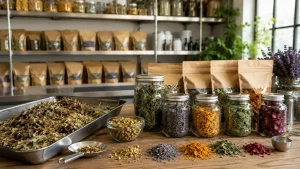
Even affordable organic herbs bulk loses its value quickly if stored incorrectly. The three variables that degrade dried herb quality are heat, humidity, and light. Managing all three simultaneously is what separates a 12-month effective shelf life from a 24-month one.
Temperature is the most controllable factor. Most dried herbs maintain quality longest below 65°F (18°C). A climate-controlled storage room or a cool corner of a warehouse achieves this in most climates. Avoid storing near HVAC units, loading dock doors, or exterior walls in hot climates, since temperature cycling accelerates degradation faster than sustained moderate heat.
Humidity is the more insidious variable. Target below 60% relative humidity for most dried plant material. At higher humidity, moisture content rises and microbial growth becomes a real risk, particularly for powders and finely cut material. Sealed Mylar bags or airtight food-grade containers are standard for bulk storage. Kraft bags with heat-sealed liners offer a short-term option but less moisture protection than rigid containers.
Light bleaches pigments and degrades volatile compounds. Store in opaque containers or in a darkened room. The color loss you’d see in calendula or chamomile after UV exposure mirrors the same degradation happening to aromatic compounds you can’t observe directly.
Label every container with herb name, supplier, lot number, harvest date, and your receiving date. First-in, first-out rotation is the minimum standard for any multi-lot inventory.
Safety Considerations for Formulators
Bulk herb sourcing comes with regulatory responsibilities that vary by application type. Whether you’re producing tea, supplements, or topical products, understanding what you can and cannot claim is essential.
Organic Echinacea Root is traditionally used in immune support formulations and is among the most studied Western herbs in ethnobotanical literature. Herbalists often recommend it as a seasonal support ingredient. For production use, consult the applicable regulatory framework (FDA for US supplements, Health Canada for Canadian market products) before finalizing any label language.
Several commonly formulated herbs, including chamomile, calendula, and echinacea, belong to the Asteraceae (daisy) family. Individuals with known sensitivities to plants in this family should exercise caution. This is a relevant disclosure for product labeling, particularly in food and supplement contexts.
No herb formulation should make disease claims. Phrases like “traditionally used for,” “may support,” and “herbalists often recommend” keep marketing copy on the right side of regulatory guidance. Avoid any language that implies diagnosis, treatment, or cure. Maintain clear labeling with botanical names and lot traceability for every ingredient in your facility.
FAQ
What does USDA Organic certification actually cover for bulk herbs?
USDA Organic certification confirms that the herb was grown under a certified organic operation without synthetic pesticides, herbicides, or fertilizers. It does not certify moisture content, microbial load, or post-harvest handling. Always request a Certificate of Analysis from the supplier to evaluate those factors independently.
How many pounds should I start with when testing a new supplier?
A one- to five-pound test order is standard for evaluating a new supplier’s material before committing to larger quantities. This gives you enough to assess aroma, color, cut consistency, and brewing performance without significant financial risk.
What is the best storage container for bulk dried herbs?
Airtight food-grade containers, sealed Mylar bags, or food-safe buckets with gasket lids are the most reliable options for bulk herb storage. Rigid containers provide better moisture and oxygen barriers than film bags for long-term storage of anything over 25 pounds.
How do I know if bulk herbs have gone bad?
The primary indicators are faded color, a flat or musty aroma, and texture that crumbles to fine dust rather than breaking into recognizable plant material. For any lot approaching or past 18 months from harvest, request a new COA before using in production.
Is it cost-effective to buy affordable organic herbs bulk as a small producer?
Yes, provided you’re realistic about usage rates and storage capacity. Overstocking herbs you won’t use within 18 months effectively raises your per-unit cost. Start with your two or three highest-volume herbs at bulk quantities, then expand as your production cadence justifies it.
Can I use the same bulk herbs for both tea blends and skincare formulations?
Many herbs serve both applications, but check the cut grade and quality spec for each use case. Calendula, chamomile, and lavender are common to both categories. Skincare formulations often require higher resin or volatile oil content than tea applications, so source-grade specifications matter more in that context.
What certifications should I look for beyond USDA Organic?
Look for suppliers who maintain Good Manufacturing Practice (GMP) compliance, hold current organic certificates with visible certifying agent names, and can provide third-party COAs with batch-specific results. Some suppliers also carry Kosher or Halal certification, which may be relevant depending on your customer base.
How does buying in bulk affect cash flow for small formulators?
The upfront cost is higher, but the per-unit cost is lower and you reduce the frequency of reorder logistics. The practical trade-off is storage space and the risk of overstock degradation. Net-30 payment terms, when available, help mitigate the cash flow impact of larger initial orders.
Building a sustainable sourcing strategy around affordable organic herbs bulk comes down to three things: understanding what certification and testing actually protect you, selecting herbs with broad application across your product line, and storing correctly to defend your margin. When you buy with clarity on grades, volume pricing, and shelf life, purchasing in bulk becomes a competitive advantage rather than a liability. Hatton Naturals supplies these ingredients in wholesale quantities for formulators who need consistency from batch to batch.