How to Calculate Cost Per Cup for Your Tea Brand
Every successful tea brand eventually has to confront the numbers, and the most revealing number in your entire cost structure is your tea brand cost per cup. It tells you whether your pricing is sustainable, where your margins are leaking, and how much room you have to grow without losing money. Many small brands underestimate their true cost per cup by focusing only on the herb itself and ignoring the compounding effect of packaging, labor, spoilage, and overhead. The result is a product that looks profitable on the surface but erodes margin with every order.
Getting this calculation right from the beginning saves you from having to reprice products later. This post walks through every component of the cost per cup formula, with real examples and the formulas you need to calculate your own numbers. Visit the Hatton Naturals shop for bulk ingredient pricing to use in your own calculations.
Why Cost Per Cup Is the Most Important Number in Tea Pricing
Retail margins in the specialty tea category typically run between 50 and 70 percent, and wholesale margins run between 30 and 50 percent. To hit those targets, you need to know with precision what it costs you to produce one cup of your tea. Your tea brand cost per cup is the foundation everything else is priced from. The calculation seems simple: divide your ingredient cost by the number of cups per package. But that version leaves out costs that consistently undermine small brand profitability. Packaging materials, fill labor, shrinkage, storage, and compliance costs all belong in the number. When you include them, your cost per cup may be 30 to 60 percent higher than your ingredient cost alone suggests.
Step One: Calculate Your Ingredient Cost Per Cup
The ingredient cost starts with your blend recipe and bulk pricing. A standard single-serve portion for most herbal teas is between 1.5 and 3 grams. For a chamomile blend with a two-gram serving size: if you source chamomile flowers whole at $20 per pound, your cost per gram is approximately $0.044. At two grams per serving, your chamomile cost per cup is $0.088.
For a blend that is 60 percent chamomile and 40 percent peppermint at $15 per pound ($0.033/gram), your blended ingredient cost per cup at two grams is: (0.60 x 2g x $0.044) + (0.40 x 2g x $0.033) = $0.053 + $0.026 = $0.079. This is your starting number. Everything else adds to it.
Step Two: Add Packaging Costs
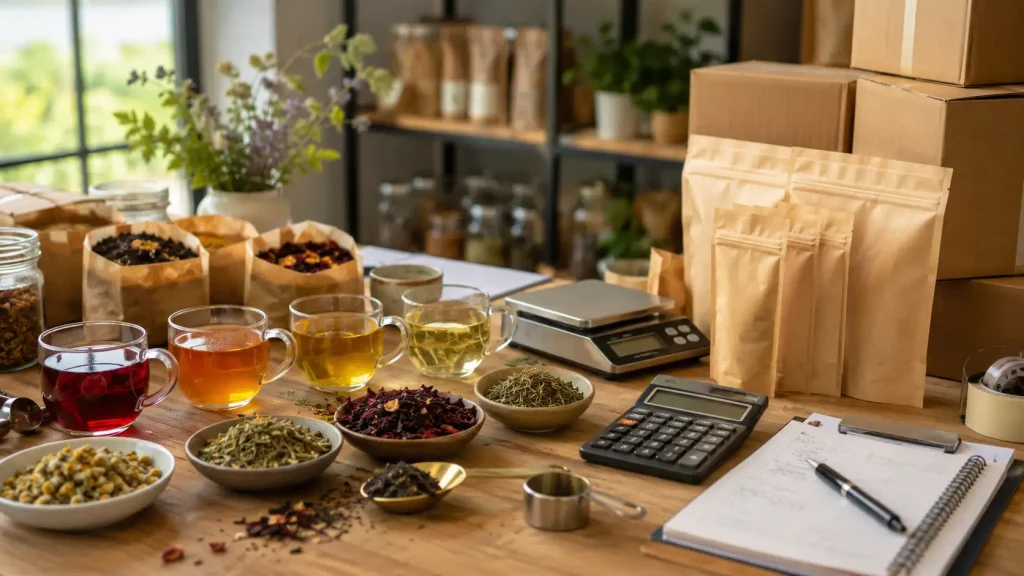
Packaging is one of the most variable and commonly underestimated costs. A standard paper tea bag costs $0.02 to $0.06 per unit. A heat-sealed pyramid sachet costs $0.08 to $0.18 per unit at small volumes. The outer retail box adds $0.15 to $0.50 per unit. For a 20-count box, divide box cost by 20 for per-cup contribution.
Using round numbers: if total per-cup packaging cost (bag plus box share) is $0.20, your tea brand cost per cup is now $0.079 + $0.20 = $0.279. That is already more than three times your ingredient cost alone.
Step Three: Account for Labor and Fill Costs
Fill labor is the cost of getting blend into packaging. For manual operations, a realistic rate is 200 to 400 units per hour. At $20 per hour and 300 units per hour, labor cost per cup is approximately $0.067. Adding to our example: $0.279 + $0.067 = $0.346. Your tea brand cost per cup is now nearly four times the ingredient cost.
Step Four: Include Overhead, Waste, and Shrinkage
Overhead includes facility costs, equipment depreciation, certifications, insurance, and software. Divide total monthly fixed overhead by cups produced per month. If overhead is $500 and you produce 2,000 cups per month, overhead per cup is $0.25. Shrinkage (dust, overweigh corrections, rejected batches, damaged packaging) runs three to five percent. Multiply combined ingredient plus packaging cost by 1.04 to 1.05 to capture average waste.
Step Five: Apply Margin and Set Your Retail Price
With a fully loaded tea brand cost per cup, apply your target margin. For a 60 percent retail margin, divide cost by 0.40. Using our example with overhead: $0.346 + $0.25 = $0.596. Minimum retail price per cup: $0.596 / 0.40 = $1.49. For a 20-count box, that is approximately $29.80 minimum retail. Cross-check against competitive market pricing to ensure viability.
What Buyers Should Know
Small differences in bulk pricing compound significantly at the cup level. A $2 per pound difference in chamomile pricing translates to roughly $0.009 per cup, but across 50,000 cups per year it represents $450 in ingredient savings. When comparing supplier pricing, always normalize to cost-per-gram or cost-per-cup. Factor in minimum order quantities, because a lower per-pound price with a 50-pound minimum may require more capital than your cash flow allows. Explore ingredient options at the Hatton Naturals shop and contact the team for volume pricing.
Sourcing and Quality Indicators
The tea brand cost per cup calculation is only as reliable as the ingredient specs you work from. Herbs with higher moisture content deliver fewer active grams per pound, inflating real cost per cup. Always source from suppliers who provide moisture content data on COAs. Cut-and-sift grade herbs fill more uniformly than whole herbs, making portion control more consistent. Organic certification adds sourcing cost but often allows premium retail pricing that more than offsets it.
Safety
All ingredients in finished tea products should meet applicable food safety standards including microbial testing, heavy metal screening, and pesticide residue testing. Ingredient COAs should be current and lot-specific. Language like “may support,” “traditionally used for,” or “herbalists often recommend” keeps claims within appropriate boundaries.
Frequently Asked Questions
What is a typical tea brand cost per cup for specialty herbal tea?
A fully loaded cost per cup typically falls between $0.40 and $1.20 depending on herb selection, packaging format, and production volume.
Should I include my own time in the calculation?
Yes. Including market-rate labor cost prepares you for scaling. If pricing does not account for labor, your business is only profitable because you subsidize it with your time.
How much does organic certification affect cost per cup?
Organic ingredients cost 20 to 50 percent more per pound, but organic positioning supports retail prices 20 to 40 percent higher than non-organic equivalents.
What serving size should I use?
Use the serving size you plan to specify on your label, typically 1.5 to 3 grams for herbal teas. Build your cost model around that fixed number.
How do I handle price fluctuations?
Build a dynamic spreadsheet where you can update ingredient prices and see cost per cup and margin impact instantly. Revisit pricing at least every six months.
What margin should a tea brand target at retail?
Most specialty tea brands target 55 to 65 percent gross margin at retail. Wholesale margins to retail accounts are typically 40 to 50 percent.
How does packaging format affect cost per cup?
A basic paper tea bag in a simple box can cost $0.10 to $0.20 per cup in packaging. A pyramid sachet in a premium printed box can cost $0.35 to $0.60 per cup.
A clear and fully loaded tea brand cost per cup is the foundation of sustainable pricing. Ingredient cost is just the starting point. Add packaging, labor, overhead, and waste, then build your margin. Visit the Hatton Naturals shop for ingredient pricing, or reach out directly to discuss sourcing at your volume.