Tea Blending for Beginners: How to Start
Tea blending for beginners is one of the most rewarding creative projects in the herbal world — and far more accessible than most people expect. You do not need professional training, exotic equipment, or an expensive collection of ingredients to start crafting custom herbal blends. A handful of quality dried herbs, a basic understanding of flavor categories, and a willingness to experiment are all it takes to begin.
Why Blend Your Own Herbal Teas?
Commercial herbal teas are convenient, but they come with limitations. The ingredient ratios are fixed, the herbs may not be the freshest, and the selection is shaped by mass-market preferences rather than your personal taste. Blending your own teas puts you in complete control.
Furthermore, blending allows you to craft teas tailored to your specific flavor preferences and needs. If you find chamomile slightly too sweet on its own, you can add a small amount of lemon balm for brightness or a pinch of lavender for complexity. Moreover, custom blends make thoughtful, personalized gifts that commercial teas simply cannot replicate. Tea blending for beginners starts with understanding the building blocks of a good blend.
Understanding Flavor Categories
Every successful herbal blend begins with an understanding of how different herbs contribute to the overall flavor profile. Experienced blenders typically think in terms of four categories: base herbs, supporting herbs, accent herbs, and functional herbs.
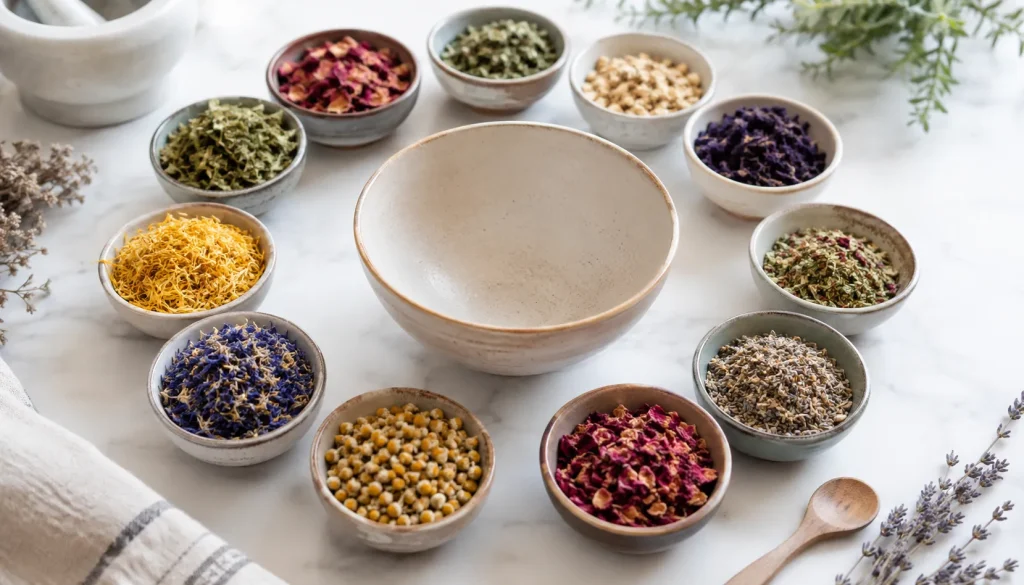
Base herbs form the foundation of the blend. They are typically mild, smooth, and high volume. Good base herbs include chamomile flowers, lemon balm, and rooibos. They provide drinkability and body without overwhelming more delicate accent flavors.
Supporting herbs add character and complexity to the base. Peppermint and spearmint are classic supporting herbs that add freshness and energy to almost any blend. Rose hips add tartness and vitamin C-rich brightness. Additionally, nettle leaf adds a mineral, grassy depth that grounds lighter floral blends.
Accent herbs are used in small amounts — often five to fifteen percent of the blend — to add distinctive character without dominating. Lavender flowers are a perfect accent herb: used sparingly, they add floral complexity; used too heavily, they become overwhelming. Similarly, hibiscus adds a vivid ruby color and tart acidity that transforms any blend it enters — a little goes a long way.
Functional herbs are added for their traditional properties rather than primarily for flavor. Examples include adaptogenic herbs like ashwagandha or tulsi. They may not contribute dramatic flavor, but they bring the traditional associations that many blenders are looking for.
The Golden Ratios for Tea Blending Beginners
One of the most helpful frameworks for tea blending beginners is the 60-30-10 ratio. Roughly sixty percent of your blend should be base herbs, thirty percent supporting herbs, and ten percent accent herbs. This ratio naturally produces balanced, drinkable blends in most situations.
However, these are starting points, not rules. After brewing and tasting your initial blend, adjust proportions to suit your palate. If the mint is too strong, reduce the supporting herb percentage. If the blend lacks character, add a touch more accent herb. As a result, a few iterations usually produce something genuinely excellent.
Record every batch you make, including the proportions used and your tasting notes. This simple habit transforms random experiments into a reproducible collection of personal blends that you can brew again and again. Therefore, even your earliest attempts have value as reference points for future development.
Three Simple Starter Blends to Try
Starting with proven combinations builds confidence before you begin experimenting freely. These three blends are designed with the tea blending beginners framework in mind — balanced, approachable, and easy to brew.
Calm Floral: 50% chamomile, 30% lemon balm, 15% lavender, 5% rose petals. This is a classic relaxation blend with sweet floral character and gentle complexity. It is one of the most popular starting points for beginner blenders because all four herbs work harmoniously together.
Bright Berry: 40% hibiscus, 30% rose hips, 20% peppermint, 10% lemon peel. This blend produces a vivid ruby-colored tea with a tart, fruity flavor and a cool mint finish. It can be served hot or cold. Furthermore, it is naturally caffeine-free and makes an excellent afternoon iced tea.
Garden Mint: 50% peppermint, 30% chamomile, 15% spearmint, 5% lavender. This is a refreshing, clean-tasting blend that works equally well as a morning tea or a post-dinner digestif. The chamomile base softens peppermint’s intensity and rounds out the overall flavor profile effectively.
Equipment for Tea Blending Beginners
You do not need specialized equipment to begin tea blending for beginners. A kitchen scale that measures in grams is the single most useful tool — measuring by weight rather than volume produces consistent results and makes scaling recipes easier. Additionally, a set of small glass jars for storing finished blends, a tea strainer or infuser, and a notebook for recording recipes are all you need to get started.
More advanced blenders sometimes use a mortar and pestle to lightly crush harder ingredients like dried rose hips or cinnamon chips. This increases surface area and speeds up flavor extraction. However, this is optional at the beginner stage.
Common Mistakes to Avoid
The most common mistake in tea blending for beginners is overcomplicating the blend. Adding too many herbs at once makes it difficult to identify which herb is contributing which flavor note. Consequently, starting with three to four ingredients and mastering that combination before adding more components produces much better results.
Another common error is using too much of a strongly flavored accent herb in the first attempt. Lavender, cloves, and hibiscus are extremely aromatic and can easily overpower a blend. Start with half of what you think you need — you can always add more in the next batch.
Safety and Precautions
When blending herbal teas, research each ingredient before including it in a blend intended for regular consumption. Some herbs have contraindications for pregnancy, specific medications, or medical conditions. For example, certain herbs should be avoided during pregnancy, and others may interact with blood thinners or sedatives. Blend with herbs you have researched and understand. This content is for informational purposes only and does not constitute medical advice.
Frequently Asked Questions
What herbs should beginners start with?
Chamomile, peppermint, lemon balm, rose hips, hibiscus, and lavender are ideal starting herbs for tea blending beginners. They are widely available, affordable, and have well-established flavor profiles that are easy to work with. These herbs also combine well with each other, making early experiments more likely to succeed.
Do I need a scale to blend herbal teas?
A kitchen scale that measures in grams is strongly recommended. Measuring by volume (teaspoons) produces inconsistent results because different herbs have very different densities. A small, inexpensive digital scale makes your recipes reproducible and far easier to scale up when you want to make larger batches.
How do I know if my blend is too strong or too mild?
Brew a small test batch — one teaspoon of your blend per eight ounces of water for five minutes — and taste it. Note which flavors are too dominant and which are too subtle. Then adjust your ratios in the next batch. Recording your tasting notes makes this iteration process much more efficient.
Can I blend herbal teas with Camellia sinensis (black, green, white) teas?
Yes. Black, green, and white teas can serve as the base for herbally enhanced blends. Green tea and chamomile is a classic pairing. White tea and rose petals is another popular combination. Just note that adding Camellia sinensis introduces caffeine and tannins, which affect both flavor and brewing parameters.
Tea blending for beginners is a journey that grows more rewarding with every batch. Browse our complete collection of organic botanicals and find the ingredients for your first custom blend today.