Virgin Coconut Oil: Best Uses in Herbal Prep & Body Care
There is a reason virgin coconut oil has held a place in tropical medicine chests, temple rituals, and kitchen pantries for thousands of years. Long before it appeared on any wellness brand ingredient list, this oil earned its role through consistent performance. The extraction process explains a lot. Virgin coconut oil comes from fresh coconut meat without heat or chemical processing. That preserves a fat profile unlike any other common plant oil. It works as a cooking medium, a carrier for herbal actives, and a base for topical formulations. The scent alone confirms its quality: a clean, faintly sweet tropical aroma signals minimal processing and high lauric acid content.
This article gives herbal formulators and DIY body care makers a full practical picture. You will find a botanical breakdown, traditional use context, and detailed application methods across both internal and topical categories. Specific guidance covers pairing virgin coconut oil with botanicals like turmeric, calendula, and lavender. The goal is enough specificity to make smarter sourcing and formulation decisions, whether you blend ten jars or three hundred.
Botanical Profile
Coconut oil comes from Cocos nucifera, a member of the Arecaceae (palm) family. The “virgin” designation means the oil was extracted from fresh coconut meat, typically within hours of opening. Producers use cold-pressing or low-heat centrifugal separation to preserve the oil’s natural character. Refined coconut oil follows a different path. Processors make it from dried copra using high heat and often chemical bleaching. That strips the aroma and alters the minor compound profile significantly.
The coconut palm is native to coastal tropical regions across South and Southeast Asia. The Philippines, Indonesia, India, and Sri Lanka account for most commercial cultivation. Individual palms begin bearing fruit at five to six years and produce for 60 to 80 years. In equatorial zones, they fruit year-round.
Producers extract the oil from the endosperm of the seed, the white meat of the mature coconut. Most plant oils run predominantly unsaturated. Virgin coconut oil runs the opposite direction: approximately 90% saturated fat. Medium-chain triglycerides (MCTs) make up around 60% of total fat content. Lauric acid alone accounts for 45 to 52% of the fatty acid composition. Only human breast milk reaches that lauric acid concentration.
Traditional and Modern Uses
Ayurvedic medicine has documented coconut oil use for over 4,000 years. Classical texts describe it as a base for medicated oils in a practice called taila. Practitioners cook herbs slowly into the oil at low heat to transfer active compounds. Craftspeople in Kerala, India still produce Kshirabala taila and Brahmi taila using this method today.
Pacific Island traditions placed coconut oil at the center of topical care across Polynesia, Micronesia, and Melanesia. Practitioners infused local botanicals directly into the oil for wound care and scalp treatments. Traditional Ayurvedic oil pulling also used coconut oil as its base. That practice functions as a traditional oral hygiene ritual rather than a therapeutic treatment.
Modern applications have expanded considerably. Virgin coconut oil now appears in functional food products, botanical extract formulations, pharmaceutical ointment bases, cosmetic serums, and massage oil blends. It melts at approximately 76°F (24°C), which makes it mechanically useful for stick formulations like lip balms and lotion bars. It also resists oxidative rancidity better than most unsaturated plant oils, which extends the practical shelf life of finished formulations.
How to Use Virgin Coconut Oil in Herbal Preparations
Temperature is the most important variable in any infused oil. Volatile and heat-sensitive plant compounds begin degrading well below cooking temperatures. For herbal infusions intended to preserve aromatic and resinous fractions, hold the oil between 95 and 110°F (35 to 43°C) for 24 to 72 hours. This low-and-slow approach consistently outperforms faster high-heat methods.
Start with a ratio of 1 part dried herb by weight to 5 parts oil by weight. For a more concentrated extract, drop to 1 part herb to 3 parts oil. That ratio requires more careful monitoring to prevent localized overheating. Always use fully dried plant material. Residual moisture from fresh or inadequately dried herbs introduces water into the oil matrix. Water accelerates microbial growth and dramatically shortens shelf life.
Turmeric Powder and virgin coconut oil
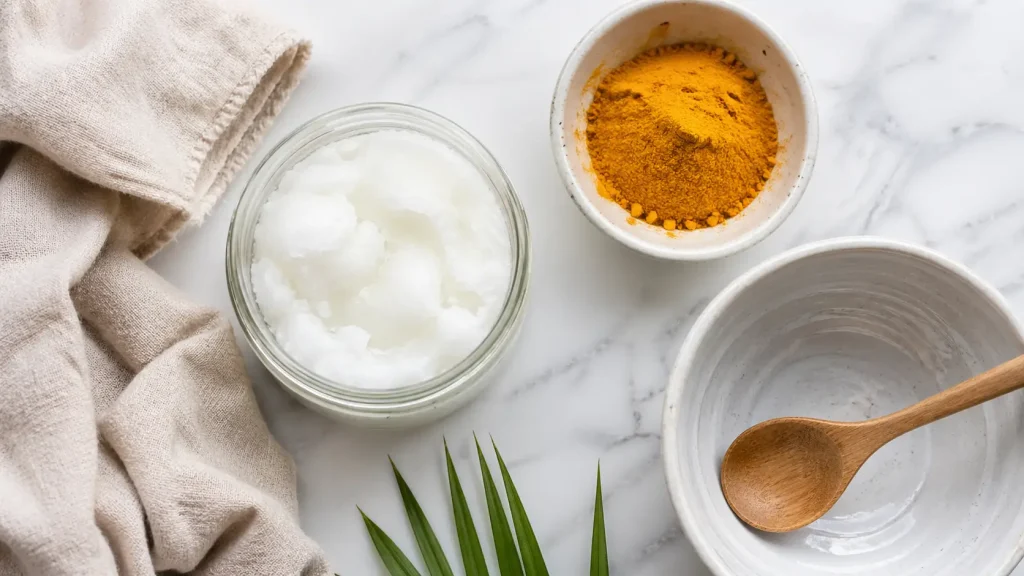
Turmeric Powder pairs exceptionally well with virgin coconut oil. Curcumin, the primary polyphenol in turmeric, is fat-soluble. An oil matrix improves its bioavailability in both oral and topical applications compared to water-based preparations. For a golden oil, combine 3 grams (approximately 1 teaspoon) of turmeric powder per 100 grams of oil. Warm gently at 100°F (38°C) for 30 minutes with continuous stirring, then strain through fine mesh or cheesecloth. The result is a vivid amber oil with a warm, earthy aroma. Available in bulk for production-scale batches, this pairing serves as a stable entry point for any wellness formulation line.
Calendula Flowers and virgin coconut oil
Organic Calendula Flowers and virgin coconut oil form an established pairing in the herbalism tradition. Calendula’s triterpenoid and flavonoid resin compounds transfer effectively into oil at low heat. Use the same 1:5 ratio and allow 48 hours for the slow infusion. Strain thoroughly, since any residual plant material reduces shelf life.
Lavender Flowers and virgin coconut oil
Organic Lavender Flowers suit aromatherapy-aligned body care formulations well. The linalool and linalyl acetate compounds that define lavender’s calming scent do transfer partially into oil infusions. The concentration lands lower than in steam-distilled essential oil, though. For production-level scent consistency, add a small quantity of lavender essential oil to a lavender-infused coconut oil base after the infusion step rather than relying on the infusion alone for fragrance.
Virgin Coconut Oil as a Body Care Base
Virgin coconut oil is occlusive rather than emollient in the classical sense. It sits on the skin surface longer than lighter oils like jojoba or rosehip. That makes it highly effective for barrier protection but potentially heavy for daytime facial use on most skin types. In body care formulations, this property works in your favor.
For a basic whipped body butter, melt virgin coconut oil with Organic Shea Butter at a 1:1 ratio by weight. Allow the mixture to cool to approximately 65°F (18°C), then whip with a hand mixer until it turns opaque and fluffy. Add botanical powders or essential oils at trace. This base holds structure at room temperature in most climates below 75°F (24°C) and stays shelf-stable for 12 to 18 months when kept sealed and dry.
Lip balm production is one of the highest-volume applications for virgin coconut oil in small-batch cosmetic manufacturing. A functional starting formula combines 30% coconut oil, 30% beeswax, and 40% a softer butter or heavier oil by weight. The coconut oil’s melting point keeps balm texture firm enough for tube filling. At skin temperature, the same characteristic delivers comfortable slip.
For scalp and hair treatments, virgin coconut oil’s low molecular weight allows partial penetration into the hair shaft. Apply it to dry hair 30 to 60 minutes before shampooing, then wash out. This reduces hygral fatigue, the mechanical stress hair undergoes when it swells during water absorption. It makes a particularly useful ingredient in protein-rich formulations for fine or color-treated hair care lines.
Sourcing and Quality Indicators
Quality in virgin coconut oil largely depends on freshness at extraction. The best producers process the oil within four to six hours of cracking the coconut. This minimizes free fatty acid development from enzymatic activity in the exposed meat. Lower-quality producers work from coconuts left sitting for 24 hours or more after harvesting. That delay raises free fatty acid percentages and produces a less clean flavor and aroma.
At intake, assess virgin coconut oil across three sensory criteria. Aroma should be clean, mildly sweet, and coconut-forward. Any rancid, sour, or chemical note signals a problem. Color should be pure white when solid and perfectly clear when liquid. A yellow tint in the liquid state or a grayish cast when solid points to contaminated processing equipment or temperature-variable storage. Texture when solid should be smooth and uniform. Grainy texture means temperature cycling occurred during storage, causing fractionation of the fat crystal structure.
Look for USDA Organic, Non-GMO Project Verified, and a current COA showing free fatty acid content below 0.5%, peroxide value below 10 mEq/kg, and moisture below 0.1%. These numbers confirm freshly processed, properly stored material.
Safety Considerations
Most skin types tolerate virgin coconut oil well topically. Its comedogenic rating of 4 out of 5, however, makes it a poor primary facial carrier for individuals prone to pore congestion. For body care and hair applications, this is rarely a relevant concern.
Internally, herbalists often recommend coconut oil as part of traditional dietary practice in cultures where it has served as a food staple for generations. Contemporary nutritional science continues evaluating the implications of its high saturated fat content for different populations. For supplement or functional food products, review applicable regulatory guidelines before finalizing any label claims.
Turmeric at culinary quantities is generally recognized as safe. At higher concentrations in supplement formulations, consult regulatory guidance for your market. Some individuals report digestive sensitivity to large quantities of curcumin-rich preparations. Lavender and calendula carry broad recognition as low-risk botanicals for external use. Herbalists traditionally use both for topical wellness applications. Individuals with known plant allergies, particularly to the Asteraceae family, should perform a patch test before broad topical application.
Organic Echinacea Root is traditionally used in seasonal immune support formulations and pairs well with coconut oil as a base for infused preparations. Traditional practice does not recommend it for extended continuous use, so consult current ethnobotanical literature for formulation guidance before building it into a production formula.
FAQ
What makes virgin coconut oil different from refined coconut oil for herbal use?
Virgin coconut oil comes from cold-pressing fresh coconut meat, which preserves its natural aroma, minor compounds, and a cleaner fatty acid profile. Refined coconut oil uses high heat on dried copra, removing most of the scent and altering the micronutrient fraction. For herbal infusions and body care, virgin performs better because its unprocessed character supports a higher-quality finished product.
Can I use virgin coconut oil as the sole carrier in a botanical infusion?
Yes, and it performs well as a standalone carrier for fat-soluble plant compounds. Blending it with a lighter oil like jojoba at a 50:50 ratio gives a finished product better skin absorption and a lighter feel. That combination works particularly well for facial serums and daily-use body oils.
How long does a coconut oil herbal infusion last?
A properly made infusion using fully dried herbs, stored in an airtight container away from heat and light, typically holds quality for 12 to 18 months. The carrier oil’s peroxide development usually limits shelf life before the botanical content degrades. Label all batches with the infusion date and assess the aroma at the six-month mark.
Is virgin coconut oil suitable for all skin types in body care formulations?
It works well for dry, mature, and body-application skin types. For acne-prone or oily facial skin, its comedogenic profile makes it a poor primary ingredient. In formulations where coconut oil stays below 10% of the total formula, comedogenicity becomes less of a concern.
What ratio of turmeric to coconut oil produces the best color for a body product?
Start at 1 to 2 grams of turmeric powder per 100 grams of oil for a golden hue with mild warmth. Push up to 3 grams per 100 grams for a more saturated amber result. Strain well to avoid an exfoliating texture in products intended for smooth application.
Does virgin coconut oil need a preservative in DIY body care?
Anhydrous formulations contain no water and therefore do not require broad-spectrum preservatives. Microbial growth needs water to establish. If your formula introduces any water phase (aloe vera, hydrosols, extracts), add a preservative system. Keep all tools and containers dry and sterile at the point of formulation regardless of formula type.
How should bulk virgin coconut oil be stored in a production facility?
Store it below 76°F (24°C) in a cool, dark location using food-grade sealed containers. At this temperature the oil stays solid, which is ideal for long-term storage. Repeated melting and resolidifying cycles do not harm the oil but can cause textural changes. Keep containers sealed to prevent absorption of ambient odors.
Can virgin coconut oil be used in tea or tincture preparation?
Oil and water do not mix without an emulsifier, so it does not suit aqueous tea preparations. It works well as a base for fat-based tinctures, sometimes called oleoresins or infused oils, where target compounds are fat-soluble. Curcumin from Turmeric Powder is a textbook example: it extracts far more effectively into oil than into water.
Virgin coconut oil remains one of the most versatile carrier ingredients available to herbal formulators and body care producers. Its stability, fat profile, and broad compatibility with dried botanicals make it a high-value stocking ingredient at any production scale. Sourcing virgin coconut oil in wholesale quantities from a certified organic supplier gives you a reliable foundation for consistent, scalable formulation across multiple product categories.