Wholesale Organic Calendula Flowers: Buyer’s Guide
For formulators in the tea, skincare, and wellness industries, sourcing organic calendula flowers bulk wholesale is a decision that affects product quality, visual appeal, and brand credibility. Calendula officinalis has been cultivated for centuries, prized for its vivid golden-orange pigment, mild herbaceous flavor, and traditional use in skin-soothing preparations. Today, demand for organic calendula spans tea blenders looking for a striking finishing botanical, cosmetic manufacturers formulating salves and balms, and supplement brands exploring calendula’s traditional properties. This guide covers everything a wholesale buyer needs to know: botanical grades and forms, quality evaluation methods, storage best practices, creative product applications, and the sourcing benchmarks that protect your investment. By the end, you will have a clear framework for purchasing calendula at scale with confidence.
Understanding Calendula Grades and Forms
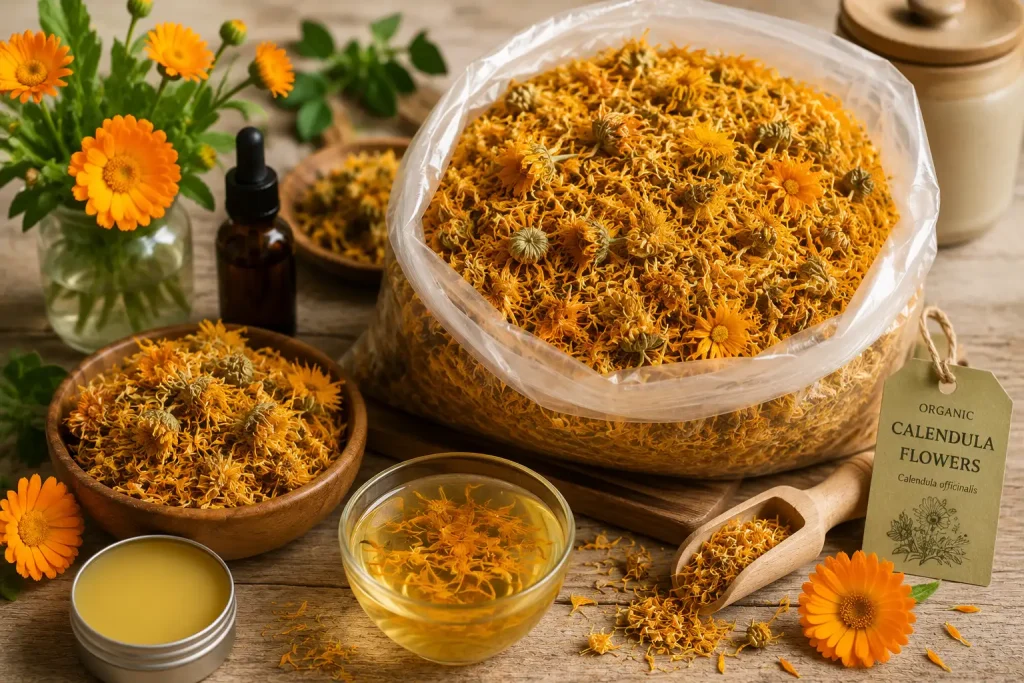
Calendula reaches the wholesale market in two primary forms, and the distinction between them matters for your application. Whole flowers consist of the entire flower head, including the receptacle (the green base) and the ray florets (the colorful petals). Organic Calendula Flowers Whole are the preferred format for premium loose-leaf tea blends, potpourri, and decorative applications where the intact bloom creates visual impact in the cup or on the shelf.
Whole petals (also called separated petals or ray florets) are the individual orange and yellow petals stripped from the flower head. Calendula Petals Whole offer a lighter texture, more uniform color distribution, and faster infusion in hot water. Tea blenders favor petals when they need consistent color release without the slight bitterness that the green receptacle can contribute. Cosmetic formulators also prefer petals for oil infusions, because the petal material yields a cleaner, more vibrantly colored extract.
When purchasing organic calendula flowers bulk wholesale, specify the form in your order. Receiving whole flowers when your recipe calls for petals (or vice versa) creates production delays and potential waste.
Why Organic Certification Matters for Calendula
Calendula is a relatively easy crop to grow organically, which makes certified organic supply more accessible than for some other botanicals. However, the certification itself carries significant value for downstream buyers. Organic certification assures your customers that the calendula was cultivated without synthetic pesticides, herbicides, or fertilizers. For skincare brands marketing “clean” or “natural” formulations, organic calendula is often a non-negotiable ingredient.
Verify your supplier’s organic certificate through the USDA organic integrity database. Confirm the certificate is current, covers the specific product form you are ordering, and is issued by an accredited certifying agent. The Bulk Organic Herbs collection at Hatton Naturals carries USDA-certified organic calendula with full traceability documentation.
What Buyers Should Know About Calendula Quality
Quality in dried calendula comes down to four observable markers: color, aroma, moisture content, and purity. Mastering these evaluations protects you from subpar material.
Color. Premium calendula petals display a deep orange to golden-yellow hue. Browning at the petal tips indicates heat damage during drying or extended storage. Pale, washed-out petals suggest overexposure to light or an aged lot. When you source organic calendula flowers bulk wholesale, request a photo of the current lot alongside your COA to verify color before committing.
Aroma. Fresh dried calendula has a subtle, slightly resinous, herbaceous scent with faint honey undertones. It should never smell musty, fermented, or flat. The aroma is mild compared to lavender or chamomile, so any off-notes are easy to detect.
Moisture content. Target lots with moisture below 12 percent. Excess moisture shortens shelf life and creates conditions for mold. Your COA should include a moisture reading from the testing laboratory.
Purity. Examine the sample for stem fragments, leaf material, insects, or foreign matter. A small percentage of stem is acceptable in whole-flower grades, but petal-only products should be clean and uniform. Excessive foreign matter signals careless processing.
Sourcing and Quality Indicators for Wholesale Calendula
Egypt, India, and parts of Eastern Europe are the primary origins for commercial calendula production. Egyptian calendula is widely available and generally offers good color and consistency at competitive pricing. Indian calendula tends to feature slightly smaller flower heads but can deliver excellent petal color when sourced from reputable farms.
The best suppliers of organic calendula flowers bulk wholesale maintain direct relationships with growing cooperatives. This closeness to the source enables lot-specific traceability and more consistent quality compared to brokers who aggregate material from multiple anonymous farms. Ask your supplier about their origin sourcing and whether they can provide harvest-date information for each lot.
Testing beyond the standard COA adds another layer of assurance. Some buyers request HPLC analysis for flavonoid content (particularly quercetin and isorhamnetin glycosides), which serves as a marker for botanical potency. While not mandatory for tea or cosmetic use, this data can support marketing claims about product quality and help justify premium pricing.
Applications in Tea and Beverage Blending
Calendula’s role in tea blends is primarily visual and mildly flavor-contributing. The petals steep to produce a warm golden liquor that photographs beautifully and signals “premium” to the consumer. In terms of flavor, calendula adds a gentle, slightly peppery herbaceousness that rounds out floral and citrus blends without overpowering them.
Popular blending combinations include calendula with chamomile for a golden “sunshine” tea, calendula with lavender and lemon balm for a relaxation blend, and calendula with rooibos and vanilla for a caffeine-free evening cup. In each case, the calendula petals serve double duty: flavor accent and visual garnish.
For cold beverages, calendula petals infuse well in room-temperature water over four to six hours, creating a naturally tinted base for herbal iced teas. The color holds through refrigeration, making calendula a practical alternative to artificial colorants for beverage brands committed to clean labels.
Applications in Skincare and Cosmetics
Calendula has a long tradition in topical preparations. Herbalists have recommended calendula-infused oils and salves for centuries, traditionally valued for soothing dry or irritated skin. In modern cosmetic formulation, calendula appears in facial oils, body balms, lip products, baby care lines, and bath soaks.
For oil infusions, whole petals are the standard material. The petals are steeped in a carrier oil (olive, sunflower, or jojoba) at low heat for several hours or at room temperature for four to six weeks. The resulting infused oil carries the characteristic golden color and the lipophilic compounds that give calendula its traditional skin-care reputation. Purchasing organic calendula flowers bulk wholesale for infusion work requires particularly clean, low-moisture material to prevent rancidity in the oil.
Bath and body brands also use whole flowers as a visual ingredient in bath tea bags, shower steamers, and decorative soap embeds. The intact flower head creates an artisanal look that communicates craftsmanship and natural sourcing to the customer.
Storage and Handling for Bulk Quantities
Dried calendula is relatively stable when stored properly, but its pigments are sensitive to light. UV exposure breaks down the carotenoid compounds responsible for the orange-gold color, leaving petals pale and visually unappealing. Store all calendula inventory in opaque containers or in a dark storage area. Food-grade poly-lined kraft bags with zip closures work well for quantities up to 10 kilograms. For larger volumes, sealed drums or bins with desiccant packs provide adequate protection.
Temperature should remain below 22 degrees Celsius, and humidity below 60 percent. Under these conditions, dried calendula maintains peak quality for 12 to 18 months. Whole flowers tend to hold up slightly better than separated petals because the intact structure offers some physical protection to the inner florets.
Handle calendula gently during transfer and blending. The petals are delicate and fragment easily when compressed or agitated roughly. Use wide-mouth scoops and avoid stacking heavy containers on top of calendula inventory. For blending operations, add calendula as the final ingredient after heavier botanicals like elderberries or ginger root have been mixed, so the petals sit on top and maintain their visual integrity in the finished blend.
Pricing Factors and Volume Considerations
Calendula pricing reflects the labor intensity of harvest and processing. The flowers are typically hand-picked at peak bloom, which limits mechanization and drives per-kilogram costs higher than many leafy herbs. Petal-only grades carry an additional premium because the separation step adds processing labor and reduces yield per flower.
Volume discounts for organic calendula flowers bulk wholesale generally begin at five kilograms and deepen at 25 and 50-kilogram increments. For brands using calendula primarily as a visual accent at five to 10 percent of blend weight, even modest orders last through many production cycles. Calculate your annual usage across all SKUs before ordering, so you can hit the volume tier that optimizes your per-kilogram cost without overstocking material that may lose color over extended storage.
Request pricing for both whole flowers and petals, even if you have a preference. In some market conditions, the price gap between forms narrows enough that upgrading to your preferred format costs less than expected.
Safety and Regulatory Notes
Calendula officinalis is generally recognized as safe for food and cosmetic use. It appears on the FDA’s GRAS list for food flavorings and is permitted in cosmetic formulations in the United States and European Union. However, calendula belongs to the Asteraceae (daisy) family, which means individuals with sensitivities to ragweed, chrysanthemums, or marigolds may experience allergic reactions. Include an advisory on your product labeling when calendula is a named ingredient.
Avoid therapeutic claims in product marketing. Statements like “heals wounds” or “treats eczema” cross regulatory boundaries. Instead, use language rooted in tradition: “herbalists have traditionally valued calendula for its skin-soothing qualities” or “calendula has been used in folk preparations for centuries.” This approach respects the botanical’s heritage without triggering regulatory action.
For cosmetic products sold in the EU, ensure your calendula supplier can provide documentation compliant with the EU Cosmetics Regulation, including allergen testing and compliance with permitted ingredient lists.
Frequently Asked Questions
What is the difference between calendula and common marigold?
Calendula officinalis (pot marigold) is a distinct species from Tagetes (common garden marigold). Only Calendula officinalis is used in herbal and cosmetic applications. Ensure your supplier specifies the botanical name to avoid confusion between these unrelated plants.
Can I use calendula flowers in tea bags?
Yes. Separated petals work best for tea bags because they distribute evenly and steep consistently. Whole flowers are better suited for loose-leaf formats where the visual impact of the intact bloom adds value when you buy organic calendula flowers bulk wholesale for tea blending.
How long does dried calendula last?
Properly stored dried calendula maintains peak quality for 12 to 18 months. After that period, the color fades and aroma diminishes, though the material remains safe for use. Prioritize fresh stock for products where color is a key selling point.
Is organic calendula significantly more expensive than conventional?
The organic premium for calendula is typically 15 to 30 percent above conventional pricing. For brands marketing organic or clean-label products, this premium is easily recovered through higher retail pricing and stronger consumer trust.
What carrier oil works best for calendula infusions?
Olive oil and sunflower oil are traditional choices for calendula infusions. Jojoba oil is popular in cosmetic formulations for its stability and skin compatibility. Choose a carrier oil that complements your finished product’s texture and shelf-life requirements.
How do I know if my calendula supplier is reliable?
Evaluate consistency across multiple lots, responsiveness to documentation requests, willingness to provide samples, and transparency about origin and processing. A supplier who proactively shares COAs and communicates about supply conditions is a strong long-term partner.
Can calendula be used in products for sensitive skin?
Calendula has a long tradition of use in preparations for sensitive and delicate skin, including baby care products. However, always conduct patch testing during product development, and note the Asteraceae family connection for allergy-prone consumers.
What volume should I order for my first calendula purchase?
Start with one to two kilograms to validate quality in your specific application. Once satisfied, scale to a volume that covers three to six months of production. This balances freshness with the cost savings of larger orders.
Sourcing premium organic calendula flowers bulk wholesale positions your brand to deliver products that are visually stunning, aromatically genuine, and aligned with consumer demand for clean, traceable ingredients. Whether you are blending teas, formulating skincare, or developing wellness products, calendula’s versatility rewards buyers who prioritize quality at the sourcing stage. Explore Organic Calendula Flowers Whole and Calendula Petals Whole alongside the full Bulk Organic Herbs catalog to find the grade, form, and volume that fits your production needs.