St John’s Wort and Appetite: What Herbalists Traditionally Say
The phrase st john’s wort loss of appetite comes up a lot in traditional herbal conversations, usually as a small observation rather than a headline claim. Herbalists tend to talk about appetite in a sensory, lived way: the smell of food, the “yes” feeling in the belly, the way tension, overwork, or a frazzled day can flatten hunger. St John’s Wort (that sunny yellow herb that stains the fingers) is more famously discussed in old herbals for the “nerves” and the mood of the spirit, yet traditional notes sometimes mention appetite shifting when the nervous system feels more settled. This article stays in that traditional lane while giving you a production-minded, tea-maker-friendly approach, especially if you’re blending St John’s Wort with chamomile whole flowers for a gentle cup that tastes like late afternoon light.
You’ll get practical ratios in grams and teaspoons, brewing temperature and timing, a clean blending workflow, how herbalists traditionally frame appetite without overpromising, and how to troubleshoot flavor and aroma so your blend stays consistent from jar to cup. No drama, no hype. Just careful craft and the kind of detail you’d jot in a notebook beside a warm mug.
What herbalists traditionally mean when they talk about appetite
When herbalists discuss st john’s wort loss of appetite, it’s rarely presented as “this herb fixes that.” More often, appetite is treated as an outcome of rhythm: sleep, stress, digestion comfort, and the simple ability to relax enough to receive a meal. In older traditions, the appetite conversation tends to circle three practical questions.
First, is the appetite low because the body feels tense or hurried? A person can be “fine” and still eat like an afterthought. Second, is appetite low because the senses feel dulled (taste, smell, desire)? Third, is the belly uneasy, so hunger gets ignored or overridden?
St John’s Wort is traditionally framed as a bright plant for the inner weather. Chamomile, in contrast, is often described as soothing and settling, especially when the day has been sharp around the edges. Together, they make a blend that tastes calm, with a soft floral sweetness that doesn’t shout. For tea makers, this is useful because it’s a blend people can actually drink consistently, and consistency is often what traditional herbalists value most: the daily ritual that gives the body a chance to respond.
Try building your blend with St John’s Wort as the lead herb and chamomile whole flowers as the aromatic cushion.
St John’s Wort and appetite in traditional practice (without hype)
If you’ve heard st john’s wort loss of appetite discussed, it may be in two very different tones. One tone is overly confident. The other is more nuanced: “Some people notice appetite returns when they feel more settled.” Traditional herbalists often describe St John’s Wort as a plant for the part of a person that gets run down by long stress, gray days, or a sense of being “rubbed raw.” In that framing, appetite can change because the nervous system is part of eating. You can’t taste a peach properly when your shoulders are up around your ears.
This is also where chamomile shines. Whole flowers bring a round, honeyed aroma that signals comfort before the first sip. From a production angle, chamomile also helps smooth the cup if your St John’s Wort is a bit grassy or resinous.
Two craft notes that matter: St John’s Wort’s aroma is delicate and can fade with light and heat; chamomile is fragrant but can go stale if it absorbs humidity. If you want a consistent customer experience (or just your own reliable jar), you treat the herbs like ingredients, not decorations: protected from light, sealed from humidity, and blended with a repeatable ratio.
For a grounding botanical backbone that doesn’t compete, consider adding a small touch of lemon balm leaf to the blend.
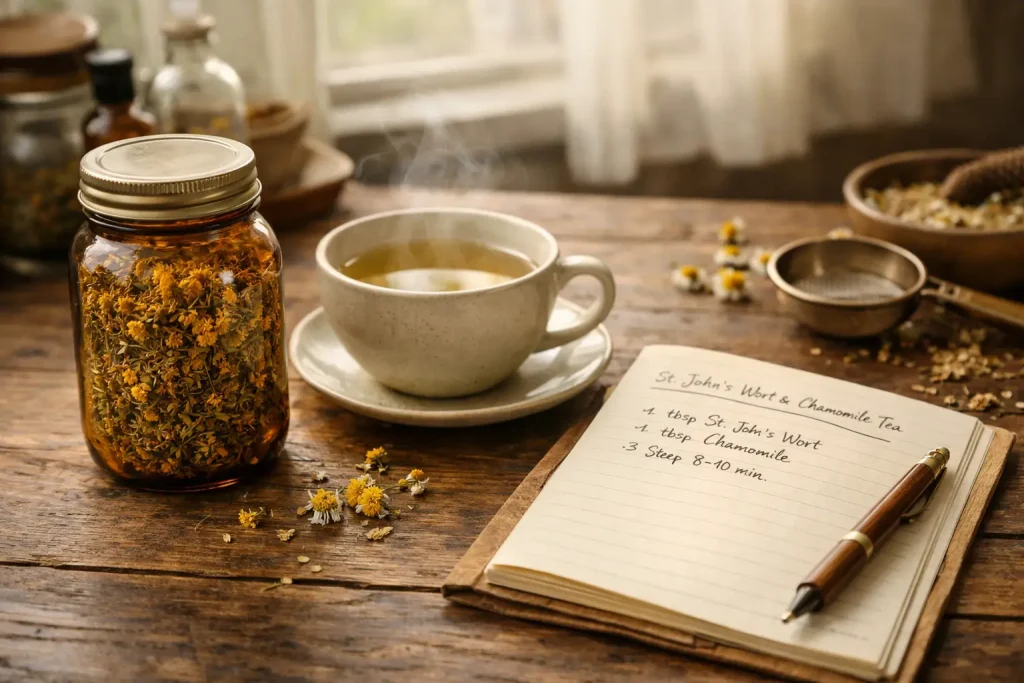
St John’s Wort + Chamomile Tea Whole Flowers blend formula (grams + teaspoons)
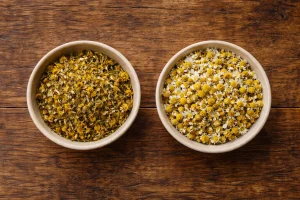 This is a practical, small-batch formula designed for a balanced cup and repeatable production. It’s built for sensory harmony first. If you’re exploring st john’s wort loss of appetite as a traditional topic, this ratio keeps the blend gentle and drinkable.
Batch size: 100 g finished blend
St John’s Wort (cut/sifted aerial parts): 55 g (about 11 tablespoons)
Chamomile whole flowers: 35 g (about 20 tablespoons, whole flowers are fluffy)
Lemon balm leaf (cut/sifted): 10 g (about 6 tablespoons)
Why this works: St John’s Wort leads, chamomile rounds and sweetens, lemon balm lifts the aroma and softens the grassy edge.
Single-cup brewing dose (8–10 oz / 240–300 ml):
2.5 g total blend (about 2 teaspoons) for a light cup
4 g total blend (about 1 heaping tablespoon) for a fuller cup
Water and time:
Use water at 90–95°C (194–203°F). Pour, cover, and steep 8–10 minutes. Covering matters because the aroma is part of the experience and it’s the first thing you lose.
Try making your first test batch with St John’s Wort and chamomile whole flowers only, then layer in lemon balm leaf once you know your base profile.
Brewing technique that protects aroma and keeps the cup smooth
For tea makers, a “good” cup isn’t only about herb choice. It’s about the small moves that protect volatile aromatics and prevent harshness. If your goal is a comforting blend that fits the traditional conversation around st john’s wort loss of appetite, you want a cup that invites a second sip.
Cover the vessel. Use a mug with a lid, a small teapot, or even a saucer. Chamomile’s sweetness and St John’s Wort’s subtle resin notes lift upward with steam. If you don’t trap them, you lose them.
Use just-under-boil water. A rolling boil can flatten delicate florals. 90–95°C is hot enough to extract well but kinder to aroma.
Don’t over-agitate. Stir once at the start and once halfway. Too much agitation can push fine particles into the cup and make the finish taste dusty.
Strain with intention. A fine mesh strainer gives a cleaner cup. If you like a rustic cup, a looser strain is fine, but expect more sediment and a stronger “field herb” impression.
If you want a warmer, deeper note without citrus peel powders, a tiny addition of cinnamon chips can give the blend a soft bakery warmth.
Taste architecture: making “gentle” actually interesting
A gentle tea can be boring if it’s only soft. The craft is to make it gentle yet layered. That’s where tea makers can go beyond the typical internet chatter about st john’s wort loss of appetite and build a blend people remember.
Think in three layers.
Top notes (first sniff): chamomile, lemon balm, a hint of brightness.
Mid notes (first sip): floral sweetness and mild green character.
Base notes (aftertaste): warm, faintly resinous, clean.
If your St John’s Wort lot is more grassy, lean on chamomile slightly higher. If your chamomile is intensely apple-sweet, keep it at 35% and let St John’s Wort carry the center.
Optional micro-adjustments for a more complex cup (per 100 g batch):
Add 3–5 g lavender buds for a perfumed top note (go easy, it dominates fast).
Add 5–8 g spearmint leaf for a brighter finish and a “clean mouth” feel.
These small additions keep your blend interesting without turning it into a perfume cloud. And they keep the cup consistent with the traditional vibe: calm, sunny, practical.
Try a test version with a touch of lavender buds if you want a more aromatic “evening light” profile.
Production notes: blending workflow, particle size, and jar consistency
When you blend for yourself, you can eyeball. When you blend for repeatability, you standardize. If you’re writing or selling around st john’s wort loss of appetite, customers expect the jar to taste the same next month.
Particle size: Aim for compatible cuts. If St John’s Wort is very fine and chamomile is whole and puffy, the blend will segregate. Either slightly crush the chamomile (gently, by hand) or use a cut chamomile grade. If you keep whole flowers (beautiful), accept that you must instruct “shake before use.”
Blending method (small batch):
Weigh each ingredient separately.
In a wide bowl, add the largest-volume ingredient first (usually chamomile).
Sprinkle the smaller-cut leaves over the top.
Add St John’s Wort last and fold gently from the bottom up for 60–90 seconds.
Rest 10 minutes, then fold again for 30 seconds. This rest helps aromatics settle and reduces dust.
Jar fill: Don’t pack tight. Packed jars crush flowers, releasing aroma early and shortening shelf life. Fill loosely and use wide-mouth jars.
Label habit: Note lot dates. St John’s Wort can lose brightness faster than you think if stored poorly. Lot tracking is how you keep quality honest.
For a mellow “green” accent that blends well at similar cut size, consider nettle leaf in tiny amounts for future experiments.
Troubleshooting: flat flavor, too tart, over-carbonation, sediment, aroma loss
Even if you’re not making kombucha here, tea makers deal with the same sensory problems. These issues can make people assume the blend “doesn’t work,” which is especially common when the conversation is already loaded like st john’s wort loss of appetite. Fix the cup first.
Flat flavor: Usually stale chamomile or too-low dose. Increase dose from 2 tsp to 1 heaping tbsp per cup, and steep covered for 10 minutes. Check that chamomile still smells sweet and strong.
Too tart: This blend shouldn’t be tart. Tartness often comes from contamination of your palate expectations (people used to hibiscus) or from pairing it with acidic foods. If it reads sharp, reduce lemon balm slightly, or add 3–5 g cinnamon chips per 100 g batch for warmth.
Over-carbonation: If you’re using this tea as a base for a sparkling herbal soda, excessive fizz usually means too much sugar or too warm a ferment. Reduce priming sugar and ferment cooler. For tea-only use, skip this.
Sediment: Caused by overly fine cut leaf or aggressive stirring. Use a coarser cut for lemon balm, stir less, and strain through finer mesh. Also consider a short “settle” of 30 seconds before pouring.
Aroma loss: Most often from leaving jars open, storing near heat, or using clear containers in light. Use amber glass or a closed tin, keep it cool and dark, and avoid repeated opening during production. Consider packing in smaller jars so you’re not exposing the whole batch daily.
If you want to reinforce aroma without adding citrus peels, a touch of spearmint leaf can lift the nose dramatically.
Storage + quality: how to keep the yellow herb bright
St John’s Wort is called the “yellow herb” for a reason. Quality is visible. If you’re making a blend associated with st john’s wort loss of appetite, the visual and aromatic cues matter because they build trust.
Airtight: Use jars with good seals or tins with snug lids. Oxygen exposure dulls aroma and fades color.
Humidity control: Flowers are humidity magnets. If your storage area is damp, include food-safe desiccant packs in bulk storage bins (not in retail jars unless you know your compliance). Keep herbs off the floor and away from steam sources.
Light protection: Light steals color. Use amber glass, opaque tins, or store clear jars inside a cabinet.
Quality cues to check monthly:
Color: St John’s Wort should look greenish with yellow highlights, not brown-gray.
Scent: Chamomile should smell sweet and apple-like, not dusty or weak.
Cup aroma: The steam should carry floral notes. If it smells like hot water and grass, your aromatics are fading.
Shelf rhythm: For best sensory quality, cycle this blend faster than heavy-root blends. Smaller batches more often usually taste better than one huge batch that sits.
For a gentle floral component that stores well when kept dry, lavender buds are stable and helpful in small percentages.
Safety: traditional language, real-world cautions, no medical claims
When discussing st john’s wort loss of appetite, keep the language compliant and honest. Herbalists traditionally share patterns, not promises. Everyone’s body is different, and appetite can change for many reasons.
Use compliant phrasing: “traditionally used,” “herbalists often use,” “may support,” “some people notice,” “commonly included in calming blends.”
Important real-world caution: St John’s Wort is known to interact with a number of medications and can change how the body processes them. If someone is taking prescription medications, pregnant, nursing, or managing a complex health situation, they should consult a qualified clinician before using St John’s Wort. Also note that some people report increased sensitivity to sunlight with St John’s Wort.
Keep it practical: Offer the tea as a ritual for settling and sensory enjoyment, not as treatment. In traditional herbal practice, the cup itself matters: warmth, aroma, the act of pausing.
If you want a similar calming ritual without St John’s Wort for some customers, a chamomile-forward blend with lemon balm leaf and spearmint leaf can be a gentle alternative.
How tea makers can talk about appetite respectfully and usefully
If you sell or share blends, you want to educate without pushing. Appetite is personal. It’s also easy to accidentally overstate. The best approach is to describe what the tea does in the cup and in the ritual. For people searching st john’s wort loss of appetite, clarity is kindness.
Talk about:
- Sensory effects: “soft floral aroma,” “comforting evening cup,” “a pause before meals,” “a gentle daily ritual.”
- Process: “steep covered,” “use just-under-boil water,” “dose adjustments for a stronger cup.”
- Consistency: “shake the jar,” “store away from light,” “freshness cues.”
And if you want to offer a pairing beyond the base two ingredients, choose herbs that match the tone. Lemon balm and spearmint make sense. Lavender works in tiny amounts. Cinnamon chips can warm the finish.
Try encouraging customers to experiment with chamomile whole flowers alone first, then blend with St John’s Wort once they know what each herb tastes like.
FAQ
What does st john’s wort loss of appetite mean in traditional herbal talk?
It’s usually discussed as an observation that appetite can shift when someone feels more settled, not as a guaranteed effect.
Can I drink St John’s Wort + chamomile tea daily?
Many herbalists use gentle teas as daily rituals, but St John’s Wort has known medication interactions. Check with a qualified clinician if that applies to you.
What’s the best steep time for this blend?
8–10 minutes, covered, with water around 90–95°C (194–203°F).
Why does my tea taste weak even with good herbs?
Increase the dose, steep covered, and confirm your chamomile still smells sweet and strong (stale herbs go flat).
How do I reduce sediment in the cup?
Use a coarser cut, stir less, let it settle briefly, and strain through a fine mesh.
Can I adjust the formula for a more aromatic cup?
Yes. A tiny amount of lavender buds or spearmint leaf can lift aroma without overpowering.
How long does the blend stay fresh?
It depends on storage. Airtight, dry, and away from light keeps aroma longer. Check color and scent monthly.
Is it okay to combine St John’s Wort with other herbs?
Tea makers often blend it with gentle aromatics like chamomile and lemon balm, but keep blends simple and be mindful of St John’s Wort cautions.