Schisandra Berry Health Benefits: Tradition + Brewing Guide
The phrase schisandra berry health benefits gets tossed around a lot, but herbalists usually mean something specific: a long history of traditional use, a distinct five flavor profile, and a berry that behaves like a “formula ingredient” more than a simple fruit tea. Schisandra (often called “five flavor berry”) can read bright and tangy, then resinous, then subtly salty, with a drying finish that feels tidy on the palate. It is the kind of herb you learn by brewing repeatedly, taking notes, and adjusting like a maker.
In this guide, you’ll get tradition-forward context without medical claims, plus production-minded brewing parameters (ratios, water temp, time, filtration), sensory checkpoints, and pairing ideas designed for tea blends and ready-to-bottle infusions. We’ll also lean into one of my favorite companions for schisandra: lemon myrtle, which brings a clean citrus lift without needing actual citrus peel. If you want a blend that feels apothecary-classic yet modern, start here. ☕🌿
schisandra berry health benefits in traditional practice
When herbalists talk about schisandra berry health benefits, they’re often pointing to how schisandra was traditionally used in East Asian herbalism as a “tonic” berry, valued for resilience and steadiness over time. In classic practice, it was not treated as a quick fix. It was used as part of a broader pattern of daily or seasonal support, frequently combined with other botanicals to balance intensity and make it easy to take consistently.
Taste is part of the tradition. Schisandra’s five flavors are not a gimmick, they are a clue. Herbalists use flavor as a compass: sour and astringent notes can feel tightening and clarifying; sweet rounds edges; bitter and pungent notes add depth; the salty trace can read mineral and grounding. None of that is a medical promise. It’s a sensory language that helps makers build blends people actually want to drink regularly.
If you’re building a tea line, schisandra is also “label-friendly.” It has a strong identity, a story rooted in tradition, and a flavor that stands up in blends without needing artificial flavoring. For sourcing and batch consistency, start with schisandra berries and evaluate aroma, berry integrity, and the color of the brew across multiple steeps.
Flavor architecture: what to expect in the cup
Schisandra infusions tend to land ruby to garnet, depending on ratio and time. The aroma can be berry-bright with a faint piney or citrusy resin note. On the tongue, expect a tart first sip that quickly becomes complex. That complexity is what makes schisandra valuable to tea makers: it can hold a blend together.
For practical blending, think in “roles”:
Lead note: schisandra’s tart berry snap.
Lift: a high citrus herb like lemon myrtle.
Body: warming roots or spices that add mid-palate.
Finish: a soft sweetener herb or floral that smooths the exit.
This is where schisandra berry health benefits discussions often miss the point. If the blend tastes harsh, nobody sticks with it, and consistency is the whole game in traditional use. Build a cup that’s craveable first. Then keep the ingredient story honest and compliant.
For a clean, modern lift without citrus peel, try organic lemon myrtle as your aromatic top note. It reads like lemon zest in the nose, but stays herbal in the finish.
Brewing ratios for tea makers (grams + teaspoons)
Here are reliable starting ratios for a 12 oz (355 ml) mug and a 1 liter batch. Use them as a baseline, then adjust by 5 to 10 percent depending on your schisandra lot and the rest of the blend.
Single-herb schisandra infusion:
12 oz (355 ml): 3 to 4 g schisandra (about 1 teaspoon, lightly heaped)
1 liter: 10 to 12 g schisandra (about 1 tablespoon + 1 teaspoon)
Water temperature and time:
Pour-over infusion: 95°C to 100°C (203°F to 212°F), steep 12 to 15 minutes
Stronger extraction: simmer 10 minutes, then cover and rest 10 minutes (more tart and deep)
If you want a smoother profile for broad audiences, use the pour-over method first. If you’re building a concentrate for blending or bottling, use the simmer-plus-rest method, then dilute.
A practical blend ratio (schisandra + lemon myrtle):
1 liter: 10 g schisandra + 1.5 g lemon myrtle (about 2 teaspoons lemon myrtle)
Steep at 95°C to 100°C for 10 to 12 minutes.
This is one of the most approachable ways to introduce schisandra berry health benefits as a traditional tonic story while keeping the cup bright, aromatic, and not too sharp.
Extraction technique: infusion vs decoction (and why it matters)
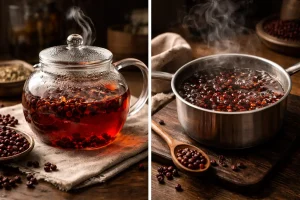 Schisandra is a berry with a sturdy skin, so extraction changes noticeably with method. For tea makers, “infusion” and “decoction” are not academic terms, they’re flavor levers.
Infusion (pouring hot water over herbs, then steeping) gives you:
Brighter aroma
Cleaner berry acidity
Less woody depth
Easier filtration
Light decoction (a brief simmer) gives you:
More saturated color
Stronger tartness and astringency
Heavier body
More sediment risk if you crush the berries
Production tip: if you plan to bottle, avoid over-crushing schisandra. Crushed berries can shed fine particulate that keeps settling. Instead, lightly crack a small percentage (10 to 20 percent of the batch) to boost extraction, while keeping most berries whole for cleaner filtration.
To add gentle warmth and reduce sharp edges, pair schisandra with ginger root. Ginger also helps the aroma “jump” when hot, which makes the first sip more inviting.
Pairing Schisandra Berry with Organic Lemon Myrtle (blend logic)
This pairing works because lemon myrtle reads like citrus without tasting like candy. It brightens the nose and makes schisandra feel less heavy, especially in blends aimed at daily use. It’s also a smart formulation move if you want a lemony profile while avoiding actual citrus peels.
A balanced daily blend (tea line friendly):
Schisandra: 70%
Lemon myrtle: 10%
Peppermint: 10%
Chamomile: 10%
Brew guidance:
3.5 g per 12 oz mug
95°C water
8 to 10 minutes for a smoother cup (peppermint can get loud if pushed too long)
Here, schisandra berry health benefits as “traditional resilience support” stays plausible and compliant, because you’re not promising outcomes. You’re offering a consistent ritual blend that tastes good and feels intentional.
For a crisp finish and clean aftertaste, try peppermint leaf. For a soft, honeyed roundness, add chamomile flowers.
Tea concentrate and bottling notes (low sugar, clean label)
If you’re making a ready-to-mix concentrate for iced tea, aim for strength you can dilute 1:3 or 1:4 without losing character.
Concentrate method (1 liter finished concentrate):
25 g schisandra
3 g lemon myrtle
Optional: 2 g cinnamon for warmth
Process:
Add herbs to a pot with 1.2 liters water.
Bring to a gentle simmer for 8 minutes.
Turn off heat, cover, and rest 12 minutes.
Strain through fine mesh, then a paper filter if you want a brighter bottle.
Reduce to 1 liter if needed (low simmer, uncovered, brief).
Shelf behavior: unsweetened botanical concentrates are more delicate than people expect. Keep cold. If you add sweetener, do it intentionally and label it honestly. A small amount of sugar can stabilize flavor perception, but it also changes customer expectations.
For a deeper, bakery-like backbone, add cinnamon chips. For a naturally sweet finish without “sugary” taste, consider a small percentage of licorice root (it’s potent, start low).
This is another spot to use the phrase schisandra berry health benefits with integrity: position it as traditional use plus craft process, not as a promise.
Troubleshooting (flat flavor, too tart, over-carbonation, sediment, aroma loss)
Flat flavor:
Cause: too low a ratio, old stock, or water not hot enough.
Fix: increase schisandra by 10 to 20%, steep 3 minutes longer, and make sure water is near boiling for pour-over. Consider a small simmer step for concentrates.
Too tart:
Cause: heavy decoction, high ratio, or long steep.
Fix: shorten time first (drop 2 to 4 minutes). Then reduce schisandra by 10%. Round the blend with chamomile or a tiny amount of licorice. If using lemon myrtle, keep it under 15% of the blend.
Over-carbonation:
This applies if you’re using schisandra infusion as a base for sparkling tea or kombucha-style secondary fermentation.
Cause: too much fermentable sugar, warm storage, or bottling before fermentation slows.
Fix: reduce added sugar, burp bottles, keep bottles cold earlier, and use pressure-rated bottles. Consider using concentrate diluted fresh instead of fermenting a high-extract base.
Sediment:
Cause: crushed berries, fine herb dust, or aggressive stirring.
Fix: keep most berries whole, pre-sift herbs, strain twice, and let the brew settle 10 minutes before final filtration.
Aroma loss:
Cause: leaving the lid off, high heat for too long, or storing near spices that “perfume” the tea.
Fix: cover during steep and rest, avoid prolonged boiling, and store finished concentrate tightly sealed. Lemon myrtle is especially aromatic, so protect it from heat and airflow.
Storage + quality (airtight, humidity, color and scent cues)
For dried herbs, quality control is mostly about oxygen, light, and humidity. Store schisandra in an airtight container, away from heat and direct light. Humidity is the quiet killer. If your workspace is humid, consider smaller working jars and keep bulk sealed.
Simple cues you can teach your team:
Schisandra berries should smell bright and berry-resinous. If they smell dull, dusty, or like cardboard, you’ll fight flat flavor no matter what.
Lemon myrtle should smell vividly lemony and green. Faded aroma means faded top notes in the cup.
Color in the brew should be clear ruby to garnet. Muddy brown suggests over-extraction, old material, or too much simmer.
For makers, keep a “reference brew” protocol: same ratio, same temperature, same time, every time you evaluate new lots. This protects consistency and reduces batch-to-batch drift.
This is where schisandra berry health benefits content becomes genuinely useful: it connects traditional use with craft discipline and ingredient respect.
Safety (compliant, no medical claims)
This article is for educational and culinary use. Schisandra and lemon myrtle are traditional herbs used by herbalists in many contexts, but they are not a substitute for medical care. Individual tolerance varies, especially with strong, aromatic herbs.
General, compliant guidance:
Start with small servings if you’re new to schisandra.
If you are pregnant, nursing, have a medical condition, or take medications, consult a qualified healthcare professional before regular use.
Keep labels and marketing language honest: “traditionally used” and “may support” style phrasing is safer than claiming treatment or cure.
If you’re selling blends, focus on sensory, ritual, and tradition. That’s how you can talk about schisandra berry health benefits without stepping into disease claims.
FAQ
What do people mean by schisandra berry health benefits?
Usually traditional tonic use, resilience support language, and the unique five flavor profile, not a promise to treat disease.
Does schisandra taste sweet or tart?
Both. It often starts tart and finishes complex, with subtle sweetness and a tidy, astringent edge.
How long should I steep schisandra berries?
For most cups, 12 to 15 minutes with near-boiling water. For a gentler cup, try 8 to 10 minutes.
Can I simmer schisandra instead of steeping?
Yes. A short simmer extracts deeper color and tartness. Cover and rest afterward for a smoother finish.
What pairs best with schisandra for a citrus vibe?
Lemon myrtle. Try organic lemon myrtle to lift aroma without using citrus peel.
How do I reduce tartness in a schisandra blend?
Shorten steep time, reduce schisandra slightly, and round with chamomile flowers or a tiny amount of licorice root.
Why is my bottled schisandra tea getting sediment?
Often from crushed berries or fine dust. Keep berries mostly whole, strain twice, and let it settle before final filtration.
Can I use schisandra in sparkling tea or fermentation?
You can, but monitor pressure carefully. Over-carbonation can happen fast if sugar is high and temperature is warm.
In the end, schisandra berry health benefits are best framed the way traditional herbalists approach them: as part of a steady ritual, supported by good sourcing, thoughtful blending, and brewing that respects both flavor and plant character.