Detox Tea Ingredients: What Actually Works in a Blend
Understanding detox tea ingredients is the first step toward building a blend that actually does something meaningful. The word “detox” gets thrown around constantly in wellness marketing, often attached to products that are little more than laxative teas in attractive packaging. Real herbal support for the body’s natural elimination and filtration systems looks quite different. It involves plants with long histories of traditional use by herbalists, plants that work on the liver, kidneys, lymphatic system, and digestive tract in ways that are gentle, sustainable, and well-documented in herbal literature.
This guide breaks down the most effective detox tea ingredients, explains what role each one plays in a formula, gives you working ratios for blending them yourself, and covers brewing tips that make the difference between a cup that tastes like mud and one you will actually drink. No shortcuts, no filler herbs added purely for color.
What “Detox” Actually Means in Herbal Context
Before getting into specific detox tea ingredients, it helps to clarify what herbalists mean when they talk about supporting detoxification. The human body already has sophisticated systems for processing and eliminating waste, primarily the liver, kidneys, skin, lungs, and lymphatic system. Herbs do not replace these systems or magically flush toxins out of your body. What the right herbs can do, according to traditional herbalism, is support and gently encourage the organs already doing this work. A liver herb may support bile production, which aids fat digestion and elimination. A kidney herb may support healthy fluid balance. A lymphatic herb may support circulation in a system that has no pump of its own. That is the lens through which to evaluate detox tea ingredients.
Dandelion Root: The Liver and Digestive Anchor
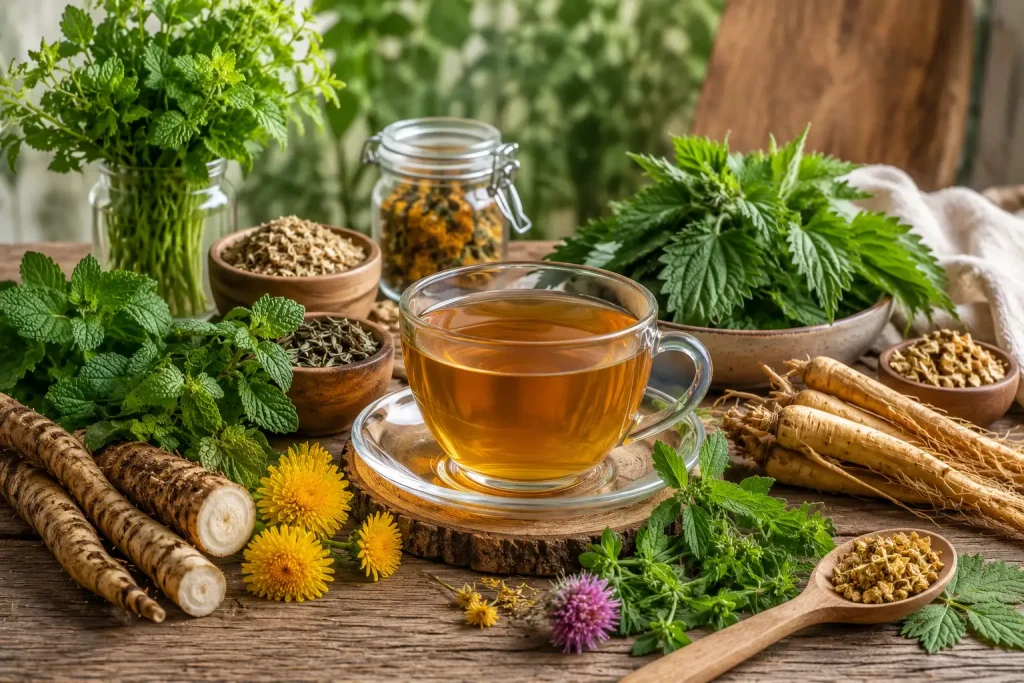
If there is a single herb that shows up in nearly every traditional liver-supportive formula, it is dandelion root. Herbalists traditionally use dandelion root to support bile flow and encourage gentle stimulation of digestive secretions. It has a pleasantly bitter, earthy flavor that is characteristic of liver herbs in general, and that bitterness is actually part of how it works, stimulating digestive activity from the moment it hits your tongue. In a blend, dandelion root works well as a base herb used at a higher ratio. Dandelion Root cut and sifted is the form most suited to tea-making, giving you good surface area without turning to powder.
Burdock Root: Deep Cleansing and Skin Support
Burdock root has a rich history in both Western and Eastern herbal traditions as one of the key detox tea ingredients for what herbalists call “alterative” or blood-cleansing action. It is traditionally used to support elimination through the skin and kidneys and is a staple in many long-term cleansing formulas. Its flavor is earthy and slightly sweet, which makes it pleasant in a blend and helps balance more bitter herbs. Burdock Root cut and sifted works well alongside dandelion as a dual-root base for your formula.
Nettle Leaf: Kidney Tonic and Nutritive Powerhouse
Nettle leaf earns its place in a detox blend through a different mechanism than the root herbs. Herbalists traditionally use it as a kidney tonic, supporting healthy urinary flow and helping the body eliminate metabolic waste through the renal system. It is also one of the most nutritive herbs available in dried form, rich in minerals that can become depleted when the body is under stress or going through a cleansing period. Nettle adds a grassy, green flavor to a blend that helps lighten the overall taste profile. Nettle Leaf cut and sifted is ideal for blending and steeps well with both roots and lighter leaf herbs.
Milk Thistle: The Liver’s Best Ally
Milk thistle is one of the most well-researched herbs in Western herbalism when it comes to liver support. Its active compound, silymarin, is found primarily in the seeds. In tea form, the seed must be cracked or ground to make silymarin available for water extraction, because whole seeds will pass through a steeping without releasing much. The herb cut and sifted form addresses this by giving you broken-down plant material that steeps more effectively. Herbalists traditionally recommend milk thistle for those whose livers are under regular stress from diet, alcohol, or environmental exposure. Milk Thistle herb cut and sifted is a foundational detox tea ingredient in any serious formula.
Red Clover: Lymphatic and Hormonal Balance
Red clover brings a different dimension to a detox blend. Herbalists traditionally associate it with lymphatic cleansing and use it in formulas aimed at long-term constitutional clearing rather than acute digestive support. It has mild isoflavone content, which gives it relevance for hormonal balance alongside its cleansing properties. In a tea blend, red clover has a pleasant, slightly sweet and grassy flavor that helps smooth out earthy root notes. Red Clover cut and sifted works well as a mid-ratio ingredient in a detox formula alongside nettle and the root herbs.
Yellow Dock: The Bile and Iron Herb
Yellow dock root is a powerful bitter herb that herbalists traditionally use for liver stimulation and support of iron absorption. It has a long history in both Appalachian folk medicine and European herbalism as a plant for slow, deep cleansing rather than rapid elimination. Because it is quite bitter and strong, it is best used at a low ratio in a blend, but its presence is meaningful. Wildcrafted Yellow Dock Root is a good choice because wildcrafted roots tend to be more potent than conventionally grown alternatives. This is one of the detox tea ingredients where a little goes a long way.
Peppermint and Lemon Peel: Flavor and Digestive Finish
No detox tea blend is complete without something to brighten and balance the heavy root flavors. Peppermint leaf does exactly that. It adds a clean, cool note that makes the whole cup more drinkable, and it has its own traditional reputation for supporting digestion and reducing bloating. Peppermint cut and sifted blends easily with all the root herbs here without dominating.
Lemon peel brings citrus brightness and a pleasant bitterness that actually complements the liver herbs rather than masking them. It also traditionally supports digestive secretion and liver function in its own right. Lemon Peel cut and sifted is the version that works best in a loose tea blend, as it distributes evenly and steeps efficiently.
A Working Formula With Ratios
Here is a baseline formula for a well-rounded blend using these detox tea ingredients. All parts are measured by weight.
- Dandelion Root: 3 parts
- Burdock Root: 2 parts
- Nettle Leaf: 2 parts
- Milk Thistle herb: 2 parts
- Red Clover: 1.5 parts
- Yellow Dock Root: 0.5 parts
- Peppermint Leaf: 1 part
- Lemon Peel: 1 part
For a 100 g batch, that works out to roughly 23 g dandelion root, 15 g burdock root, 15 g nettle, 15 g milk thistle, 12 g red clover, 4 g yellow dock, 8 g peppermint, and 8 g lemon peel. Mix thoroughly and store in a sealed glass jar.
How to Brew Detox Tea Ingredients for Best Results
Root herbs require longer steep times than leaf herbs to fully release their constituents. For a blend like this, the standard approach is a decoction-infusion hybrid method. Combine the roots (dandelion, burdock, yellow dock) with 2 cups of cold water in a small saucepan. Bring to a gentle simmer and hold for 10 minutes. Remove from heat and add the leaf herbs (nettle, red clover, peppermint, lemon peel, milk thistle). Cover and steep for an additional 10 minutes. Strain thoroughly and drink warm. Use 1 tablespoon of the blended herbs per cup of water. This method extracts far more from root herbs than simply pouring hot water over the whole blend.
Safety
Several herbs in this blend deserve specific caution notes. Yellow dock root, when used in large amounts or over a long period, may cause loose stools due to its anthraquinone content. Keep it at low ratios and do not use this blend daily for more than four to six weeks without a break. Milk thistle is generally well-tolerated, but people with ragweed allergies should approach it with care due to potential cross-reactivity. Red clover contains phytoestrogens and is not recommended for individuals with hormone-sensitive conditions or those taking hormone-related medications. Dandelion is a gentle herb but may interact with certain diuretic medications. Nettle leaf may affect blood sugar and blood pressure in sensitive individuals. If you are pregnant, nursing, or taking prescription medications, consult your healthcare provider before using this or any herbal blend. None of the information here constitutes medical advice.
Frequently Asked Questions
How often should I drink a detox tea blend?
Most herbalists suggest one to two cups per day for a defined period, typically two to four weeks, followed by a break of equal length. Daily long-term use of strong liver and kidney herbs is not recommended because it can strain rather than support these systems over time. Cycling gives your body a chance to respond and integrate.
Can I use detox tea ingredients if I take medication?
Some herbs in a detox formula, particularly dandelion, yellow dock, and red clover, may interact with certain medications including diuretics, blood thinners, and hormone therapies. Always disclose herbal use to your prescribing physician before starting a new herbal protocol, especially one involving liver or kidney herbs.
Will this tea help me lose weight?
This blend is not designed as a weight loss product. Herbs that support digestive and elimination function may reduce temporary bloating, but any visible slimming effects are water-related and short-term. Anyone claiming an herbal tea will produce lasting fat loss is overstating the evidence significantly.
Do I need to use organic detox tea ingredients?
For herbs that concentrate compounds from soil, like dandelion root and burdock root, organic sourcing is especially relevant. Roots absorb whatever is present in the soil, including pesticide residues, at a higher rate than above-ground plant parts. Choosing certified organic or wildcrafted sources is a meaningful decision when working with root herbs.
Can I cold brew this blend overnight instead of decocting it?
Cold brewing works well for leaf herbs like nettle, peppermint, and red clover, which release their compounds readily in cool water. However, root herbs like dandelion, burdock, and yellow dock do not extract efficiently in cold water. For a blend heavy in roots, the simmer-then-steep method will always give you a more complete cup than cold brewing alone.
How do I know if the herbs I buy are fresh enough to use?
Fresh dried herbs should have a strong, characteristic aroma when you open the bag. Dandelion root should smell earthy and slightly bitter. Peppermint should smell sharp and menthol-forward. Lemon peel should smell citrusy and bright. If any herb smells faint, dusty, or like nothing in particular, it has lost most of its potency and needs to be replaced. Buy from suppliers with high turnover and clear harvest dating when possible.
Can I add sweetener to a detox blend?
You can, but consider whether it makes sense for your goals. Raw honey or a small amount of maple syrup is fine and will not undermine the blend. Avoid refined sugar, which adds unnecessary glycemic load. Some people find that drinking the blend unsweetened helps them stay attuned to how their body is responding to the bitterness, which in herbal theory is itself a signal to the digestive system.
What is the difference between detox tea and a daily herbal tea?
A daily herbal tea is generally mild enough to drink indefinitely, using herbs like chamomile, peppermint, or rose. A detox-focused blend uses stronger bitter and alterative herbs that are better suited to short cycles rather than everyday long-term use. The distinction comes down to herb selection and strength of the formula, not any magical property of the word “detox.”
Choosing the right detox tea ingredients means understanding what each herb does, how they work together, and how to use them responsibly. With dandelion, burdock, nettle, milk thistle, red clover, and yellow dock as your core, supported by peppermint and lemon peel for flavor, you have a formula built on real herbal tradition rather than marketing. Source quality ingredients, follow the ratios, brew it properly, and give your body the time and space to respond.