Ceylon Tea With Milk: How to Make It Smooth (Not Flat)
There is a specific kind of disappointment that happens when ceylon tea with milk tastes “fine” but forgettable. The aroma is shy. The mid-palate goes quiet. The finish feels chalky or thin, like the milk muted the tea instead of rounding it. The fix is not more sugar or more tea. It is structure: the right leaf grade, the right water temperature, the right infusion time, and a milk strategy that respects Ceylon’s bright, citrusy lift. Add cardamom the way an herbalist would (measured, intentional, not loud), and the cup gets silky without losing sparkle 🍵.
This guide is written for home brewers and for production-minded kombucha makers who want repeatability. You will get exact ratios in grams and teaspoons, a simple workflow for scaling, and a strict 2F method that keeps the milk-tea profile aromatic rather than flat. No fluff, just craft.
Ceylon tea with milk: choose tea and milk that stay bright
Ceylon tea (Sri Lanka) tends to lean brisk, citrusy, and clean. That brightness is the whole point, so your ingredients should protect it.
Tea selection notes:
Leaf grade: “Orange Pekoe” and “BOP” (Broken Orange Pekoe) often perform best for milk tea because they extract evenly and stay aromatic. Very fine dust can over-extract fast and turn astringent.
Freshness: if your tea smells like cardboard, the cup will taste like beige. Choose tea that still smells like citrus peel, cedar, or light malt when dry.
Water: use water that tastes good on its own. If your water is heavily chlorinated, filter it. Chlorine can read as “flatness” in the finished cup.
Milk selection notes:
Whole milk gives the smoothest texture, but ultra-high-protein milks can make tannins feel chalky.
If you use oat milk, pick a “barista” style that can handle heat without separating.
Avoid strongly vanilla-flavored milks if you want cardamom to stay crisp.
If you are shopping the Hatton Naturals catalog for a clean, classic backbone, start with Organic Ceylon tea and build from there.
The core problem: tannins, fat, and why “flat” happens
“Flat” milk tea is usually one of these:
Under-extracted tea (not enough aromatic compounds).
Over-extracted tea (too many tannins, so milk tastes dull and drying).
Milk added too hot or too much, which smothers top notes.
Spices thrown in randomly, creating muddled aroma.
Ceylon has a bright top note that behaves like citrus zest. Milk is a blanket. The craft is learning how to keep the blanket thin and warm, not heavy and damp.
A practical trick from tea houses: build a “bright base” first (tea that tastes slightly stronger than you want), then soften it with milk. If you brew weak tea and try to rescue it later, you get sweetened beige.
Brew parameters that keep aroma alive (temperature, time, agitation)
For a smooth cup, treat your infusion like a controlled extraction, not a guess.
Target brew window (for black Ceylon):
Water temp: 95 to 98°C (203 to 208°F)
Steep time: 3:00 to 4:15 minutes
Agitation: gentle stir at 1:00 minute, then stop
Why this works:
High temp pulls aromatics fast, but time is the throttle.
Gentle agitation improves consistency without shredding the leaf into bitterness.
Going past ~4:30 with many Ceylons can tip into dry tannins that milk cannot “fix.”
If you want a brighter cup, shorten time, not temperature. If you want more body, increase dose slightly before you increase time.
Exact ratios in grams and teaspoons (single cup + small batch)
 Use a scale when you can. If you cannot, teaspoons work, but write down the brand and leaf size because volume shifts.
Single cup (12 oz / 355 ml final drink):
Tea: 2.2 g (about 1 heaping tsp for many BOP styles)
Water for brewing: 180 ml (about 3/4 cup)
Milk: 120 to 150 ml (1/2 to 2/3 cup), warmed
Optional sweetener: 6 to 10 g sugar (1 1/2 to 2 1/2 tsp), or skip
Small batch (4 servings, good for prep):
Tea: 9 g (about 4 heaping tsp)
Water for brewing: 720 ml
Milk: 480 to 600 ml, warmed separately
Process:
Pre-warm your cup or pot with hot water, then discard.
Brew tea with the measured water at 95 to 98°C.
Strain immediately at target time.
Warm milk to 55 to 65°C (131 to 149°F). Hotter can mute aroma and taste “cooked.”
Combine tea and milk. Taste before sweetening.
This is the fastest route to ceylon tea with milk that feels round yet still lively.
Cardamom, correctly: green pods for lift, not loudness
Cardamom is not meant to shout. It is meant to make the cup feel “higher” and more fragrant, like you opened a window.
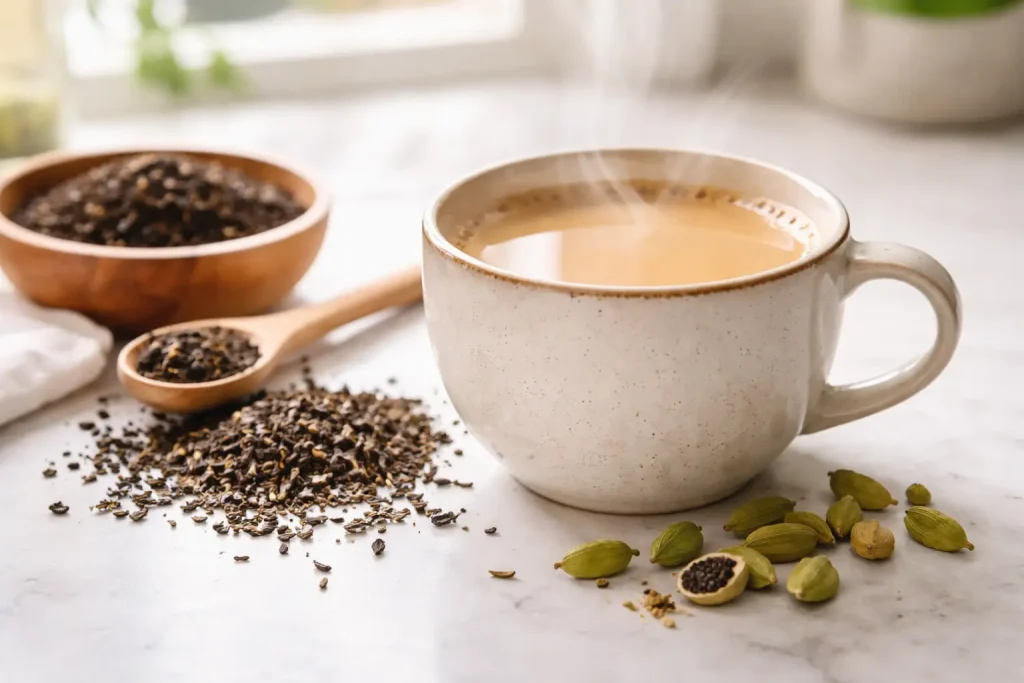
Best form: whole green pods. Grind only what you need. For most batches, cracking pods is enough.
Dosing guide:
Per 12 oz / 355 ml cup: 1 pod, lightly crushed
Per 4 servings: 4 pods, lightly crushed
If you grind: start with 0.15 g per cup (a small pinch), then adjust
Two clean techniques:
Tea-steep method: add crushed cardamom to the teapot for the last 60 seconds only. This keeps aroma bright.
Milk-warm method: warm the milk with cardamom at 55 to 60°C for 10 minutes, then strain. This gives silk and perfume without bitterness.
If you want the simplest upgrade, keep cardamom whole green on hand and treat it like a measured ingredient, not a sprinkle.
Flavor architecture for makers: bright, warm, and structured add-ins
If you are building a signature profile, think in layers: bright top, warm middle, grounding base. Keep the blend small so it stays readable.
Bright top options:
Organic orange peel powder (micro-dose, adds citrus lift)
Organic lemon myrtle (sharp, lemony, very potent)
Warm middle options:
Cardamom whole green (eucalyptus-citrus perfume)
Cinnamon chips (round warmth without heavy sweetness)
Grounding base options:
Ginger root chips (clean heat, keeps finish lively)
Hibiscus flowers (tart backbone for blends and 2F, use carefully in milk-style profiles)
When you work with milk tea, avoid stacking too many loud ingredients. One bright, one warm, one grounding is usually enough. Write batch notes like a brewer: grams, time, temperature, taste result.
Milk strategy: how to get silky mouthfeel without muting the tea
Milk does three jobs: texture, sweetness perception, and aroma suppression. You want the first two, not the third.
Rules that keep the cup lively:
Warm milk, do not boil it.
Add milk after brewing, never steep tea in simmering milk unless you are intentionally making a heavy chai.
Start with less milk than you think. You can always add more.
A practical ratio that works:
60% brewed tea, 40% milk for a bright, aromatic cup
50% brewed tea, 50% milk for a softer “tea latte” vibe
If your cup tastes flat, it is often just too much milk. Reduce milk by 15% and increase tea dose by 10% before you change anything else. That adjustment alone often rescues ceylon tea with milk.
Kombucha 2F: a strict, repeatable milk-tea profile (without dairy in bottle)
Real talk for kombucha makers: dairy in sealed bottles is not the move for shelf stability and cleanliness. The smart approach is to build a milk-tea aroma profile using tea concentrate and spice, then let the drinker add milk (or a milk alternative) at serving.
This section gives you a repeatable method that tastes like ceylon tea with milk when served, while staying kombucha-safe in the bottle.
Option A: Tea concentrate dosing (recommended)
Make a concentrate you can dose by weight. This is consistent, scalable, and easy to standardize across batches.
Concentrate formula:
Ceylon tea: 30 g
Water: 600 g at 96°C (1:20)
Steep: 4:00 minutes
Strain immediately
Optional cardamom: add 10 lightly crushed pods for the final 60 seconds, then strain
You get roughly 540 to 560 g concentrate after leaf absorption.
Dosage per 16 oz / 473 ml bottle:
15 to 30 g tea concentrate (start at 20 g)
Optional: 0.3 to 0.6 g sugar if your base is very dry and you want roundness without making it “soda”
Fill remainder with finished 1F kombucha, leaving 1 to 1.5 inches headspace
Consistency tips:
Weigh concentrate into each bottle. Do not eyeball.
Keep concentrate chilled and use within 48 hours for best aroma.
Record dose, base kombucha acidity, and carbonation outcome in batch notes.
Serving cue:
In a glass, add 30 to 60 ml cold milk or oat milk, then pour the kombucha slowly. This creates the sensory illusion of milk tea without putting dairy through 2F pressure.
Option B: Direct botanicals in bottle (optional)
This is more rustic and can create sediment. Only do it if your audience likes “bottle craft.”
Per 16 oz / 473 ml bottle:
Ceylon tea: 0.2 to 0.35 g (a small pinch, about 1/8 tsp depending on leaf)
Cardamom: 1 pod, lightly crushed
Optional orange peel powder: 0.05 g (a tiny pinch)
Fill with finished 1F kombucha, cap, ferment 12 to 24 hours at room temp, then refrigerate.
Consistency tips:
Use identical pinch spoons or, better, a scale with 0.01 g resolution.
Pre-portion tea and botanicals for the whole batch to reduce drift.
Strain into glass at serving if you want a clean sip.
Troubleshooting: flat flavor, too tart, over-carbonation, sediment, aroma loss
Flat flavor:
Likely cause: under-dosed tea or too much milk at serving.
Fix: increase concentrate from 20 g to 25 g per bottle, or reduce milk addition by 15%. Also check steep time (too short equals quiet aroma).
Too tart:
Likely cause: 1F fermented too long before 2F.
Fix: shorten 1F by 12 to 24 hours next batch, or add a micro-dose of sugar (0.3 to 0.6 g per bottle) to round perception, not to sweeten heavily.
Over-carbonation:
Likely cause: too much fermentable sugar, warm room, long 2F.
Fix: reduce 2F to 12 to 18 hours, chill earlier, and standardize sugar additions. Use a consistent headspace.
Sediment:
Likely cause: direct botanicals in bottle or fine tea dust.
Fix: switch to Option A concentrate, or use larger leaf grade. If using powders, keep doses tiny.
Aroma loss:
Likely cause: boiling milk, old tea, or cardamom steeped too long.
Fix: warm milk gently (55 to 65°C), use fresher tea, and add cardamom in the last 60 seconds or via milk-warm method.
If you dial these variables, ceylon tea with milk stops being unpredictable and starts being repeatable.
Storage + quality: keep tea and spices vivid (airtight, humidity, cues)
Tea and cardamom are aroma-first ingredients. Treat them like you would hops or coffee.
Storage rules:
Airtight containers, away from light and heat.
Avoid humid shelves near kettles or dishwashers.
Do not store tea next to strong-smelling spices unless sealed well. Tea absorbs odors.
Quality cues:
Ceylon tea should smell like citrus peel, dry wood, or light malt. If it smells dull, papery, or smoky when it should not, it is fading.
Cardamom pods should feel slightly tacky-resinous when cracked and smell immediate. If you crack a pod and the aroma is faint, increase dose or replace stock.
For production-minded workflows:
Date your containers.
Write a “sensory check” line in batch notes: dry aroma, brewed aroma, finish texture.
Rotate stock like any other perishable ingredient.
Safety (compliant, no medical claims)
This article focuses on craft and flavor. It is not medical advice. Herbalists often use tea and spices as part of daily ritual and enjoyment, and some ingredients are traditionally used in various wellness traditions. If you are pregnant, nursing, have a medical condition, or take medications, consider checking with a qualified professional about what is appropriate for you. For kombucha, follow standard food-safety hygiene: clean equipment, use properly fermented 1F, and refrigerate finished bottles to slow fermentation.
FAQ
1) Why does ceylon tea with milk sometimes taste chalky?
Usually from over-extraction (too many tannins) or very high-protein milk. Shorten steep time and warm the milk gently instead of overheating it.
2) What is the best steep time for Ceylon if I want it smooth?
Start at 3:30 minutes at 95 to 98°C, then adjust by 15-second steps. Dose changes are often better than time changes.
3) Do I add cardamom to the tea or to the milk?
Both work. For brighter aroma, add crushed pods for the last 60 seconds of tea steeping. For silkier perfume, warm milk with cardamom at 55 to 60°C for 10 minutes and strain.
4) Can I make it without sugar and still keep it interesting?
Yes. Focus on correct extraction and a small cardamom dose. A micro-dose of orange peel can also lift aroma without sweetness.
5) How do I make a kombucha that tastes like milk tea?
Use a tea concentrate in 2F, then add milk (or oat milk) when serving in the glass. That keeps the bottle stable and the flavor clear.
6) How much tea concentrate should I dose per 16 oz bottle?
Start at 20 g per 16 oz / 473 ml bottle, then adjust within 15 to 30 g based on your base kombucha intensity.
7) Why is my aroma strong in the pot but weak in the cup?
Often the milk was too hot or you used too much. Warm milk to 55 to 65°C and start with a 60/40 tea-to-milk ratio.
8) What is the simplest way to upgrade my daily cup?
Use fresh tea, weigh your dose, and keep cardamom whole green on hand. One crushed pod added late in the steep makes a noticeable difference.
A truly satisfying ceylon tea with milk is not about making the tea stronger until it bulldozes the milk. It is about precision: a brisk, aromatic infusion that is stopped on time, then softened with gently warmed milk and a measured aromatic (cardamom) that lifts rather than clutters. For kombucha makers, the same logic applies. Build a repeatable tea concentrate, dose by weight, and keep milk out of the bottle so the final drink stays clean, bright, and consistent. When you treat tea like a craft ingredient, “smooth” stops meaning “muted” and starts meaning “silky, vivid, and memorable.”