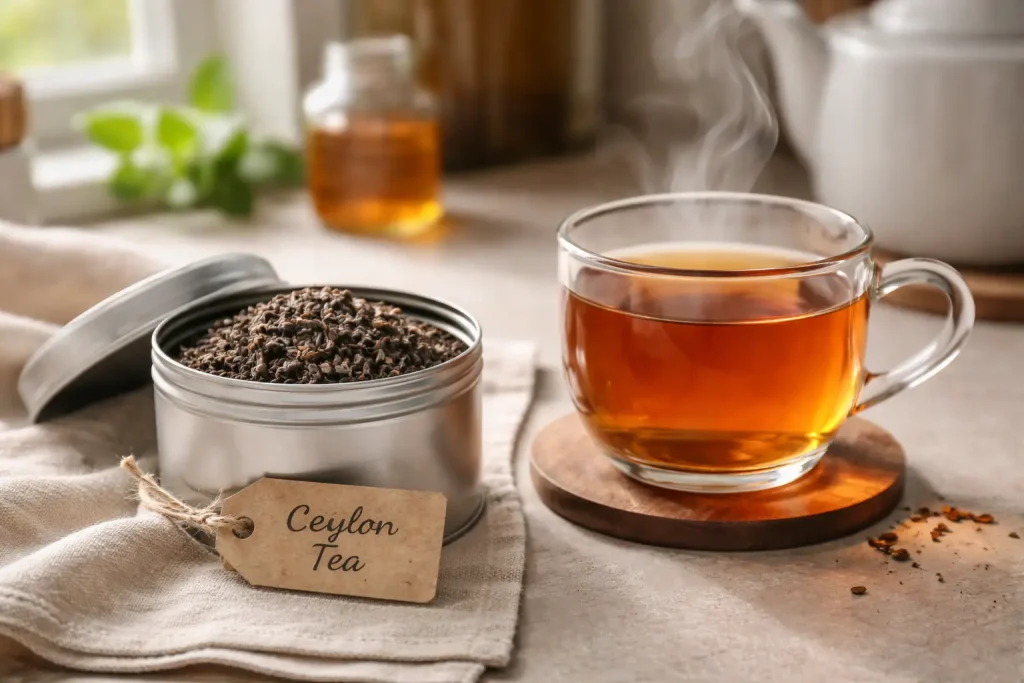
Ceylon Tea: What It Is and How It Tastes
Ceylon in tea is a flavor you can recognize even before you learn the geography: bright, clean, and structured, with a gentle lift that feels like sunlight on polished wood. It is the kind of black tea that tastes “tidy” when brewed well (not muddy, not smoky), and that tidy profile is exactly why beverage makers love it. For kombucha, ceylon in tea is a reliable base that leaves room for botanicals without getting swallowed by them. It ferments into something clear and aromatic, then takes spice like a well-cut suit takes tailoring.
This guide is for drinking-cup people and production-minded kombucha makers. You will learn what ceylon in tea is (in practical terms), how it tastes across brew styles, how to dial in steeping without bitterness, and how to pair it with spice for a clean finish. We will also build a repeatable 2F method you can run bottle after bottle with the kind of consistency that makes labeling and customer expectations easier.
What “Ceylon” means in a tea tin (and why it matters for flavor)
Ceylon is the historical name for Sri Lanka, and in tea language it signals origin. But for your palate, what matters is the style it often expresses: clarity, brightness, and a crisp edge that reads as citrusy or brisk even when there is no citrus in the blend. Compared with many darker, heavier black teas, ceylon in tea tends to feel less earthy and more “high note,” especially when brewed with good water and proper temperature discipline.
For makers, this matters because fermentation amplifies some notes and rounds others. A clean tea base tends to ferment into a clean kombucha. A tea base with heavy, murky tannins tends to ferment into “brown” flavor (flat sweetness, harsh grip, less aromatic lift). If your goal is a kombucha that still smells like something after refrigeration, ceylon in tea gives you a head start.
Try a classic base with Organic Ceylon tea when you want a bright, dependable fermentation profile.
How ceylon in tea tastes: a practical sensory map
Think in layers. First impression: brisk and bright, sometimes with a lemon-peel-like lift even without citrus. Mid-palate: gentle malt, a clean sweetness, and a light woody structure. Finish: drying but not dusty when you get the steep right. Some lots lean more floral, some more cocoa-malt, and some have a peppery sparkle that reads like “energy” rather than heat.
Here is a simple sensory map you can use while tasting:
Aroma: citrus peel, honeyed wood, faint stone fruit, sometimes a hint of eucalyptus-like freshness (not minty, just airy).
Sip entry: bright, quick, clean.
Body: medium, not syrupy.
Finish: dry, neat, lightly astringent (pleasant), with lingering perfume when brewed correctly.
When you push it too hard, ceylon in tea can turn sharp and overly tannic, like chewing on grape skins. That is not a “bad tea” problem most of the time. It is usually a time, temperature, or dose problem.
Try building a spice-leaning cup with organic clove powder when you want warmth without heaviness.
Choosing the cut and grade for clean brews and consistent batches
If you are brewing for yourself, leaf grade is a pleasure. If you are brewing for production, leaf grade is a control knob. Smaller particles extract faster and can spike bitterness if you do not adjust time. Larger leaf can be more forgiving but may require longer steep or higher dose.
Practical guideline for repeatability:
If your tea is fine cut or “dusty”: lower steep time and consider slightly cooler water for the first pass.
If your tea is medium leaf: standard black-tea parameters work well.
If your tea is larger leaf: slightly longer steep or a touch more dose can help, but do not compensate with extra heat plus extra time at the same time.
For kombucha base, you want strength without roughness. Your end goal is a brewed tea that tastes a little stronger than you would drink straight, but still smells clean and pleasant. If it tastes harsh before fermentation, fermentation will not magically make it elegant. It will just be harsh and sour.
Try a clean, classic base with Ceylon tea if you want consistent extraction across batches.
Brewing ceylon in tea for a clean cup (temperature, time, water)
 Ceylon in tea rewards precision. Use water that tastes neutral. If your water tastes like chlorine, your tea will taste like chlorine. If your water is extremely hard, your tea may taste flat and chalky. A simple carbon filter often improves clarity.
Baseline cup parameters (adjust to taste):
Water: 96 to 100°C (205 to 212°F)
Dose: 2.0 g tea per 240 ml cup
Time: 3 to 4 minutes
Goal: bright, aromatic, clean finish
If you get bitterness, do this before changing anything else: shorten the steep by 30 to 60 seconds. If still bitter, drop temperature to around 95°C (203°F). If still bitter, reduce dose slightly. Most bitterness issues come from time, not from the tea “being bitter.”
If you want a softer, rounder profile for milk or spice, you can brew slightly cooler and a bit longer, but keep the finish clean. The win condition for ceylon in tea is “brisk but not abrasive.”
Try adding orange peel powder when you want citrus lift without extra acidity.
Exact ratios (grams and teaspoons) for a spice-forward ceylon blend
This section is for repeatability. Teaspoons are convenient, grams are consistent. If you do one thing to level up your results, weigh your botanicals.
A simple spiced ceylon blend (makes about 4 cups, or a small test pitcher):
Ceylon tea: 8 g (about 4 teaspoons, depending on cut)
Organic clove powder: 0.5 g (about 1/4 teaspoon)
Optional orange peel powder: 1.5 g (about 1 teaspoon)
Optional ginger cut: 2 g (about 1 teaspoon chopped pieces, if cut is small)
Brew method:
Bring water to 96 to 100°C (205 to 212°F).
Add tea to a heat-safe vessel. Pour 1 liter water. Start timer.
At 3 minutes, taste. At 4 minutes, stop the brew if the finish turns edgy.
Whisk clove powder with a small amount of hot tea in a separate cup to make a smooth slurry, then add back. (This prevents clove clumps.)
Strain if needed for your preferred clarity.
Why this works: clove is powerful and can dominate. Keeping it in a tight range gives warmth and a faint vanilla-like impression without turning medicinal or numbing. Ceylon in tea stays bright under spice, so the cup still feels clean.
Try warming a blend with organic clove powder when you want a crisp spice finish, not a heavy chai.
Ceylon in tea for kombucha base: strength, tannin, and fermentation clarity
For kombucha, you are not brewing a “tea you sip.” You are brewing a foundation that will be sweetened, fermented, acidified, and chilled. Your goal is a base that ferments cleanly and still smells alive after refrigeration.
A practical base target for kombucha:
Brewed tea should taste clearly like tea even after adding sugar.
Astringency should be present but not harsh.
Aroma should be noticeable before fermentation (it will change, but strong aroma generally survives better).
If your kombucha base tastes flat, your 2F flavors will have to work harder, and you will end up overdosing botanicals to compensate. If your base tastes harsh, you will chase it with sweetness and fruit, and it can still read as “rough.” Ceylon in tea usually makes this easier because it brings brightness without needing aggressive dosing.
Try a clean fermenting base with Ceylon tea when you want brightness that carries through 2F.
Kombucha 2F with ceylon in tea: strict, repeatable method
This is a production-minded method built for consistency. We will do two options. Option A is recommended because it keeps dosing controlled and reduces bottle-to-bottle variation.
General notes for both options:
Use finished 1F kombucha that is pleasantly tart but not vinegar-sharp.
Always dissolve powders into a small slurry before adding to bottles.
Label your bottles with date, formula, and grams. Your future self will thank you.
Option A: Tea concentrate dosing (recommended)
Make a ceylon concentrate designed for 2F dosing.
Concentrate recipe (yields about 500 ml):
- Ceylon tea: 20 g
- Water: 500 ml
- Steep: 4 minutes at 96 to 100°C (205 to 212°F), then strain
Optional spice concentrate add-in (choose one):
Clove micro-dose: 0.6 g organic clove powder whisked into 100 ml hot concentrate, then combined back in
Or citrus lift: 6 g orange peel powder steeped 10 minutes in 150 ml hot concentrate, then strained
Dosage per 16 oz / 473 ml bottle:
- Ceylon concentrate: 30 to 60 ml
- Clove concentrate (if using): 5 to 10 ml (start low)
- Top up with 1F kombucha to fill line, leaving 2 to 3 cm headspace
Process:
Add measured concentrate to bottle first.
Add 1F kombucha gently to reduce foaming.
Cap tightly.
Ferment at room temp 24 to 72 hours, depending on your sugar level and ambient temperature.
Chill fully before opening.
Consistency tips:
Weigh tea for the concentrate every time.
Keep steep time fixed. Set a timer.
Keep bottle headspace consistent.
Write batch notes: 1F tartness, room temp, hours in 2F, and sensory outcome.
This method gives you repeatable “flavor math.” You can scale it. You can tweak it. And you can run ceylon in tea as a signature base that still feels crafted.
Try building a controlled 2F concentrate with Ceylon tea for a bright, consistent profile.
Option B: Direct botanicals in bottle (optional)
This method is simpler, but it varies more and creates more sediment. Use it for small experimental batches or rustic styles.
Per 16 oz / 473 ml bottle:
- Organic clove powder: 0.05 to 0.12 g (a tiny pinch, roughly 1/32 to 1/16 teaspoon)
- Optional orange peel powder: 0.5 to 1.5 g (about 1/4 to 1 teaspoon)
- Optional hibiscus flowers: 1 to 2 g (for tart color and backbone)
Process:
Make a slurry: mix powders with 10 to 20 ml warm water or a little kombucha until smooth.
Add slurry to bottle.
Add 1F kombucha, cap, ferment 24 to 72 hours, then chill.
Direct dosing is less precise, so treat it as exploration. If you want consistent flavor at scale, Option A wins.
Try adding hibiscus flowers when you want a tart backbone that makes spice feel brighter.
Pairing ideas that keep ceylon in tea bright (not muddy)
Ceylon in tea likes botanicals that either lift aroma or add structured tartness. It can get muddy if you combine too many heavy roots and too much powder without filtration. Keep your pairings purposeful.
Bright lift pairings:
Orange peel powder for citrus sparkle
Lemon myrtle for sharp aromatic lift
Rose petals for a soft floral top note
Structured backbone pairings:
Hibiscus flowers for tartness and color
Ginger for warmth and a clean bite
Warm spice pairings (use a light hand):
Organic clove powder for sweet-warm finish
Cinnamon chips (if you like that profile) for round warmth without powder haze
Try adding lemon myrtle when you want ceylon in tea to taste extra “clean and bright” in 2F.
Try adding organic dried rose petals when you want a perfumed top note without heaviness.
Try adding ginger cut when you want warming bite that stays crisp.
Troubleshooting: flat flavor, too tart, over-carbonation, sediment, aroma loss
Flat flavor (tastes like sour water, weak aroma):
Increase concentrate dose in Option A (move from 30 ml to 60 ml per bottle). Check that your concentrate is actually strong (20 g per 500 ml, 4 minutes). Also check 1F: if it is over-fermented and too acidic, it can mute aroma. Brew a slightly stronger 1F base next time with ceylon in tea.
Too tart too fast:
Shorten 2F time. Chill earlier. If your room is warm, 24 hours may be plenty. Also reduce added fruit sugars if you use them. Tartness rises fast when the yeast and bacteria are active.
Over-carbonation (gushers):
Reduce ferment time, lower added sugar inputs, and keep headspace consistent. Always chill fully before opening. Consider burping only if you are intentionally controlling pressure, but note it reduces consistency and aroma retention.
Sediment (too much powder settling):
Use Option A concentrates and strain where possible. If using powder directly, accept a rustic sediment layer or pour through a fine strainer when serving.
Aroma loss (smells great day 1, fades by day 3):
Use airtight bottles, minimize headspace oxygen, chill promptly after desired carbonation, and rely on concentrates rather than loose botanicals. Some aromatics are volatile. Ceylon in tea helps, but your process still matters.
Try switching to concentrate dosing with Organic Ceylon tea if you want less sediment and more consistent aroma.
Storage + quality: keeping tea and botanicals fresh
Quality starts before the kettle. Tea is a dried agricultural product, and it absorbs odors and humidity like a sponge.
Storage rules for tea and botanicals:
- Airtight containers, ideally with a good gasket.
- Keep away from heat, light, and strong pantry odors.
- Avoid storing above the stove.
- Use clean, dry scoops. Do not dip a wet spoon into powders.
Freshness cues:
- Ceylon tea should smell lively and bright, not papery or dusty.
- Clove powder should smell sweet-warm and intense. If it smells dull, use more carefully or replace it.
- Orange peel powder should smell like citrus peel, not cardboard.
- Hibiscus should be deep colored and tart-smelling, not brown and muted.
For production, write the open date on tins and jars. Rotate stock. Consistency comes from controlled inputs.
Try keeping your spice aromas bright with fresh organic clove powder stored airtight and away from humidity.
Safety notes (compliant, practical, no medical claims)
This article is about flavor, traditional use, and beverage-making process. It is not medical advice. Herbalists often use tea and spices as part of daily food traditions, but individual tolerance varies. If you are sensitive to caffeine, consider smaller servings or shorter steeps. Spices like clove are potent, so start with low amounts and adjust gradually for taste. For kombucha, use clean equipment, food-safe bottles, and refrigeration to slow fermentation once carbonation is where you want it. If something smells off or looks abnormal (mold, unusual textures), discard the batch.
If you are sharing kombucha with others, label caffeine and spice content clearly. Keep your formulations consistent, and avoid overstating effects. Keep the focus on taste, craft, and quality.
Try building your base with Ceylon tea and adjust strength for taste rather than chasing “effects.”
FAQ
What is ceylon in tea, exactly?
Ceylon in tea refers to tea from Sri Lanka. In the cup it often tastes bright, clean, and brisk with a tidy, citrusy lift.
Does ceylon in tea taste different from Assam or breakfast blends?
Often yes. Ceylon in tea tends to be lighter and brighter, while many Assam-heavy blends taste deeper, maltier, and sometimes heavier on the finish.
How do I stop ceylon tea from turning bitter?
Shorten steep time first. If needed, slightly lower water temperature. Bitter results are usually a time-temperature issue.
Can I use clove in kombucha without it tasting medicinal?
Yes. Keep doses tiny and consistent. Use a slurry or a measured concentrate so organic clove powder does not clump or spike bottle-to-bottle.
What’s the best repeatable 2F method for a tea-forward flavor?
Use Option A with a measured concentrate. It gives consistent dosing, less sediment, and predictable outcomes.
How much concentrate should I add per bottle?
For a 16 oz / 473 ml bottle, start with 30 to 60 ml of ceylon concentrate and adjust based on your base strength and desired flavor.
Why is my tea 2F aroma fading in the fridge?
Volatile aromas dissipate with oxygen and time. Reduce headspace, chill promptly, and rely on concentrates for better retention.
Which botanicals pair cleanly with ceylon in tea?
Citrus peels, lemony leaves, floral petals, and tart flowers pair well. Use warm spices like clove carefully and in very small doses.