Ceylon Tea Taste: Flavor Notes and Pairing Ideas
The first time you really notice ceylon tea taste, it is not “tea” as a generic idea. It is structure. A bright top note that reads like citrus peel. A clean, brisk spine. A finish that can lean honeyed, woody, or lightly tannic depending on leaf grade, region, and how you brew. For tea makers, that clarity is a gift. It means you can build blends that stay legible even when you add florals, roots, or fruit peels. It also means you can tune it for different formats: a delicate hot cup, a bold iced tea, or a concentrate that holds up in batching.
This guide treats ceylon tea taste like a tasting flight you can recreate in your own kitchen or production bench. We will map the main flavor lanes (citrus, malt, spice, floral, resin) and then turn those lanes into pairing logic you can repeat. You will get practical ratios (grams and teaspoons), steep temperatures and timing, and maker-minded notes on sediment, aroma loss, and consistency across batches. The goal is simple: brew a cup that tastes intentional, then scale it without losing the soul of it.
Ceylon tea taste, explained like a tasting note 🔎
When people say ceylon tea taste is “bright,” they usually mean it has a high-toned aromatic lift that lands fast on the palate. Think orange zest, lemon oil, or bergamot-like sparkle (even when no bergamot is present). Under that top note, good Ceylon tends to carry a clean mid-palate and a firm finish. If you push the steep, the finish becomes more tannic. If you shorten it, you keep the sweetness and let the citrus stay crisp.
A useful way to describe it for blending is by three axes:
First axis: brightness vs. depth. Brightness is citrus and fresh wood. Depth is malt, caramel, and cocoa-like warmth.
Second axis: clarity vs. softness. Clarity is sharp edges and a clean finish. Softness is round, plush, and low-tannin.
Third axis: aroma vs. grip. Aroma is what you smell while the cup is hot. Grip is the tannin structure that holds up to milk, sugar, ice, or dilution.
If you can place your brewed cup on those axes, you can predict pairings. Bright, clear cups love peels and florals. Deeper, grippier cups love roots and spices. Soft cups welcome vanilla-style notes and naturally sweet botanicals.
Grades, leaf style, and why your steep changes everything
The same label can still produce different ceylon tea taste results depending on leaf size and processing. Tea bag cut or smaller particle sizes extract faster, which means tannins rise quickly and the cup can feel sharper. Whole leaf or wiry leaf styles extract slower, often yielding a cleaner sweetness with less bite at the same time mark.
For consistency, lock three variables before you judge flavor:
Water temperature: Black Ceylon usually likes near-boiling water. If you brew too cool, you get a thin cup with aroma but no backbone.
Time: Most “flat” cups are under-steeped. Most “too harsh” cups are over-steeped.
Agitation: Stirring or shaking an infuser speeds extraction. In batching, even the pour pattern matters.
If you are testing for a signature profile, brew three cups back-to-back with identical dose and temperature, changing only steep time (for example 3:00, 4:30, 6:00). Taste them in order. That tiny experiment teaches you more about ceylon tea taste than reading a hundred tasting notes.
A simple tasting flight you can run at home or in R&D
This is a maker-friendly flight that reveals how ceylon tea taste behaves with dilution, sweetness, and pairing. Keep a notebook. Use the same mug volume each time.
Set up:
Base hot cup
Diluted cup (for iced tea behavior)
Paired cup (with Rooibos)
Brew base cup:
Use the “Ratios” section below. Taste at 2 minutes (aroma), at full time (structure), and after cooling 5 minutes (finish).
Diluted cup:
Pour 50% of your brewed tea into a second cup and add 50% hot water. Now taste again. If the cup collapses when diluted, your base was too thin or too short-steeped.
Paired cup:
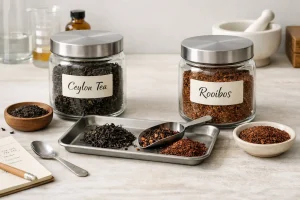
Blend with Organic Fair Trade Rooibos Tea. Rooibos brings vanilla-honey warmth and a soft body that can round the edges of a brisk Ceylon. Try it as a 70/30 split first, then adjust. A good pairing should keep the Ceylon’s bright top note while smoothing the finish.
In your notes, record: citrus note (zest vs. marmalade), sweetness (honey vs. caramel), and the finish (clean vs. drying). That vocabulary becomes your blending compass.
In this section’s spirit, build your pairing shelf with a few reliable botanicals. Try a citrus lift with organic orange peel powder. Add floral perfume with organic dried rose petals. For gentle spice warmth, try cardamom whole green.
Ratios you can repeat (grams + teaspoons) for cups, pitchers, and concentrates
These ratios are tuned to highlight ceylon tea taste without pushing harshness. Adjust for your leaf cut and your water.
Single cup (12 oz / 355 ml)
Ceylon: 2.5 g (about 1 heaping teaspoon if medium-cut leaf)
Water: 355 ml
Temp: 95–100°C (203–212°F)
Steep: 4 minutes (start tasting at 3:30)
Pitcher (1 liter)
Ceylon: 7 g (about 3 teaspoons)
Water: 1,000 ml
Temp: 95–100°C
Steep: 4 minutes, then strain fast
Blended with Rooibos (1 liter)
Ceylon: 5 g (about 2 teaspoons)
Organic Fair Trade Rooibos Tea: 3 g (about 2 teaspoons, rooibos is lighter per volume)
Water: 1,000 ml
Temp: 95–100°C
Steep: 5–6 minutes (rooibos likes time, Ceylon provides the spine)
Iced tea method (bright, not bitter)
Brew a double-strength base, then chill over ice.
For 1 liter iced:
Ceylon: 14 g (about 6 teaspoons)
Water: 500 ml hot + 500 ml ice/cold water
Steep: 4 minutes in the 500 ml hot water, strain, then pour over 500 ml ice/cold water.
If your iced tea tastes dull, it is usually under-dosed or under-steeped. If it tastes sharp and puckering, reduce time by 30–60 seconds before reducing the dose. That preserves ceylon tea taste without thinning it.
To expand your blend options, add a small citrus backbone with orange peel powder in the pitcher, or soften the finish with organic fair trade rooibos tea at 30–40%.
Pairing logic: how to match brightness, body, and finish
Pairing is not “what tastes good,” it is “what solves a specific flavor problem.” Start by naming the job you want the blend to do. Then pick botanicals that do that job.
Job: Add warmth without losing clarity
Use Rooibos as the base softener. It wraps the briskness and adds honeyed depth, keeping ceylon tea taste recognizable. Try: 60% Ceylon, 40% Rooibos.
Job: Add citrus sparkle and longer aroma
Ceylon already has citrus-like lift. You can amplify it with peel in a way that feels natural, not perfumey. Try: a tiny pinch of orange peel powder per cup, or a measured gram dose per liter.
Job: Add floral perfume without turning soapy
Rose is powerful. Dose it like seasoning. A few petals can turn a bright Ceylon into something that smells like a clean linen cabinet, in a good way, if you keep it restrained. Try: organic dried rose petals at 0.2–0.5 g per liter.
Job: Add spice structure
Cardamom gives a cool, green spice note that plays well with Ceylon’s citrus top note. It makes ceylon tea taste feel more dimensional without adding heat. Try: lightly crushed cardamom whole green and strain well.
Job: Add grounded “tea house” depth
If you want the cup to taste more roasted and anchored, bring in a root note. A small amount can make the finish feel longer and richer. Try adding dandelion root tea as a supporting layer in a blend.
If you are building a Hatton Naturals-style pantry lineup, keep these as your reliable modules: organic fair trade rooibos tea, orange peel powder, organic dried rose petals, cardamom whole green, dandelion root tea, and organic tulsi. Each one does a specific job.
Pairing ideas you can brew today (with clear outcomes)
Here are repeatable pairings designed to keep ceylon tea taste at the center.
Ceylon + Rooibos “round and golden”
Outcome: smoother finish, honeyed body, still bright up top.
Blend: 2 parts Ceylon, 1 part organic fair trade rooibos tea.Ceylon + Orange peel “bright and clean”
Outcome: citrus lift, longer aroma, crisp iced tea energy.
Dose: 1/16 teaspoon orange peel powder per 12 oz cup (start tiny).Ceylon + Rose “soft perfume”
Outcome: elegant aroma, less perceived bitterness, more “lift.”
Dose: a small pinch of organic dried rose petals per liter.Ceylon + Cardamom “green spice clarity”
Outcome: cool spice note, cleaner finish, more complexity.
Dose: 2–3 lightly crushed cardamom whole green pods per liter.Ceylon + Tulsi “herbal calm, still crisp”
Outcome: basil-like herbal warmth, less sharpness, aromatic depth.
Blend: 80% Ceylon, 20% organic tulsi.Ceylon + Dandelion root “toasty backbone”
Outcome: deeper finish, more roasted nuance, holds up to milk.
Blend: 70% Ceylon, 30% organic dandelion root tea.
The rule: add one supporting note at a time, taste, then decide if you need a second note. Over-layering is the fastest way to blur ceylon tea taste into “brown liquid.”
Brewing for tea makers: batching, filtering, and keeping flavor consistent
If you are producing tea by the liter, consistency comes from process, not intuition. Start by weighing everything. Volume-based scoops can drift with humidity and leaf settling, and that drift will show up as “sometimes flat, sometimes sharp.”
Batching checklist:
Use a scale for leaf and botanicals.
Heat water to a stable target.
Start a timer when the leaf hits the water, not when you finish pouring.
Stir once, gently, at the start only. Too much agitation can pull tannins fast.
Strain decisively at the target time. “Just a little longer” is how bitterness sneaks in.
Filtration and sediment:
Ceylon can throw fine particles, especially with smaller cuts. If you want a clean bottle, strain through a fine mesh, then a paper filter if needed. Rooibos also produces fines. Those fines are not dangerous, but they can flatten aroma if they continue extracting in the container. Strain clean and fast.
If you are building concentrates, remember: aroma concentrates too, but tannin concentrates faster. To keep ceylon tea taste lively in a concentrate, shorten steep time a bit and increase dose, rather than steeping longer at a normal dose.
For an aromatic upgrade, keep a citrus module on hand. Try orange peel powder in measured micro-doses for a consistent top note that reads “fresh” even after chilling.
Troubleshooting: flat flavor, too tart, over-carbonation, sediment, aroma loss
 Flat flavor:
Usually under-dosed, under-steeped, or brewed too cool. Increase dose first, then time. If it is still flat, check storage. Stale leaf gives weak ceylon tea taste no matter how well you brew.
Too tart (or “sharp”):
Ceylon is not tart like hibiscus, but it can feel sharp from tannin. Reduce steep time by 30–60 seconds. If you need more body, add organic fair trade rooibos tea instead of steeping longer.
Over-carbonation:
This shows up more in tea-based sparkling projects. Over-carbonation often comes from excess fermentables or bottling before primary activity has calmed. Use consistent sugar dosing and leave headspace. Chill fast when it hits the pressure you want. To keep aroma, avoid long warm holds.
Sediment:
Caused by fines and botanical dust. Pre-sift powders, use fine mesh, and consider a second filtration. Powdered ingredients like organic orange peel powder can settle. That is normal. If you want clarity, use very small doses and strain again.
Aroma loss:
Heat, oxygen, and time are the enemies. Brew with a lid, strain promptly, and cool quickly. If your chilled tea smells dull, a tiny peel or spice top note can restore perception, but do not use that to hide poor leaf quality. Good ceylon tea taste should still smell like something after chilling.
Storage + Quality: keeping leaf bright, sweet, and stable
If you want consistent ceylon tea taste, treat tea like a fragrant ingredient, not a shelf-stable commodity. It absorbs odors, loses volatile aromatics, and reacts to humidity.
Storage rules:
Airtight container with a tight seal.
Keep away from light and heat.
Avoid storing near spices, coffee, or scented pantry goods. Tea will pick up those aromas.
Use a desiccant pack near the container if your environment is humid (not inside the tea).
Quality cues:
Color: Ceylon should look lively and even, not dusty gray.
Scent: dry leaf should smell crisp, slightly sweet, and aromatic. If it smells like cardboard, it is tired.
Brew: fresh tea gives immediate aroma in the first minute. If the cup stays mute until minute four, you likely have stale leaf.
For botanicals:
Rooibos stores well but still loses aroma over time. Keep organic fair trade rooibos tea sealed.
Clumping is a humidity signal.
Florals like organic dried rose petals fade fast if exposed to air. Keep them in smaller jars you open less often.
Safety: compliant, practical guidance without medical claims
This article discusses flavor and craft. It is not medical advice. Herbalists often use teas and botanicals as part of traditional routines, but effects vary by person. If you are pregnant, nursing, taking medications, or managing a health condition, consult a qualified clinician before making significant changes to what you consume.
For production:
Use clean, food-safe containers.
Strain botanicals well if serving to groups, since fines can be irritating to sensitive throats.
Label allergens and shared-equipment risks when relevant.
Introduce new botanicals one at a time, in small doses, to evaluate flavor and tolerance.
When you keep the goal on flavor and quality, ceylon tea taste becomes a reliable building block rather than a gamble.
FAQ: quick answers for tea makers
What does ceylon tea taste like?
Ceylon tea taste is typically bright and brisk with citrus-like top notes, a clean mid-palate, and a structured finish that can become tannic if over-steeped.
How do I make ceylon tea taste less bitter?
Shorten steep time by 30–60 seconds first, then adjust dose. Keeping ceylon tea taste bright usually means avoiding long steeps.
Can I blend Ceylon with rooibos?
Yes. Rooibos rounds the finish and adds honey-like warmth while keeping ceylon tea recognizable. Start with 70/30 Ceylon to organic fair trade rooibos tea.
Why does my iced Ceylon taste weak?
A: You probably brewed too light before chilling. Use a double-strength hot brew, then dilute over ice. That preserves ceylon tea taste after chilling.
Q5: Does orange peel work with Ceylon?
A: It can be excellent if dosed tiny. A micro-dose of orange peel powder can amplify the citrus lift already present in ceylon tea taste.
Q6: How should I store tea to keep it fresh?
A: Airtight, cool, dark, and away from strong odors. Fresh leaf gives a more vivid ceylon tea taste and better aroma.
Q7: What’s the best steep time for a balanced cup?
A: Around 4 minutes at near-boiling water is a good starting point. Then tune by 30-second steps to land your preferred ceylon tea taste.
In the end, ceylon tea taste is one of the easiest profiles to make feel “designed” because it already carries clarity and structure. Treat it like a backbone, then add one supporting note with intention: a softener like rooibos, a lift like orange peel, or a single floral accent. Brew precisely, strain promptly, store carefully, and your cups will stay bright, legible, and repeatable.